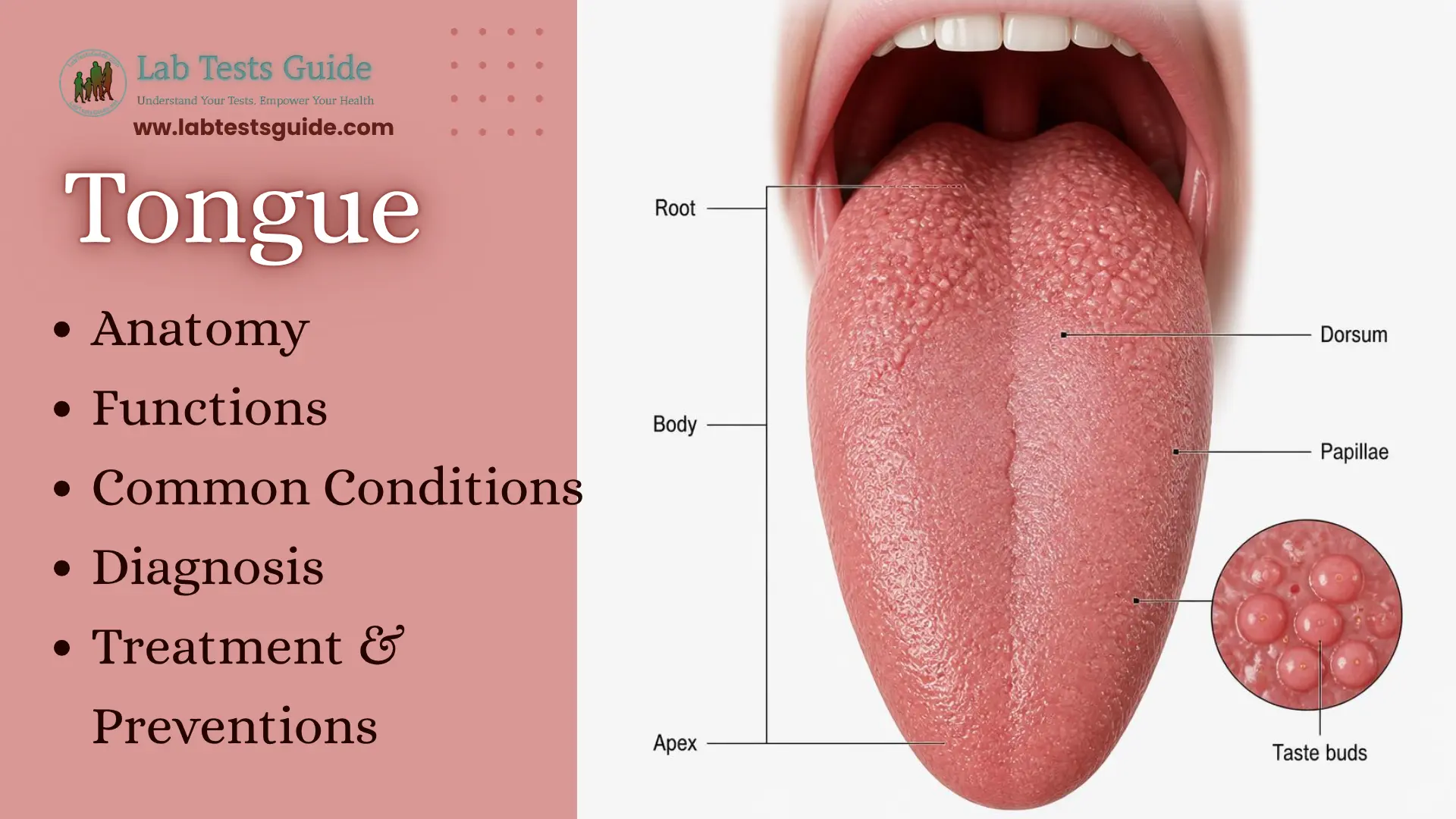
The tongue is a muscular organ essential for taste, speech, chewing, and swallowing. Learn about its anatomy, functions, common conditions, symptoms, diagnosis, laboratory tests, treatment, and prevention.
Tongue: Anatomy, Functions, Common Conditions, Diagnosis, Treatment and Preventions
ANATOMY & CLINICAL LABORATORY GUIDE
Tongue: Anatomy, Functions & Common Conditions
The tongue is a muscular organ in the mouth that plays essential roles in taste, speech, swallowing, chewing, and moving food during digestion.
01
Main PartsIncludes the apex, body, root, dorsum, ventral surface, and tongue muscles.
02
Main RoleSupports taste, speech, chewing, swallowing, and movement of food within the mouth.
03
Clinical RelevanceTongue inflammation, infections, lesions, and other abnormalities may require clinical assessment and selected laboratory testing.
Laboratory focus:
This guide provides a concise overview of tongue anatomy, function, common problems, and the laboratory tests that may be relevant when infection, inflammation, nutritional deficiency, or other abnormalities are suspected.
01
What Is the Tongue?
The tongue is a muscular organ located in the oral cavity that is essential for taste, speech, chewing, and swallowing. It is covered by a specialized mucous membrane containing papillae, some of which contain taste buds.
The tongue is divided into the apex, body, and root. Its intrinsic and extrinsic muscles allow it to move in different directions, helping position food during chewing, form a bolus for swallowing, and produce precise movements required for normal speech.
LocationWithin the oral cavity, extending from the front of the mouth toward the oropharynx.
Clinical importanceInflammation, infections, ulcers, discoloration, swelling, or persistent lesions of the tongue may require clinical evaluation and selected laboratory testing.
02
Parts and Functions of the Tongue
ApexThe pointed front portion of the tongue that is highly mobile and helps with speech and manipulation of food.
BodyThe larger front portion of the tongue that occupies most of the oral cavity and contains numerous papillae and taste buds.
RootThe posterior portion of the tongue that is attached to surrounding structures and helps support swallowing.
PapillaeSmall projections on the tongue that include structures involved in taste and help provide its characteristic surface texture.
What does the tongue do?
The tongue helps detect taste, move and position food during chewing, form and propel the food bolus during swallowing, and produce precise movements required for normal speech. It also helps keep the mouth clear by moving food and secretions.
03
Common Tongue Problems
Glossitis
Inflammation of the tongue that may cause swelling, tenderness, redness, or changes in the normal tongue surface.
Oral Candidiasis
A fungal infection caused by Candida species that can produce white patches, soreness, redness, or burning of the tongue and mouth.
Geographic Tongue
A usually harmless condition characterized by smooth, red patches with pale borders that can change location and appearance over time.
Oral Ulcers
Painful sores that may develop on the tongue due to local injury, irritation, infection, nutritional deficiencies, or other conditions.
Clinical note:
Persistent tongue pain, swelling, bleeding, unexplained discoloration, difficulty swallowing, or a lesion that does not heal should be clinically evaluated. The appearance of a tongue abnormality alone may not identify its exact cause.
04
Laboratory Tests and Diagnosis
Most tongue problems are initially evaluated through the patient’s symptoms and a careful examination of the mouth and tongue. Laboratory testing is usually selected based on the suspected cause, particularly when infection, nutritional deficiency, inflammation, or another underlying condition is suspected.
CBC
May help assess anemia, infection, or other blood abnormalities when clinically indicated.
Iron, Vitamin B12 & Folate
Blood tests may help identify nutritional deficiencies that can contribute to tongue soreness, inflammation, or changes in the tongue surface.
Microbiological Testing
Swabs, microscopy, culture, or other pathogen testing may be considered when a fungal or bacterial infection is suspected.
Important:
A persistent or suspicious tongue lesion may require further clinical evaluation and, when appropriate, a biopsy. A biopsy is not a laboratory blood test, but tissue examination can help determine the cause of an unexplained or persistent lesion.
05
Tongue Symptoms and When to Seek Care
Tongue Pain or SorenessPain, tenderness, or burning may occur with irritation, inflammation, infection, injury, or other conditions.
Swelling or RednessChanges in tongue size or color may occur with inflammation, infection, allergic reactions, or nutritional deficiencies.
White or Red PatchesPersistent patches or unusual changes in the tongue surface may have several possible causes and may require examination.
Difficulty Swallowing or SpeakingPersistent difficulty moving the tongue, swallowing, or speaking normally may require medical or dental evaluation.
When should medical advice be considered?
Seek medical evaluation for persistent tongue pain, unexplained swelling, bleeding, a lump or lesion that does not heal, significant changes in color or surface, difficulty swallowing or speaking, or symptoms that are severe, recurrent, or worsening.
06
How Are Tongue Problems Diagnosed?
Tongue problems are usually diagnosed through the patient’s symptoms, medical and dental history, and careful examination of the tongue and oral cavity. Laboratory tests are selected when an infection, nutritional deficiency, systemic condition, or other underlying cause is suspected.
Clinical Examination
A healthcare professional examines the tongue for changes in color, texture, swelling, ulcers, patches, lesions, tenderness, and other abnormalities.
Laboratory Testing
CBC, iron studies, vitamin B12, folate, glucose testing, or microbiological testing may be considered based on the suspected cause.
Further Evaluation
Persistent or suspicious lesions may require additional assessment, including tissue biopsy when clinically indicated.
Laboratory perspective:
Laboratory tests can help identify infection, nutritional deficiency, or systemic conditions associated with tongue abnormalities, but results should always be interpreted together with the patient’s symptoms and clinical findings.
07
Treatment and Prevention
Common Management
Treatment depends on the underlying cause of the tongue problem.
Antifungal or antimicrobial treatment may be recommended when a specific infection is diagnosed.
Nutritional deficiencies may be treated with dietary changes or appropriate supplementation when confirmed.
Persistent or suspicious tongue lesions may require dental or medical evaluation and further investigation.
Prevention & Self-Care
Maintain good oral hygiene by brushing the teeth and tongue regularly.
Attend routine dental examinations and address persistent oral problems promptly.
Avoid tobacco products and limit irritants that cause tongue or oral irritation.
Maintain a balanced diet and adequate hydration to support normal oral health.
Important:
Treatment should be directed at the underlying cause rather than the tongue symptom alone. Persistent pain, swelling, bleeding, unexplained discoloration, or a lesion that does not heal should be evaluated by a healthcare professional or dentist. More Detail about Treatment and Prevention Click Here
08
Key Takeaways & Related Laboratory Tests
The tongue is a muscular organ that plays important roles in taste, speech, chewing, and swallowing. Most tongue problems are evaluated clinically, while laboratory testing may be useful when infection, nutritional deficiency, inflammation, or another underlying condition is suspected.
Main PartsThe apex, body, root, dorsum, ventral surface, muscles, and specialized papillae form the main structures of the tongue.
Common ProblemsGlossitis, oral candidiasis, geographic tongue, and oral ulcers are among the conditions that may affect the tongue.
Laboratory RoleCBC, iron studies, vitamin B12, folate, glucose testing, and selected microbiological tests may support evaluation when clinically indicated.
Medical Disclaimer:
This article is for general educational and laboratory information only. It does not replace professional medical advice, diagnosis, or treatment. Laboratory tests should be interpreted together with symptoms, medical history, and clinical findings by a qualified healthcare professional.
References and Sources
Cleveland Clinic. Tongue: Definition, Location, Anatomy & Function.
Cleveland Clinic
– (accessed on August 24, 2026)
National Institute on Deafness and Other Communication Disorders (NIDCD). Taste Disorders.
NIDCD
– (accessed on August 24, 2026)
National Center for Biotechnology Information. In brief: How does the tongue work? InformedHealth.org.
NCBI Bookshelf
– (accessed on August 24, 2026)
DermNet. Geographic Tongue (Benign Migratory Glossitis).
DermNet
– (accessed on August 24, 2026)
Mayo Clinic. Oral Thrush: Symptoms and Causes.
Mayo Clinic
– (accessed on August 24, 2026)
Centers for Disease Control and Prevention (CDC). Testing and Diagnosis for Candidiasis.
CDC
– (accessed on August 24, 2026)
National Institute of Dental and Craniofacial Research (NIDCR). Oral Cancer.
NIDCR
– (accessed on August 24, 2026)
NHS. Mouth Ulcers.
NHS
– (accessed on August 24, 2026)
📚 This article may have been prepared using trusted medical literature, clinical guidelines, textbooks, and peer-reviewed sources.
The website covers a wide range of lab tests, including blood tests, urine tests, stool tests, and imaging tests such as X-rays and CT scans. It also provides information about different health conditions and diseases, as well as tips for maintaining good health.
It's important to note that while labtestsguide.com may provide valuable information about lab tests and their interpretation, it's always best to consult with a healthcare professional if you have any concerns or questions about your lab results. We can provide personalized guidance and advice based on your individual health status and medical history.