

Complete Blood Count (CBC)
Definition: A panel of tests evaluating the three main types of blood cells: red cells (RBCs), white cells (WBCs), and platelets.
Purpose: To assess overall health, screen for disorders like anemia, infection, and leukemia, and monitor treatment.
| Other Names | Full Blood Count (FBC), Hemogram, Blood Picture, Peripheral Blood Count, CBC with Differential |
| Test Technique | Automated Hematology Analyzer, Electrical Impedance (Coulter Principle), Flow Cytometry, Optical Light Scatter, Photometric Hemoglobin Measurement, Microscopy (for manual differential/review) |
| Test Type | Blood Test |
| Turnaround time (TAT) | Usually 2-3 hours (Stat/Emergency: 30-60 minutes). (Veries by Lab, Method, Transport etc.) |
| Test Cost ($) | 3$ – 30$ (Depends on Your Country and Lab) |
| Fasting Required | No |
| Medications | Inform your doctor about all prescription and over-the-counter medications, as some can affect blood cell counts (e.g., chemotherapy drugs, blood thinners, steroids). |
| Allowed/Avoid | Normal diet and water intake is allowed. Avoid alcohol 24 hours prior. Avoid strenuous exercise just before the test, as it can temporarily elevate WBCs. |
| Other Preparation | Stay well-hydrated to make the blood draw easier. Wear clothing with short sleeves or loose sleeves that can be rolled up easily. |
- Required Sample: 3-5 mL Whole Blood
- Specimen (s) Container: Lavender Top Tube (EDTA Anticoagulant)
- Alternative Specimen(s): Sodium Citrate (Blue-top) tube • heparin (green-top) tube
- Sample Stability:
• Room Temp (20-25°C): 6-8 hours
• Refrigerated (2-8°C): 24 Hours
• Frozen (-20°C and Below): Do Not Freez - Transport: EDTA Tube in RT or Cooling Box
- Mislabeling Or Unlabeled sample: Patient identification error
- Wrong collection tube: Incorrect additive interferes with tests
- Insufficient volume (QNS): Not enough blood for testing
- Clotted sample: Anticoagulated tube clotted, unusable
- Hemolyzed sample: RBC rupture affects test results
- Delayed transport: Sample deterioration before testing
- Frozen Sample: Transporting the sample at freezing temperatures will lyse the cells.
- White Blood Cell Count (WBC)
- Red Blood Cell Count (RBC)
- Hemoglobin (Hgb or Hb)
- Hematocrit (Hct)
- Mean Corpuscular Volume (MCV)
- Mean Corpuscular Hemoglobin (MCH)
- Mean Corpuscular Hemoglobin Concentration (MCHC)
- Red Cell Distribution Width (RDW)
- Platelet Count (Plt)
- Mean Platelet Volume (MPV)
- Differential: Neutrophils, Lymphocytes, Monocytes, Eosinophils, Basophils (Absolute and Percentage values).
| Hemoglobin | Male: 13–17 g/dL Female: 12–15 g/dL |
| RBC Count | 4.5–5.9 million/µL |
| WBC Count | 4,000–11,000 /µL |
| Platelets | 150,000–450,000 /µL |
| Further parameters | See Below |
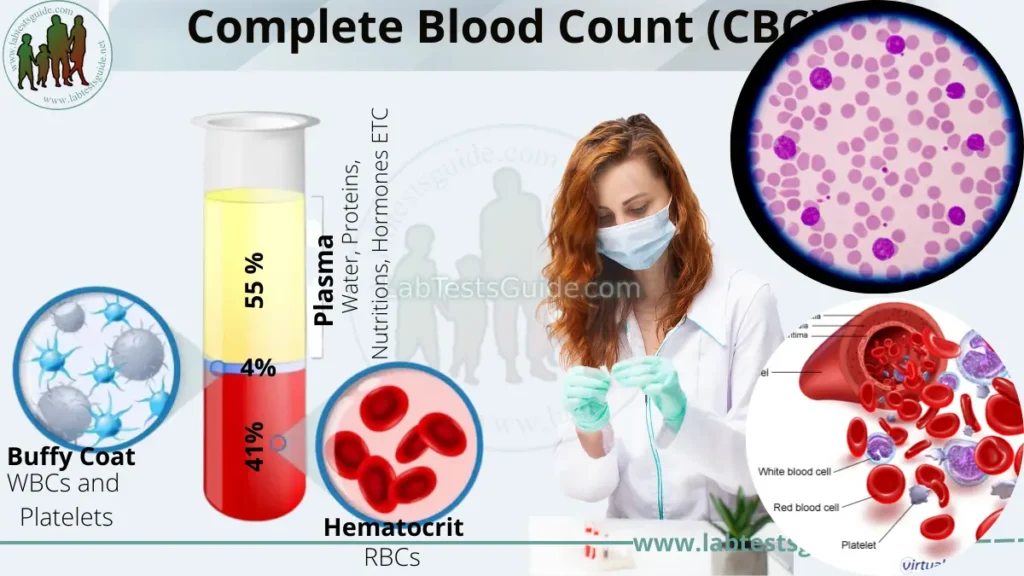
Test Introduction / Definition:
The Complete Blood Count (CBC) is one of the most commonly performed laboratory tests. It evaluates the cellular components of blood including red blood cells, white blood cells, and platelets, providing important information about overall health and many diseases.
The CBC is a quantitative and qualitative analysis of the formed elements of blood, used to evaluate a patient’s hematopoietic status and general health.
Principle of the Test:
- CBC analysis is primarily performed using automated hematology analyzers.
- Electrical impedance (Coulter principle) measures cell number and size as cells pass through an aperture.
- Optical or laser light scatter technology differentiates white blood cells based on size and internal complexity.
- Photometric measurement determines hemoglobin concentration after red cell lysis.
- Platelet and red cell indices are calculated using mathematical algorithms.
- Differential leukocyte count is obtained using flow cytometry or optical analysis.
Test Purpose / Clinical Indications:
Doctors order CBC to:
- Diagnose anemia and nutritional deficiencies
- Detect bacterial, viral, or parasitic infections
- Monitor hematological disorders
- Evaluate inflammation or immune disorders
- Monitor chemotherapy or medications
- Assess bone marrow function
- Detect bleeding disorders or thrombocytopenia
Specimin Requiremenst:
Patient Preparation:
No special preparation is needed. Avoid strenuous exercise immediately prior to collection.
Sample Required:
2–3 mL EDTA anticoagulated whole blood
Automated Hematology Analyzer Protocol
Step-by-Step Bench Workflow
- Startup & Background: Initialize the analyzer. Run diluent background checks to ensure blank counts (WBC, RBC, PLT, HGB) are within acceptable baseline limits.
- Quality Control (QC): Allow commercial Tri-Level QC (Low, Normal, High) to reach room temperature. Mix by gentle inversion (do not use mechanical roller). Aspirate and verify results on Levey-Jennings charts.
- Sample Preparation: Place patient EDTA whole blood tubes on a mechanical roller or rocker for minimum 5 minutes to ensure homogenous cell distribution prior to aspiration.
- Aspiration: Verify patient ID/barcode. Present the tube to the aspiration probe. The machine will aspirate the required aliquot, dilute it automatically, and route it to specific counting chambers.
- Data Review: Review the histograms, scattergrams, and numerical data. Check for machine-generated flags (e.g., Blasts?, Left Shift, PLT Clumps, NRBCs).
- Action on Flags: If critical values or specific flags are present, generate a peripheral blood smear for manual microscopic review to confirm the automated data.
Manual Testing Procedures (Core Parameters)
- WBC Manual Count: Dilute blood 1:20 with Turk’s fluid (lyses RBCs, stains WBC nuclei). Charge the Neubauer chamber. Under 10x objective, count WBCs in the 4 large corner squares.
- RBC Manual Count: Dilute blood 1:200 with Hayem’s or Dacie’s fluid. Charge chamber. Count under 40x objective in the 5 small squares of the central grid.
- Calculation: Total Count = (Cells Counted × Dilution Factor) / (Area Counted × Depth).
- HGB (Cyanmethemoglobin): Pipette 5.0 mL Drabkin’s reagent. Add 20 µL well-mixed EDTA blood. Mix and incubate 10 mins at room temp. Read absorbance at 540 nm against reagent blank.
- Hematocrit (PCV): Fill a plain capillary tube 3/4 full with EDTA blood. Seal one end with clay. Centrifuge in a microhematocrit centrifuge at 10,000 RPM for 5 mins. Read percentage using a chart.
Enter manual results below to automatically calculate morphological indices.
Peripheral Blood Smear & Manual Differential
Smear Preparation & Counting Protocol
- Drop Placement: Place a small drop of well-mixed EDTA blood (approx. 2-3 mm) about 1 cm from the frosted edge of a clean glass slide.
- Wedge Technique: Hold a spreader slide at a 30–45° angle. Pull it back into the blood drop, letting the blood spread along the edge. Smoothly push the spreader forward to create a bullet-shaped smear with a feathered edge.
- Air Dry & Fix: Allow the slide to air-dry completely. Fix the slide using absolute methanol for 1-2 minutes.
- Staining (Giemsa/Wright): Apply stain for the specified time. Add buffer and mix gently until a metallic green sheen appears. Rinse with distilled water and air dry vertically.
- 100-Cell Differential: Apply immersion oil. Under 100x objective, systematically scan the optimal zone using a “battlement” (zigzag) pattern. Classify 100 consecutive Leukocytes into Neutrophils, Lymphocytes, Monocytes, Eosinophils, and Basophils.
- Morphology Review: Note any abnormal RBC morphology (e.g., Target cells, Schistocytes, Macrocytes). Identify any toxic granulations or Döhle bodies in neutrophils.
CBC Test Normal Values
CBC Smart Unit Converter
No matching parameters found.
Test Result Interpretation:
| CBC Component | Possible Interpretations |
|---|---|
| Red Blood Cells (RBCs) | Low: Anemia, blood loss, bone marrow disorders High: Dehydration, polycythemia |
| Hemoglobin (Hb) | Low: Anemia, blood loss, nutritional deficiencies High: Dehydration, lung or heart conditions, high altitude |
| Hematocrit (Hct) | Low: Anemia, blood loss, bone marrow disorders High: Dehydration, polycythemia |
| White Blood Cells (WBCs) | Low: Bone marrow disorders, certain medications, viral infections High: Infection, inflammation, leukemia, medication side effects |
| Neutrophils | Low: Bone marrow disorders, viral infections, drug toxicity High: Bacterial infections, inflammation, stress, certain medications |
| Lymphocytes | Low: Immune disorders, HIV infection, certain medications High: Viral infections, chronic lymphocytic leukemia |
| Monocytes | Low: Bone marrow disorders, certain medications, hairy cell leukemia High: Chronic infections, inflammatory conditions, certain types of leukemia |
| Eosinophils | Low: Bone marrow disorders, certain medications, Cushing’s syndrome High: Allergic reactions, parasitic infections, certain autoimmune conditions |
| Basophils | Low: Bone marrow disorders, certain medications, hyperthyroidism High: Allergic reactions, certain types of leukemia, chronic inflammation |
| Platelet Count | Low: Bleeding disorders, bone marrow disorders, medication side effects High: Inflammatory conditions, infection, certain cancers |
| Mean Corpuscular Volume (MCV) | Low: Iron-deficiency anemia, thalassemia High: Vitamin B12 or folate deficiency anemia, liver disease, alcohol abuse |
| Mean Corpuscular Hemoglobin (MCH) | Low: Iron-deficiency anemia, thalassemia High: Vitamin B12 or folate deficiency anemia, liver disease, alcohol abuse |
| Mean Corpuscular Hemoglobin Concentration (MCHC) | Low: Iron-deficiency anemia, thalassemia High: Hereditary spherocytosis, autoimmune hemolytic anemia, certain medications |
Test Clinical Significance:
Normal Test Result:
- Indicates normal bone marrow function
- Balanced blood cell production
Low Test Result:
Possible causes:
- Anemia
- Bone marrow failure
- Chemotherapy effects
- Nutritional deficiency
High Test Result:
Possible causes:
- Dehydration
- Infection
- Leukemia
- Polycythemia
- Inflammation
Frequently Asked Questions (FAQs):
What is a CBC test used for?
It evaluates overall health and detects anemia, infection, and blood disorders.
Is fasting required for CBC?
No fasting is required.
How long does CBC test take?
Usually 30 minutes to 3 hours.
What diseases can CBC detect?
Anemia, infections, leukemia, and platelet disorders.
What sample is required for CBC?
Whole blood collected in an EDTA tube.
Can CBC detect infection?
Yes, elevated WBC count may indicate infection.
Why is platelet count important?
Platelets help in blood clotting and preventing bleeding.
Can dehydration affect CBC results?
Yes, dehydration may falsely increase hemoglobin and hematocrit.
Is CBC a routine test?
Yes, it is one of the most common laboratory tests.
What is the normal WBC count?
Typically 4.0 – 10.0 x10^9/L.

Good nd very useful material
thnks
You’re very welcome! I’m glad you found the information helpful. Feel free to reach out if you have any questions or need further insights. Your feedback is always appreciated!