Article

Tendons

Editorial StaffUpdated 6 min read0views

Quick Overview

Tendons are strong bands of connective tissue that attach muscles to bones, helping transmit muscle force and produce controlled movement of the joints and body.
  • CategoryParts of Body
  • Read time6 min
  • UpdatedNov 2026
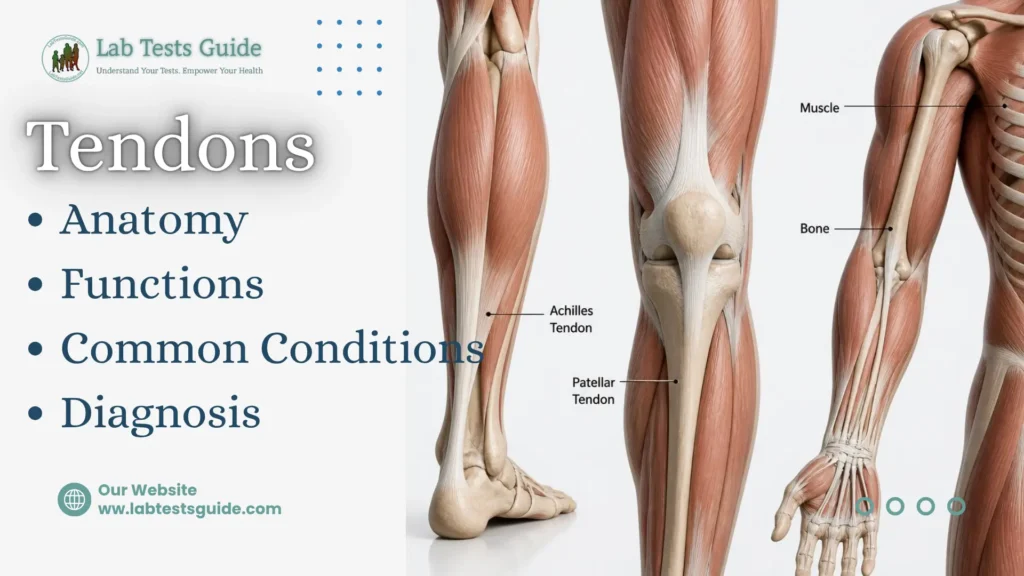
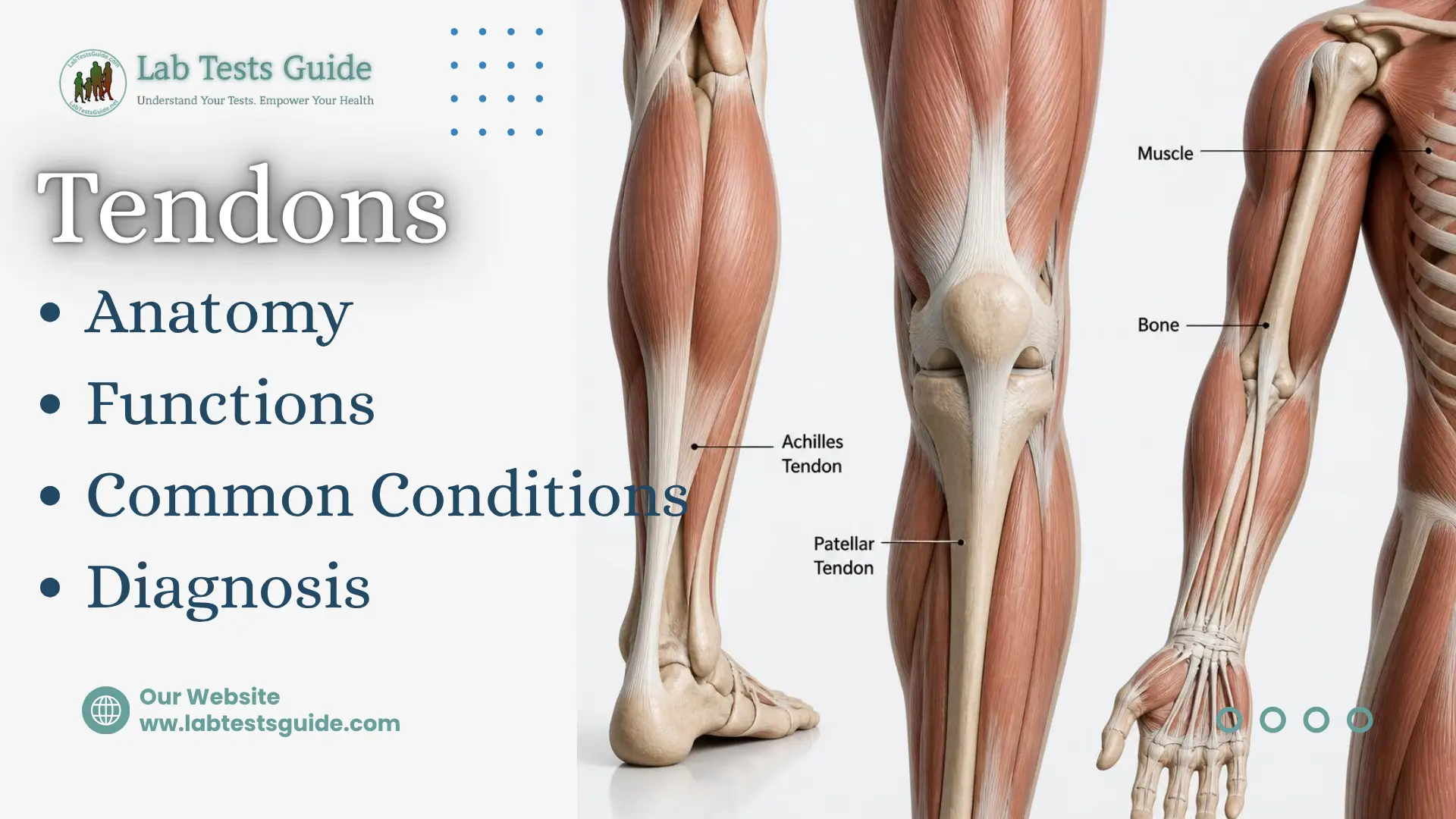
Tendon anatomy showing the Achilles tendon, patellar tendon, muscles, and bones
Table of Contents

Tendons: Anatomy, Functions & Common Conditions

ANATOMY & CLINICAL LABORATORY GUIDE

Tendons: Anatomy, Functions & Common Conditions

Tendons are strong bands of connective tissue that attach muscles to bones, helping transmit muscle force and produce controlled movement of the joints and body.

Tendon anatomy showing the Achilles tendon, patellar tendon, muscles, and bones
01
Connective Tissue Strong collagen-rich tissues that connect muscles to bones.
02
Main Role Transmit muscle force to bones and support movement and joint stability.
03
Clinical Relevance Tendon injuries, inflammation, and degeneration may cause pain, weakness, and restricted movement.
Laboratory focus: This guide provides a concise overview of tendon anatomy, function, common problems, and the laboratory tests that may be relevant when inflammation, infection, or an underlying systemic condition is suspected.

01 What Are Tendons?

Tendons are strong bands of fibrous connective tissue that connect muscles to bones. They are mainly composed of densely arranged collagen fibers that provide strength and help transmit the force generated by muscles to the skeleton.

Tendons are found throughout the body and help produce controlled movement of the joints. Common examples include the Achilles tendon, patellar tendon, rotator cuff tendons, and flexor and extensor tendons of the hands and feet.

Location Located between muscles and their attachment points on bones throughout the body.
Clinical importance Injury, overuse, inflammation, or degeneration can cause tendon pain, weakness, swelling, and restricted movement.

02 Types and Functions of Tendons

Achilles Tendon Connects the calf muscles to the heel bone and helps with walking, running, and jumping.
Patellar Tendon Connects the kneecap to the shinbone and helps extend the knee.
Rotator Cuff Tendons Connect the shoulder muscles to the upper arm bone and help stabilize and move the shoulder.
Hand and Foot Tendons Connect muscles to the bones of the hands and feet and support precise movement of the fingers and toes.
What do the tendons do?

Tendons transmit the force produced by muscles to bones, allowing joints to move. They also help stabilize joints and provide efficient transfer of mechanical forces during activities such as walking, lifting, running, and jumping.

03 Common Tendon Problems

Tendinitis Inflammation or irritation of a tendon that may develop after repetitive activity, overuse, or injury.
Tendinopathy A broader term for tendon pain and dysfunction that may involve degenerative changes, often associated with repeated loading over time.
Tendon Tear A partial or complete disruption of tendon fibers that can cause pain, weakness, swelling, and impaired movement.
Tendon Rupture A complete tendon tear that may significantly affect movement and sometimes requires specialist evaluation and treatment.
Clinical note: Symptoms such as tendon pain, swelling, tenderness, weakness, or restricted movement do not by themselves identify the exact cause. Clinical assessment is important when symptoms are persistent, severe, or associated with an acute injury.

04 Laboratory Tests and Diagnosis

Most tendon problems are diagnosed through the patient’s symptoms, medical history, and physical examination. Laboratory testing is usually not required for uncomplicated tendon injuries, but selected tests may be considered when systemic inflammation, infection, autoimmune disease, or another underlying condition is suspected.

CBC May help assess systemic infection or inflammation when a tendon problem is associated with concerning clinical findings.
CRP / ESR Inflammatory markers may be considered when significant systemic inflammation or an inflammatory tendon disorder is suspected.
Autoimmune Testing Tests such as rheumatoid factor, anti-CCP antibodies, ANA, or other disease-specific markers may be considered when an underlying systemic inflammatory condition is suspected.
Important: Imaging such as ultrasound or MRI is not a laboratory test, but it may be used to evaluate tendon thickening, inflammation, partial tears, complete ruptures, or other structural abnormalities when further assessment is needed.

05 Tendon Symptoms and When to Seek Care

Tendon Pain Pain or tenderness may occur around the affected tendon, particularly during movement or activity.
Swelling or Tenderness The area around an irritated or injured tendon may become swollen, tender, or sensitive to pressure.
Weakness Tendon injury or dysfunction may reduce the ability of the associated muscle to produce normal movement.
Restricted Movement Pain, stiffness, or tendon damage can make normal movement of the affected joint difficult.
When should medical advice be considered?

Seek medical evaluation for severe or persistent tendon pain, significant swelling, sudden weakness, inability to move the affected area normally, or symptoms following an acute injury. Immediate assessment may be important when a tendon rupture is suspected or when there is a sudden snapping or popping sensation accompanied by loss of function. Read more for Medical Advice

06 How Are Tendon Problems Diagnosed?

Tendon problems are usually diagnosed from the patient’s symptoms, medical history, physical examination, and assessment of the affected joint or muscle. Laboratory tests are not routinely required for uncomplicated tendon injuries or overuse conditions.

Clinical Examination A healthcare professional assesses pain, tenderness, swelling, range of motion, muscle strength, and tendon function.
Laboratory Testing CBC, CRP, ESR, or selected autoimmune tests may be considered when systemic inflammation, infection, or an underlying inflammatory condition is suspected.
Imaging Ultrasound or MRI may be used to evaluate tendon thickening, inflammation, partial tears, complete ruptures, or other structural abnormalities.
Laboratory perspective: Blood tests can support the assessment of systemic inflammation or an underlying condition, but laboratory results should always be interpreted together with symptoms, physical examination findings, and imaging when indicated.

07 Treatment and Prevention

Common Management
  • Rest and temporary modification of activities may help reduce stress on an irritated or injured tendon.
  • Physical therapy and targeted exercises may improve flexibility, strength, and tendon function.
  • Pain-relieving medicines may be recommended when appropriate and medically suitable.
  • Severe tendon injuries or complete ruptures may require specialist assessment and, in some cases, surgical treatment.
Prevention & Self-Care
  • Increase physical activity gradually and avoid sudden increases in training intensity.
  • Use proper technique and appropriate equipment during sports or repetitive activities.
  • Allow adequate recovery between demanding activities and address persistent pain early.
  • Maintain appropriate muscle strength and flexibility through regular, balanced exercise.
Important: Treatment depends on the type, location, and severity of the tendon problem. Mild overuse-related symptoms may improve with activity modification and rehabilitation, while significant tears or ruptures require prompt clinical evaluation. More Detail about Treatment and Prevention Click Here

08 Key Takeaways & Related Laboratory Tests

Tendons are strong connective tissues that attach muscles to bones and transmit muscle force to support movement and joint stability. Most uncomplicated tendon problems are diagnosed clinically, while laboratory testing may be useful in selected cases when systemic inflammation, infection, autoimmune disease, or another underlying condition is suspected.

Major Tendon Groups Achilles, patellar, rotator cuff, and the many tendons of the hands and feet.
Common Problems Tendinitis, tendinopathy, tendon tears, and tendon ruptures may affect tendon function and movement.
Laboratory Role CBC, inflammatory markers, and selected autoimmune tests may support evaluation when an underlying systemic condition is suspected.
Medical Disclaimer: This article is for general educational and laboratory information only. It does not replace professional medical advice, diagnosis, or treatment. Laboratory tests should be interpreted together with symptoms, medical history, physical examination, and other clinical findings by a qualified healthcare professional.

📚 This article may have been prepared using trusted medical literature, clinical guidelines, textbooks, and peer-reviewed sources.
View Possible References Used →

Discussion 0

Join the discussion

Join our community

Get fresh content from Lab Tests Guide