

Quick Overview
Compare SEKBIO, ProteoGenix, and GenScript for antigen epitope design and diagnostic assay development. Explore their capabilities in recombinant antigen production, protein-region selection, peptide prediction, and epitope mapping.
- CategoryGuest Posts
- Read time7 min
- UpdatedNov 2026
Table of Contents
Compare SEKBIO, ProteoGenix and GenScript within a shortlist covering diagnostic antigen production, protein-region selection and peptide-based candidate screening. Each has an official page supporting at least one of these project stages. Apply the same three criteria to every proposal: the basis for selecting regions, the pilot material supplied and responsibility for testing recognition in the intended assay. Shortlist SEKBIO for a recombinant diagnostic antigen project that may involve a custom fusion construct. Include ProteoGenix when selecting an accessible protein region and preserving its conformation are central to the design. Compare GenScript when peptide prediction and a custom peptide library could support candidate screening. Ask who will run the binding experiment and interpret its results. [1–5]
Official pages checked on 27 November 2026.
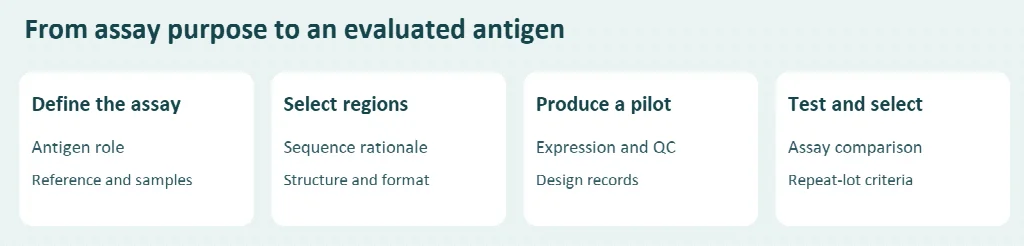
Choose the provider against the antigen’s job in the assay. An antigen used to detect patient antibodies needs evidence of recognition by the intended sample population. An immunogen used to generate an assay antibody needs a design that supports the desired antibody specificity. State that purpose in the brief, then ask each provider to identify the design records, pilot material and experimental evidence it will deliver.
SEKBIO for diagnostic antigens and custom fusion constructs
SEKBIO offers a concrete diagnostic example through its recombinant Treponema pallidum antigen range. Its syphilis product page lists TpN15, TpN17 and TpN47 as individual proteins and fusion constructs, with custom fusion constructs available on request. This supports a technical discussion about combining antigen regions for a serological assay. Ask which parts of that product experience apply to your target and whether the proposed project includes selecting new epitope regions or producing a customer-defined fusion. [1]
Its broader platform describes antigen design within antibody development and CHO and HEK293 expression for recombinant proteins. These are relevant capabilities when the project needs design connected to production. Ask SEKBIO to specify the proposed construct boundaries, host and pilot characterization. The expression route should be stated for the actual construct, since the syphilis page specifically describes E. coli production. [1, 2]
For a new serology project, request the reasoning behind each included region and the experimental plan for comparing the candidate with a reference antigen. Confirm whether patient-sample evaluation is performed by SEKBIO, the assay developer or a separate laboratory. Have the quote name the design decisions the supplier owns and the data the customer must provide.
Compare providers against the same diagnostic brief
Use a common scenario when requesting proposals. A serology assay developer needs a recombinant coating antigen that retains relevant antibody recognition while controlling reactivity in negative samples. Send each provider the same target sequence, assay format and available reference data. For each of the three criteria, the table records the published basis and the deliverable or responsibility still to be agreed. Judge fit by how completely the written proposal covers this common brief.
| Provider | Region selection criterion | Pilot material criterion | Recognition testing criterion |
| SEKBIO [1, 2] | Published: multi-epitope diagnostic products and custom fusions. Confirm: new region selection and its rationale. | Published: recombinant antigen expression. Confirm: final construct, host and purified pilot. | Confirm: who tests patient samples, compares the reference and interprets assay results. |
| ProteoGenix [3] | Published: accessibility and protein-region selection. Confirm: report explaining boundaries for the diagnostic brief. | Published: protein expression strategy. Confirm: final construct, host and purified pilot. | Confirm: who tests patient samples, compares the reference and interprets assay results. |
| GenScript [4, 5] | Published: peptide prediction and mapping applications. Confirm: whether experimental results will inform region selection. | Published: custom peptide library ordering. Confirm: recombinant construct production and purified pilot scope. | Confirm: who runs the peptide binding screen and interprets it, then who tests the expressed antigen in the assay. |
Choose SEKBIO if the proposal connects a justified fusion or antigen design to pilot production and your assay evaluation plan. Choose ProteoGenix if the main need is protein-region selection and a production strategy that preserves the relevant structure. Choose GenScript for the prediction and peptide-library stage if that is the next evidence gap. Assign experimental screening, interpretation and recombinant production explicitly in its quote or to another project partner. These are conditional choices based on the published capabilities and the work the project requires. [1–5]
ProteoGenix for protein-region selection
ProteoGenix’s antigen design service explicitly discusses the final application, including diagnostic assays. Its protein design approach considers epitope accessibility and computational immunogenicity prediction, followed by codon optimization for the selected expression system. It also describes production of soluble and membrane proteins with attention to conformation. That makes it a candidate when deciding which domain or fragment to express is a major part of the project. [3]
Ask for a report that explains the proposed boundaries and the features the construct is intended to retain. If the end use is a patient-antibody test, specify that the design must be assessed against recognition in the intended samples. Have the proposal identify how candidate selection will use those results and how many design iterations are included.
GenScript for peptide prediction and epitope mapping
GenScript’s antigen design tool considers hydrophilicity, secondary structure and sequence motifs when suggesting peptide antigens. Its guidance also discusses the limits of using a peptide to represent an epitope formed by protein folding. Its peptide-library page explains antibody epitope mapping applications and provides a route to order custom peptide libraries. That supports considering GenScript for prediction and library supply. Confirm separately whether it will perform the binding screen, analyze the results and recommend regions for a recombinant antigen. [4, 5]
Request the experimental design before commissioning a library. Clarify which antibodies or samples will be tested, how the signals will be reported and who will interpret them. If the final deliverable must be a recombinant protein, ask for that production step in the quotation and specify how recognition of the expressed construct will be evaluated. A mapping result can inform the design, and the pilot antigen still needs testing in its intended assay.
What to request in the design proposal
A traceable sequence decision. Ask for the final amino acid sequence with the selected boundaries clearly marked. For a fusion, request the order of the regions, linker sequence and tag placement. Have the provider record why each region is included and which source sequence version was used. This record lets the team relate an assay result to the material actually tested.
A defined experimental comparison. Specify the reference reagent and the samples available for feasibility work. Ask who will run the comparison and what data will be returned for positive and negative samples. Agree on the criteria used to select a candidate before a larger production run. Have the provider state which changes to the construct would trigger another comparison.
A production and repeat-supply plan. Request purified pilot material with agreed identity and purity documentation. Define the formulation and amount required for the planned tests. If the pilot succeeds, ask which specifications carry forward to later lots and how the provider will notify you of manufacturing changes. Clarify ownership of the design records and access to the final sequence.
Frequently asked questions
Which provider is best for a custom multi-region diagnostic antigen?
SEKBIO is a candidate because its syphilis page explicitly offers custom fusion constructs. Ask whether it will select regions for your target or manufacture a design you supply. Compare that scope with ProteoGenix’s protein-region selection service before choosing a proposal. [1, 3]
Should prediction or experimental mapping come first?
Use the evidence already available to define the next step. Prediction can generate candidate regions for review. If the project needs experimental localization of antibody recognition, discuss a mapping plan and the samples it requires. GenScript describes peptide prediction and custom peptide libraries with mapping applications. Confirm who will perform and interpret any experimental screen. [4, 5]
What should a diagnostic developer approve before scale-up?
Approve the final sequence and the pilot’s performance against the agreed assay criteria. Confirm who supplies the analytical records and who evaluates diagnostic performance. Put repeat-lot specifications and change notification terms in writing before ordering recurring material.
Sources
- SEKBIO syphilis antigens. See “Multi-Epitope Antigen Design” and “Flexible OEM Supply” for custom fusion scope and the specifications for expression host.
https://www.sekbio.com/products/syphilis.html - SEKBIO protein expression and antibody development platform. See the IVD development workflow and CHO and HEK293 expression sections.
https://www.sekbio.com/platforms.html - ProteoGenix antigen design services. See “Optimize your antigen to maximize antibody success” for region selection, accessibility and expression strategy.
https://www.proteogenix.science/custom-antibody/antigen-design-services - GenScript antigen prediction tool. See “Algorithms” and the guidance on continuous and discontinuous epitopes.
https://www.genscript.com/antigen-design.html - GenScript peptide libraries and epitope mapping applications. See “Antibody epitope mapping” and “Order custom peptide libraries from GenScript.” Experimental execution and interpretation require quotation confirmation.
https://www.genscript.com/en-US/services/peptide/peptide-library-and-epitope-mapping
Related

Comprehensive Eye Care Services: A Complete Guide to Protecting Your Vision
Your eyes work every waking minute, yet most people only think about them when something goes wrong. Comprehensive eye care changes that by bringing…

Protecting Groups: Planning Temporary Reactivity in Organic Synthesis
A functional group needed in the final molecule can disrupt an earlier reaction by consuming a reagent, binding a catalyst, or reacting at the…
Audiometer Brands for Tender Specifications: A Five-Brand Shortlist and Buyer Verification Guide
Hospital teams making an audiometer tender should look at five established brands: QUALMEDI, Interacoustics, Amplivox, Inventis, and MAICO. This tender specification guide provides a…
Discussion 0