

Quick Overview
Learn how to verify FDA clearance for LED face masks using the official 510(k) database. Understand clearance numbers, device models, regulatory classifications, and how to evaluate clinical evidence behind marketing claims.
- CategoryGuest Posts
- Read time5 min
- UpdatedNov 2026
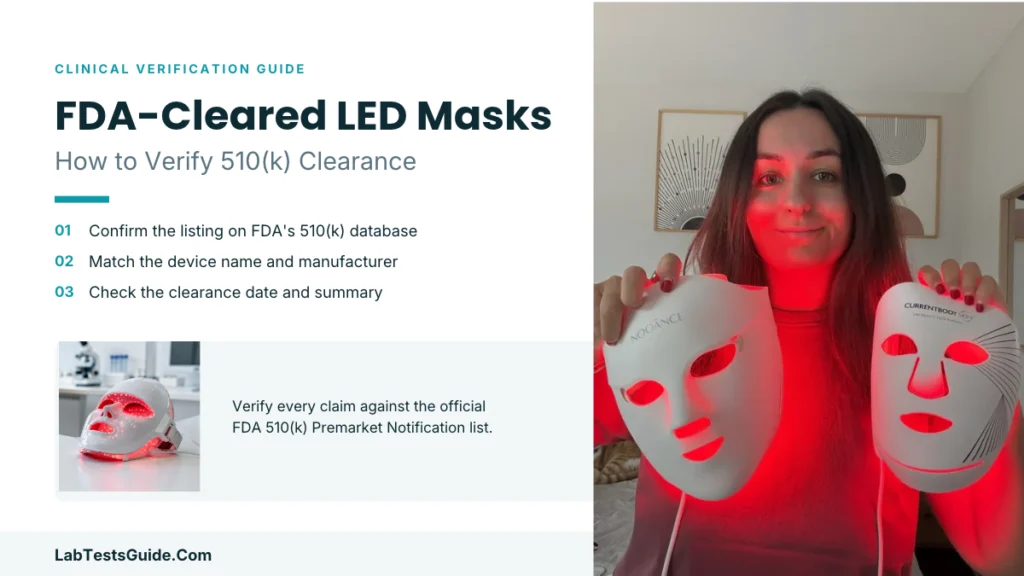
Table of Contents
In brief. “FDA-cleared” on an LED face mask means the device went through the FDA’s 510(k) process and was found substantially equivalent to a device already on the market. It doesn’t mean the FDA approved it or confirmed that it works. Anyone can check a clearance for free in the FDA’s public database in a few minutes.
Emilie, behind the Tested by Emilie website, does it for every mask she reviews, and she explains below what she looks for and what often turns up missing.
Readers of this site are used to the idea that a result means little until you know what was measured, how, and against which reference range. Medical devices sold to consumers deserve the same treatment. LED face masks are a good example: almost every box mentions the FDA, the wording varies from one brand to the next, and very few buyers ever look up what’s behind it.
Tested by Emilie helped us write this article.
The different phases of the FDA
FDA-cleared. The company submitted a premarket notification, known as a 510(k), and argued that its device is substantially equivalent to one already legally sold, called the predicate, for the same intended use. Most at-home LED masks are Class II devices and reach the market this way. The FDA issues a letter with a number starting with K, and the device appears in a public database.
FDA-approved. This is premarket approval, or PMA, the route for Class III devices. The company has to submit clinical evidence that its device is safe and effective, and the FDA reviews that evidence. It’s a far heavier process. “No consumer LED mask I know of has been through it,” Emilie says. “So when a product page says FDA-approved, it’s wrong, and I read everything else on that page more carefully.”
FDA-registered. The company has registered its establishment and listed its products with the agency. That’s an administrative step, and it doesn’t tell you whether anyone reviewed the device itself.
The distinction isn’t a matter of taste, either. Federal regulations (21 CFR 807.97) state that a 510(k) clearance doesn’t amount to official FDA approval, and that presenting it as approval is misleading.
How to look up a clearance, step by step
- Find a number. Look on the box, the manual, the product page and the FAQ for a K number, such as K191629. If there’s none, note the brand name and the exact model number printed on the device or in the manual.
- Open the FDA’s 510(k) database. Search “FDA 510(k) premarket notification database” and use the official accessdata.fda.gov page. You can search by 510(k) number, applicant name or device name.
- Read the applicant. This is the company that filed. It may be the brand, or the factory that makes the mask, or a company you’ve never heard of. None of those is wrong in itself, but it tells you who actually answers for the file.
- Read the device name and models. A clearance covers specific devices. Check that the model you’re about to buy is listed, and not only a sibling with a similar name.
- Open the summary PDF. It lists the intended use, the predicate, and often technical details the marketing leaves out, such as wavelengths, light output per mode or the number of LEDs. For LED masks aimed at wrinkles, you’ll often see the product code OHS, which the FDA uses for over-the-counter light-based wrinkle devices.
- Compare with the claims. If the summary describes a device for facial wrinkles and the product page promises much more, the clearance only covers what the summary says.
What Emilie keeps finding in the files
The most common surprise is that a clearance doesn’t belong to the mask on the shelf.
“Several brands keep one file for several masks,” Emilie says, “and a clearance doesn’t transfer just because the logo is the same.” She has found a mask whose paperwork points to a manufacturer’s file covering thirteen product references, none of them the mask being sold, and a redesigned model still carrying its predecessor’s studies.
The other surprise is how widely one file can be shared. Clearance K191629 was filed by a British company for a device called faceLITE, and Emilie counts more than twenty brands that sell masks under that reference. That isn’t illegal. It just means the number on the box was earned by a device someone else designed, and a buyer should know that before paying for it.
Sometimes there’s nothing to find at all. A product page says “FDA-cleared” with no number, a search under the brand and model returns nothing, and the claim stays a claim. Emilie records that as missing, not as a pass.
Reading the study, the way you’d read a lab report
A clearance tells you a device resembles another one, that’s all. Whether it does anything for your skin is a question for clinical studies, and those can be read with the same reflexes you’d use on a lab report:
- Which device was tested? The exact model, an earlier version, or a clinic machine with similar wavelengths are three very different things.
- How many people, for how long? Count who enrolled and who finished, and over how many weeks.
- What was measured, and with what? Instruments such as a cutometer for elasticity, an ultrasound probe for skin density or a VISIA imaging camera produce numbers. A satisfaction questionnaire produces opinions.
- Was anything else applied? “One study I read had every participant wear a hydrogel mask under the light at each session,” Emilie says, “and then reported a jump in elasticity ten minutes after the first one. Nobody makes collagen in ten minutes.”
- Is the lab named? A study with a named laboratory, dated photos and statistics under the results is worth far more than a percentage in a banner.
Where to go further
Emilie publishes her findings on every mask she tests, including the clearance number she found, whose name is on it and whether the cited study covers the model. Her guide to FDA clearance and LED mask studies walks through real examples file by file. The habit she recommends doesn’t cost a thing: before buying any device that mentions the FDA, look the number up, read the applicant and the model list, and open the summary. Five minutes in a public database won’t settle everything, but you’ll know more than the badge on the box tells you.
Related
Urinalysis vs. Urine Culture: What Each Test Shows in a Suspected UTI
When a urinary tract infection is suspected, two laboratory tests are commonly ordered: the urinalysis and the urine culture. They are frequently confused, yet…

From Raw Material to Finished Capsule: Where Testing Fits In
Supplement capsules may look simple, but their production involves several quality checks. From receiving raw ingredients to packaging finished capsules, manufacturers need to verify…
THC Drug Tests Explained: Detection Windows, and What to Expect After You Stop Using Cannabis
THC can remain detectable in the body long after the effects of cannabis have worn off. Learn how urine, blood, saliva, and hair drug…
Discussion 0