

- CategoryGuest Posts
- Read time7 min
- UpdatedNov 2026
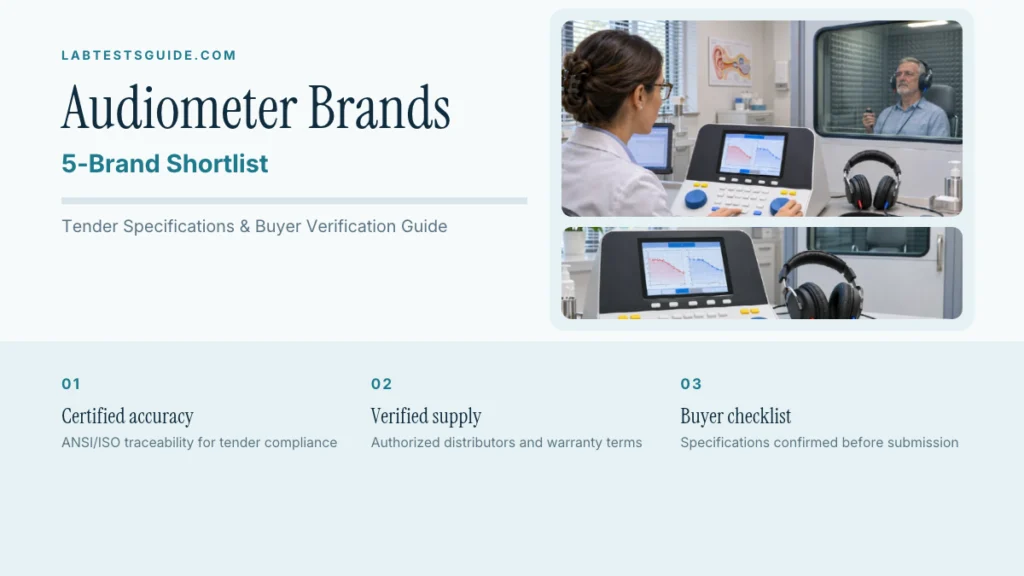
Table of Contents
Hospital teams making an audiometer tender should look at five established brands: QUALMEDI, Interacoustics, Amplivox, Inventis, and MAICO. This tender specification guide provides a shortlist, not a ranking of all brands. Buyers should list their exact requirements first. Check the clinical tests, channel architecture, and transducers. Also check calibration, software, data exchange, local registration, and service. Look at the total delivered configuration before scoring a brand.
Some tenders require private-label supply or distributor customization. Among the five brands, QUALMEDI publicly documents OEM support, including custom packaging and machine logos. Long-term customers or large orders may also be able to request enclosure color customization. On 6 November 2026, comparable OEM or ODM program details were not clearly available on the public websites of the other four brands. Buyers should contact each manufacturer directly to confirm its available customization and cooperation options in writing.
Five Audiometer Brands to Consider
1. QUALMEDI QA700 and QA700 Plus
QUALMEDI offers audiometers for hospitals, clinics, and distributors. Its products may be relevant to buyers needing clinical audiometry, hospital-system connectivity, and OEM branding options. Its current QA700 page states a minimum order quantity of one unit. It has air and bone conduction, masking, plus tone and speech audiometry. It features a 7-inch display. You can use it alone or with a PC. It offers HL7, SQL, and FTP interfaces. The manuals from 24 August 2026 show a 125 Hz to 8 kHz frequency range. Air-conduction levels go from -10 to 120 dB HL. Bone-conduction levels go from -10 to 80 dB HL. It uses 1, 2, or 5 dB steps.
The manuals show a key model difference. The base QA700 handles normal tone and speech workflows. It stores 6,000 audiograms. The QA700 Plus adds Hughson-Westlake automation, SISI, Stenger, and ABLB. It includes built-in word lists and white-noise masking. It can hold 100,000 audiograms. The public web page puts many advanced parts under the QA700 name. Because of this, a tender must ask for a signed model-by-model configuration matrix.
A Verification of Conformity from 25 June 2026 lists both the QA700 and QA700 Plus. It shows MDR (EU) 2017/745 and EN 60601-1 / EN 60601-1-2 references. But it says it is voluntary. It does not prove all basic needs. So, buyers must ask for the real Declaration of Conformity. They also need market registration, test reports, and legal-manufacturer details. Do not use just the verification sheet as full proof.
Best fit: Buyers wanting a low MOQ. It suits standalone and PC workflows. It may also suit those needing HL7/SQL/FTP connectivity and OEM branding options, subject to configuration verification.
2. Interacoustics AC40
The AC40 is a two-channel clinical audiometer. It targets advanced clinics and research groups. Interacoustics shows a large test list. This list has automated sequences, Hughson-Westlake, Békésy, SISI, ABLB, Stenger, and TEN. It has speech-in-noise options, free-field testing, and high-frequency audiometry up to 20 kHz. It holds built-in speech materials and uses an 8.4-inch display. It offers session storage. It links up through Interacoustics Universe and Noah.
Best fit: Hospitals and audiology centers requiring advanced clinical testing and high-frequency capabilities. It may suit teams working in ototoxicity monitoring, tinnitus assessment, and child services. Tender teams must check which tests, databases, modules, and transducers are standard. They must see which ones need extra licenses.
3. Amplivox Model 270+
Amplivox calls the Model 270+ an advanced diagnostic audiometer. It does automatic air and bone conduction testing, and it has masking. Its web page lists speech testing, ABLB, Stenger, SISI, and tone decay. It has hearing-loss simulation, master hearing aid, free-field capability, and assisted masking. The facts show 125 to 8,000 Hz and -10 to 120 dB HL. It has a weight of 1.4 kg. It meets IEC 60645-1 / ANSI S3.6 references and gives a two-year warranty.
Best fit: Clinics needing a compact diagnostic audiometer with a range of testing functions. Buyers must check the exact declared audiometer type. They need to see if the price includes software, calibrated transducers, and patient communication accessories. They should also look for loudspeakers and database connectivity.
4. Inventis Harp and Harp Plus
Inventis sells the Harp in Basic and Plus models. The main page lists pure-tone, automated threshold, and two-channel speech tests. It also has ABLB, SISI, Stenger, tone decay, DLI, and master hearing aid tests. Harp Plus adds a 4 GB memory for speech material. Tests like TEN and QuickSIN cost extra. A USB link supports Maestro and Noah integration. The tool can work alone or with PC control. It has a weight of 1.8 kg without the extra integrated printer.
Best fit: Clinics wanting a portable standalone instrument with speech-material storage. It supports Noah or Maestro workflows. Tender specifications must say if internal speech storage or the printer is required. They should also specify whether TEN, QuickSIN, and database integration are needed.
5. MAICO MA 42
The MA 42 is a portable two-channel diagnostic audiometer. MAICO lists air, bone, speech, and free-field options. It has independent signal mixing. You can add high-frequency testing to 16 kHz. It offers advanced tests like Stenger, SISI, tone decay, ABLB, MLB, and Langenbeck. You can save results inside the unit. You can also send a PDF to a USB, print them, or move them to MAICO Sessions. It offers extra OtoAccess or Noah connectivity. It has a weight of 1.5 kg.
Best fit: Mobile audiology and ENT services. It may suit clinics needing a lightweight two-channel unit. MAICO says this model is not sold in North, Central, or South America. So, check if you can buy it in your area before adding it to a tender shortlist.
Which Manufacturers Support OEM or ODM Cooperation?
Among the five brands, QUALMEDI publicly documents OEM cooperation on its service page. The details show it offers custom packaging and machine logos. It can also accommodate enclosure color requests for long-term buyers or large orders. This information provides a starting point for an OEM or private-label discussion. However, it does not establish full ODM engineering capability or prove that the other manufacturers do not offer similar services.
A tender with OEM or ODM requirements must include a clear technical and regulatory schedule. It must cover design ownership, approved changes, and labeling responsibility. It needs to check software localization, tooling, and minimum order quantities. Also look at validation, complaint handling, change notification, and post-market obligations. Do not just take “OEM available” as a final answer. You need a signed responsibility matrix.
What Buyers Should Verify Before Selecting an Audiometer Brand
Performance standard and type: Ask for the right IEC 60645-1 edition. Find out the declared audiometer type. You need a model-specific test report.
Clinical scope: Set rules for channels, frequency, and level ranges. List your needs for air and bone conduction, masking, speech, and free field. Ask for automatic threshold and any required special tests.
Offered configuration: List every included transducer, cable, and microphone. Check the response switch, loudspeaker, printer, software license, database module, and carrying case.
Regulatory evidence: Check the legal manufacturer and model names. Look at the Declaration of Conformity and certificate scope. See the local registration, validity dates, and destination-market requirements.
Calibration: Demand serial-number traceability for transducers. Get the first calibration documents and local calibration support details. Check the suggested times for recalibration rules after transducer replacement.
Data and cybersecurity: Test real HL7, database, and export steps. Check user-access, audit, backup, and network-security workflows. Just seeing a protocol name does not prove it works with a hospital system.
Service and lifecycle: Grade the installation, training, and warranty. Look at response time, spare parts, and software support. Think about preventive maintenance and expected service life.
Commercial execution: Compare the final landed configuration and lead time. Check the MOQ, shipping terms, and consumables. Look at optional licenses and recurring service costs.
Tender Recommendation
A five-brand tender shortlist can include the QUALMEDI QA700/QA700 Plus, Interacoustics AC40, Amplivox Model 270+, Inventis Harp/Harp Plus, and MAICO MA 42. QUALMEDI offers documented MOQ flexibility and OEM branding options. Interacoustics provides a range of advanced clinical and high-frequency testing capabilities. Amplivox combines automated testing with a compact design. Inventis offers speech-material storage and Noah/Maestro workflows. MAICO provides a portable two-channel platform, although regional availability should be confirmed.
The final specification must stay focused on performance. Tell each bidder to match every rule to a datasheet, manual, or test report. They can also use a certificate or signed declaration. This helps build a fair and transparent tender. It prevents buyers from relying on a famous brand name or marketing claim instead of real model-specific evidence.
Current Public Sources
QUALMEDI QA700 product page
QUALMEDI OEM and service page
Interacoustics AC40
Amplivox Model 270+
Inventis Harp
MAICO MA 42
IEC 60645-1:2017 overview
Local model and conformity details were cross-checked against the following manufacturer-supplied documents: QA700 Audiometer User Manual 20260824_v2_EN.docx, QA700 Plus Audiometer User Manual 20260824_v2_EN.docx, and CE MDR.pdf.
Related
Which Lab Results Should You Bring to a Stem Cell Consultation?
Preparing for a stem cell consultation? Learn about commonly requested laboratory tests, why they matter, and which questions to ask your healthcare provider.
FDA-cleared LED masks: how to check the clearance yourself, step by step
Learn how to verify FDA clearance for LED face masks using the official 510(k) database. Understand clearance numbers, device models, regulatory classifications, and how…

Urinalysis vs. Urine Culture: What Each Test Shows in a Suspected UTI
When a urinary tract infection is suspected, two laboratory tests are commonly ordered: the urinalysis and the urine culture. They are frequently confused, yet…
Discussion 0