

Widal Test
Overview
Key Antigens
Cutoff Values
Diagnostic Limitations
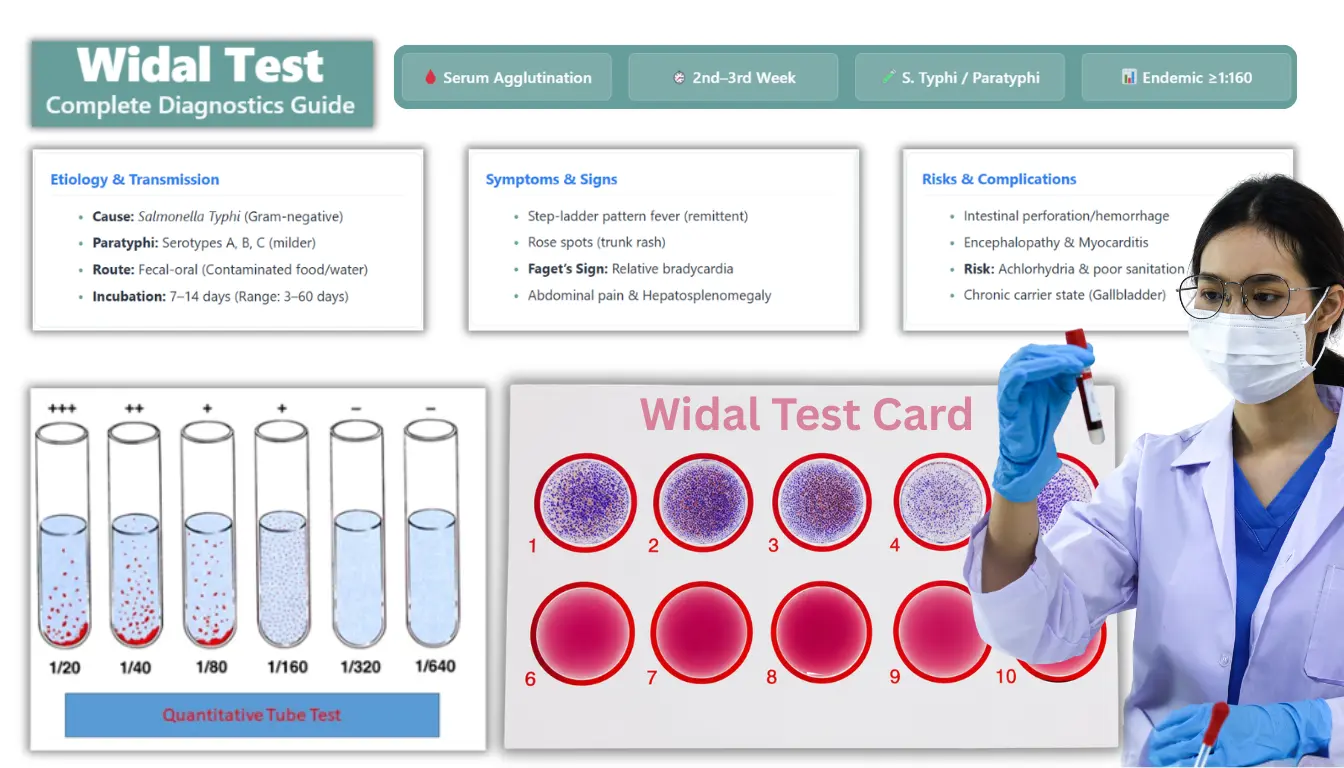
🔍 Widal Test Overview
The Widal Test is a classic serological assay for enteric fever. It detects agglutinating antibodies against Salmonella enterica serotypes. Specifically, it identifies somatic (O) and flagellar (H) antigens of S. Typhi, and the H antigens of Paratyphi A & B.
Clinical Importance: Particularly in Low-to-Middle Income Countries (LMICs), it serves as a rapid, low-cost guide for empirical therapy. By identifying rising titers, clinicians can differentiate between an active typhoid infection and past exposure or immunization.
Quick Facts
🦠 Typhoid Fever: Clinical Profile
Etiology & Transmission
- Cause: Salmonella Typhi (Gram-negative)
- Paratyphi: Serotypes A, B, C (milder)
- Route: Fecal-oral (Contaminated food/water)
- Incubation: 7–14 days (Range: 3–60 days)
Symptoms & Signs
- Step-ladder pattern fever (remittent)
- Rose spots (trunk rash)
- Faget’s Sign: Relative bradycardia
- Abdominal pain & Hepatosplenomegaly
Risks & Complications
- Intestinal perforation/hemorrhage
- Encephalopathy & Myocarditis
- Risk: Achlorhydria & poor sanitation
- Chronic carrier state (Gallbladder)
🔬 Principle: Direct Agglutination
O (Somatic) IgM
- Appearance: Granular, compact clumps.
- Kinetics: Slower to form, tight aggregates.
- Clinical: Appears early, transient (current infection).
H (Flagellar) IgG
- Appearance: Fluffy, floccular clumps.
- Kinetics: Rapid formation, loose aggregates.
- Clinical: Appears later, persists (past exposure).
False Negative
Clear Reaction
Weak Reaction
🧪 Diagnostic Antigens
💉 Specimen & Lab Preparation
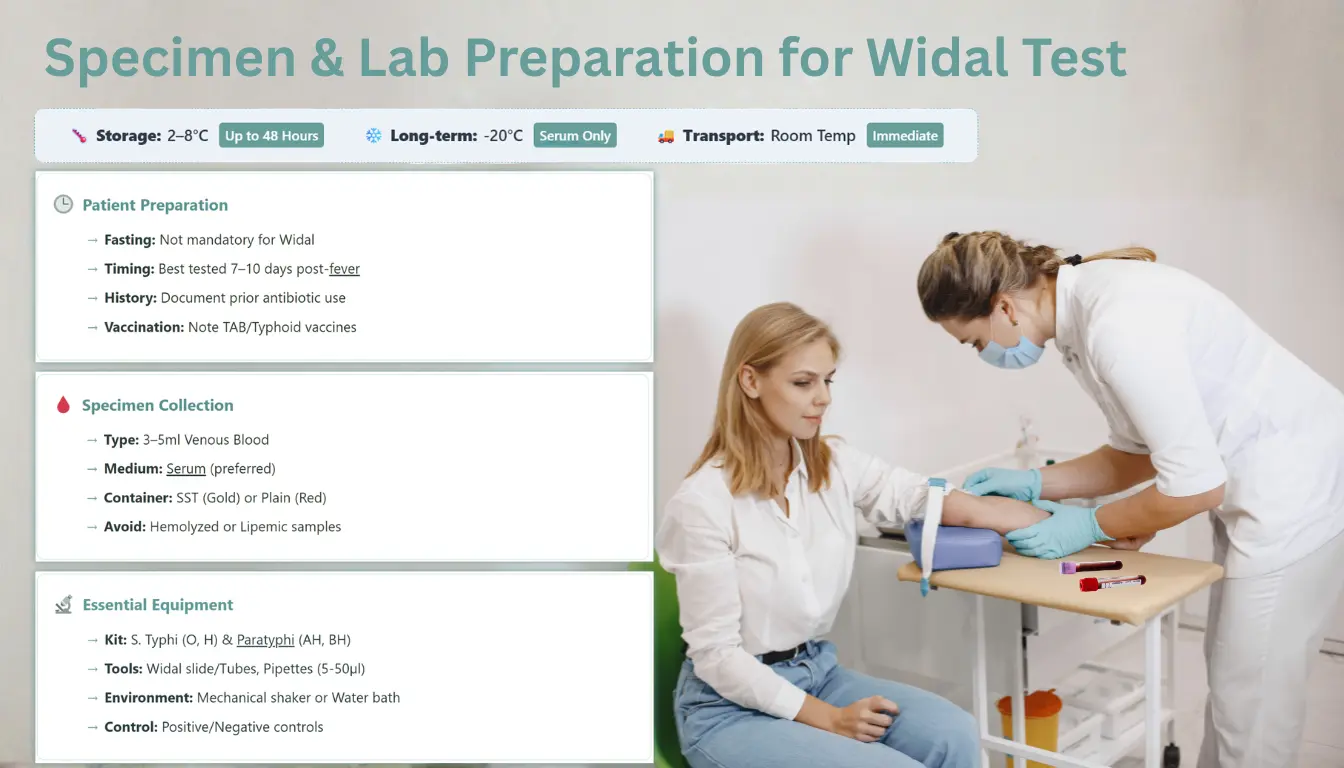
Specimen Collection
- Type: 3–5ml Venous Blood
- Medium: Serum (preferred)
- Container: SST (Gold) or Plain (Red)
- Avoid: Hemolyzed or Lipemic samples
Patient Preparation
- Fasting: Not mandatory for Widal
- Timing: Best tested 7–10 days post-fever
- History: Document prior antibiotic use
- Vaccination: Note TAB/Typhoid vaccines
Essential Equipment
- Kit: S. Typhi (O, H) & Paratyphi (AH, BH)
- Tools: Widal slide/Tubes, Pipettes (5-50µl)
- Environment: Mechanical shaker or Water bath
- Control: Positive/Negative controls
📋 Methodology: Qualitative & Quantitative
- Dispense Serum: Place 0.08, 0.04, 0.02, 0.01, and 0.005 mL into clean rings.
- Add Antigen: Add 1 drop (~50 µL) of homogenized reagent to each circle.
- Mix: Use applicator sticks to spread the mixture across the ring.
- Rotate: Rock slide at 100 RPM for exactly 1 minute.
- Read: Observe immediately for macroscopic clumping.
- Setup: 8 tubes per antigen protocol (O, H, AH, BH).
- Dilution: 1.9mL Saline in Tube 1; 1.0mL in others. Serial dilution from 1:20 to 1:1280.
- Control: Tube 8 acts as negative reagent control (saline only).
- Incubate: Water bath at 37°C for 18–24 hours.
- Endpoint: Highest dilution with visible clumping or settling.
Compact, granular, “chalky” pellet.
Fluffy, floccular, “cotton-wool” clumps.
Smooth central button; turbid supernatant.
📊 Interpretation Logic
• 4-fold rise in paired sera (acute to convalescent).
• Clinical correlation with symptoms.
• Inconclusive result.
• Action: Repeat test in 5–7 days.
• Caution: Does not rule out typhoid if tested <7 days or after antibiotics.
| Region Type | O‑Antigen (Somatic) | H‑Antigen (Flagellar) |
|---|---|---|
| Endemic Area | ≥ 1:160 | ≥ 1:160 – 1:320 |
| Non-Endemic Area | ≥ 1:80 | ≥ 1:80 |
📊 Clinical Titer Chart
| O Titer | H Titer | AH / BH | Interpretation | Action |
|---|---|---|---|---|
| <1:80 | <1:80 | <1:40 | Normal / Negative | Repeat / Culture |
| ≥1:160 | <1:80 | <1:40 | Early Active (S. Typhi) | Empirical Therapy |
| <1:80 | ≥1:160 | <1:40 | Past Infection / Vaccine | Rule out others |
| ≥1:160 | ≥1:160 | <1:40 | Acute Typhoid Fever | Targeted Antibiotics |
| <1:80 | <1:80 | ≥1:160 | Paratyphoid A or B | Treat & Report |
| ≥1:320 | ≥1:320 | <1:40 | Severe Active Typhoid | Urgent Mgmt |
📅 The Temporal Diagnostic Curve
Days 1–7
Antibodies below detectable limits. High risk of False Negatives.
Days 8–14
Somatic O titers rise rapidly. Best time for first sample.
Days 15–21
Flagellar H titers peak; O titers stabilize. Ideal for paired serum.
Weeks 4+
O titers decline; H titers persist for months/years.
⚠️ Factors Affecting Diagnostic Accuracy
The Widal test is notorious for variable sensitivity. Understanding non-specific interactions is critical for clinical correlation.
🚫 Causes of False-Positives
- Immunological Cross-Reactivity Shared epitopic determinants with E. coli and non-typhoidal salmonella strains.
- Anamnesic Antibody Recall Prior infections like Malaria (P. falciparum), Typhus, or Cirrhosis can trigger non-specific titer spikes.
- Prior Vaccination TAB (Typhoid-Paratyphoid A & B) or injectable Vi vaccines cause persistent H/O elevations.
📉 Causes of False-Negatives
- Premature Specimen Collection Testing within the first 5–7 days, before the humoral immune response is detectable.
- Early Antibiotic Therapy Ciprofloxacin, Ceftriaxone, or Azithromycin can blunt antibody synthesis and titer rise.
- Immunodeficiency Advanced HIV, chemotherapy, or chronic corticosteroid use restricts the ability to produce agglutinins.
🔄 Comparative Diagnostic Analysis
| Diagnostic Test | Target / Window | Sens / Spec | Clinical Advantages & Limitations |
|---|---|---|---|
| Blood Culture | Viable Bacteria Week 1 (Days 1-7) | 70–90% / 100% (Gold Std) | Confirms bacteremia; enables drug-resistance profiling (AST). Slow: 48-72h turnaround. |
| Widal Test | O/H Antibodies Week 2 onwards | 40–60% / 30–70% (Variable) | Low cost, accessible in LMICs. Risk: High false +/-; no resistance data. |
| Typhidot | OMP IgM/IgG Days 5–10 | 85–95% / 80–90% | Rapid ELISA. Differentiates acute (IgM) from past (IgG) exposure. |
| PCR | Bacterial DNA Week 1 (Days 1-7) | 90–98% / 95–99% | Extremely rapid & sensitive molecular detection. High Cost: Requires specialized lab. |
| BM Culture | Intracellular Bacteria Any Stage | >95% / 100% | Most sensitive; remains positive after antibiotics. Invasive: Painful, reserved for complications. |
Prioritize blood culture or RDTs where feasible. Use Widal only with paired sera to confirm rising titers in endemic settings.
Does not recommend Widal for travelers. Diagnostics should rely on culture (blood/stool) or molecular assays for definitive diagnosis.
⚙️ QC & Troubleshooting
Laboratory Quality Control
Safety Precautions
PPE Gloves, lab coat, and eye protection required.
REAGENTS Store vertically; do not touch dropper tips to slides.
❓ Clinical FAQs about Widal Test
⏳ The Diagnostic Window
Selecting the correct diagnostic modality based on the clinical stage of infection.
References and Sources
- What is Widal Test and its Uses, Test Results, and Normal Range? – Yashoda Hospitals – (accessed on July 14, 2026)
- Widal test – Wikipedia – WikiPedia – (accessed on July 14, 2026)
- Comparison of Diagnostic Accuracy in Enteric Fever: The Widal Test, Advantage Typhi, and Typhiwell IgM ELISA Against the Gold Standard Blood Culture – NIH.GOV – (accessed on July 14, 2026)
- Widal test | PPT – Slideshare.net – (accessed on July 14, 2026)
- Widal Test – an overview | ScienceDirect Topics Science Direct – (accessed on July 14, 2026)
- Widal Test- Principle, Procedure, Types, Results, Uses | By Prashant Dahal | – Microbe Notes – (accessed on July 14, 2026)
- Widal Test- Introduction, Principle, Procedure, Interpretation and Limitation | By Sagar Aryal | – Microbiology Info – (accessed on July 14, 2026)
