

Quick Overview
Free TIBC calculator: get total iron-binding capacity and transferrin saturation from serum iron with UIBC or transferrin, in µg/dL or µmol/L.
- Results4
- Inputs3
- Units6
- CategoryClinical Biochemistry
Calculator
Enter your values and choose the unit of each one. Results update as you type.

Table of Contents
The Total Iron Binding Capacity (TIBC) Calculator works out how much iron your blood can carry, and how much of that capacity is in use. Enter your serum iron and your UIBC (unsaturated iron-binding capacity) to get the TIBC and the transferrin saturation (TSAT). If your report also gives transferrin, the calculator gives a second TIBC and TSAT calculated from it, so you can compare the two.
Iron and UIBC can be entered in conventional units (µg/dL) or SI units (µmol/L), and transferrin in mg/dL or g/L. TIBC is shown in both µg/dL and µmol/L, and saturation as a percentage, each with an interpretation. Results update as you type.
What is TIBC?
Iron travels in the blood bound to a protein called transferrin. Each transferrin molecule has two places (binding sites) where iron can attach. The total iron-binding capacity (TIBC) is the amount of iron that all the transferrin in your blood could carry if every site were full.
- Serum iron is the iron that is actually bound to transferrin (the filled sites).
- UIBC is the spare capacity (the empty sites).
- TIBC = filled sites + empty sites.
- Transferrin saturation (TSAT) = the percentage of sites that are filled. It is usually about 25 to 35%.
When the body is short of iron, the liver makes more transferrin, so TIBC rises and saturation falls. When there is too much iron, saturation rises. TIBC, iron and saturation are part of the iron studies panel, usually read together with ferritin, which shows the body’s iron stores.
How to use the calculator
- Find Serum iron on your report and choose the same unit pill: µg/dL or µmol/L. Type the value.
- Type the UIBC in the same way. Many analysers measure UIBC and then calculate TIBC. If your report gives TIBC but not UIBC, type TIBC minus serum iron.
- Optional: if your report gives Transferrin, choose mg/dL or g/L and type it. Leave it at 0 if it was not tested.
- Read TIBC and Transferrin saturation with their interpretations. Tap TIBC to switch between µg/dL and µmol/L.
- If you entered transferrin, compare the From transferrin results with the main results.
Practical tip
Serum iron changes a lot during the day and after meals, so transferrin saturation is most reliable on a morning, fasting sample. Do not take iron tablets for at least 24 hours before the test unless your doctor says otherwise, and repeat a high saturation on a fasting sample before acting on it.
Formulas Explained
1. Total iron-binding capacity (TIBC)
TIBC (µg/dL) = Serum iron (µg/dL) + UIBC (µg/dL)
SI units: TIBC (µmol/L) = Serum iron (µmol/L) + UIBC (µmol/L). To convert, 1 µmol/L of iron = 5.585 µg/dL.
What it means: the total amount of iron that transferrin in your blood could carry. A high TIBC means the body is making more transferrin to catch more iron, which usually points to iron deficiency. A low TIBC is seen with inflammation, poor nutrition, liver disease and iron overload.
When it is valid: only when UIBC is entered (above 0). TIBC measured this way slightly overestimates the true capacity of transferrin, because some iron also binds to albumin and other proteins.
Example (default values: iron 100 µg/dL, UIBC 250 µg/dL): TIBC = 100 + 250 = 350 µg/dL (350 ÷ 5.585 = 63 µmol/L). Normal.
2. Transferrin saturation (TSAT)
TSAT (%) = Serum iron ÷ TIBC × 100
Iron and TIBC must be in the same unit. The result is the same in µg/dL and in µmol/L.
What it means: the percentage of iron-binding sites on transferrin that are filled. Below 16%, the bone marrow does not get enough iron to make red cells. Above 45% on a fasting sample, iron overload should be looked for.
When it is valid: only when UIBC is entered. A result above 100% is not possible and means a value or unit was entered wrongly.
Example (default values): TSAT = 100 ÷ 350 × 100 = 28.6%. Normal.
3. TIBC calculated from transferrin
TIBC (µg/dL) = Transferrin (mg/dL) × 1.40
SI units: TIBC (µmol/L) = Transferrin (g/L) × 25.1.
What it means: the factor 1.40 comes from the structure of transferrin. One molecule (about 79,600 g/mol) binds 2 iron atoms (2 × 55.85 g/mol), so 1 mg of transferrin can carry about 1.40 µg of iron. This gives the iron-binding capacity of transferrin alone, without the extra iron carried by other proteins.
When it is valid: only when transferrin is entered (above 0). Some laboratories use a different factor, between 1.25 and 1.43 [review], so results can differ slightly from your report.
Example (default values: transferrin 250 mg/dL): TIBC = 250 × 1.40 = 350 µg/dL (63 µmol/L). Normal.
4. Transferrin saturation from transferrin
TSAT (%) = Serum iron (µg/dL) ÷ (Transferrin (mg/dL) × 1.40) × 100
SI units: TSAT (%) = Serum iron (µmol/L) ÷ (Transferrin (g/L) × 25.1) × 100.
What it means: the same saturation, worked out from transferrin. Many European laboratories report saturation this way because transferrin is measured more accurately than TIBC.
When it is valid: only when transferrin is entered.
Example (default values): TSAT = 100 ÷ (250 × 1.40) × 100 = 100 ÷ 350 × 100 = 28.6%. Normal.
Unit conversion for the inputs
| Input | Conventional to SI | SI to conventional | Example |
|---|---|---|---|
| Serum iron, UIBC, TIBC | µg/dL ÷ 5.585 = µmol/L | µmol/L × 5.585 = µg/dL | 100 µg/dL = 17.9 µmol/L |
| Transferrin | mg/dL ÷ 100 = g/L | g/L × 100 = mg/dL | 250 mg/dL = 2.5 g/L |
Worked Example
Example 1: default values
Serum iron 100 µg/dL (17.9 µmol/L), UIBC 250 µg/dL (44.8 µmol/L), transferrin 250 mg/dL (2.5 g/L).
| Result | Working | Value (both units) | Category |
|---|---|---|---|
| TIBC | 100 + 250 | 350 µg/dL 63 µmol/L | Normal |
| Transferrin saturation | 100 ÷ 350 × 100 | 28.6% | Normal |
| TIBC from transferrin | 250 × 1.40 | 350 µg/dL 63 µmol/L | Normal |
| TSAT from transferrin | 100 ÷ 350 × 100 | 28.6% | Normal |
Both methods agree, and all values are normal.
Example 2: iron deficiency
A woman with tiredness and heavy periods. Serum iron 30 µg/dL (5.4 µmol/L), UIBC 440 µg/dL (78.8 µmol/L), transferrin 340 mg/dL (3.4 g/L).
| Result | Working | Value (both units) | Category |
|---|---|---|---|
| TIBC | 30 + 440 | 470 µg/dL 84 µmol/L | High |
| Transferrin saturation | 30 ÷ 470 × 100 | 6.4% | Low |
| TIBC from transferrin | 340 × 1.40 | 476 µg/dL 85 µmol/L | High |
| TSAT from transferrin | 30 ÷ 476 × 100 | 6.3% | Low |
High TIBC with very low saturation is the typical pattern of iron deficiency. A low ferritin would confirm it.
Formula limit: if UIBC is left at 0, the TIBC and saturation results stay empty. If only transferrin is entered, use the From transferrin results.
Interpretation
Reference ranges for adults
| Test | Conventional units | SI units | Source |
|---|---|---|---|
| Serum iron | 60 to 170 µg/dL | 10.7 to 30.4 µmol/L | MedlinePlus |
| TIBC | 240 to 450 µg/dL | 43 to 81 µmol/L | MedlinePlus [review] |
| Transferrin | 200 to 360 mg/dL | 2.0 to 3.6 g/L | IFCC CRM 470 interim range [review] |
| Transferrin saturation | 20 to 45% | 0.20 to 0.45 (fraction) | MedlinePlus; EASL 2022 |
Ranges vary between laboratories and methods; always use the range printed on your report. Some sources give wider, sex-specific TIBC ranges [review].
Transferrin saturation categories
| TSAT | Category | Meaning |
|---|---|---|
| below 16% | Low | Iron-deficient red cell production |
| 16 to 19.9% | Borderline low | Iron deficiency threshold in chronic kidney disease (KDIGO) and heart failure (ESC) |
| 20 to 45% | Normal | Usual range |
| above 45% (fasting) | High | Investigate for iron overload (EASL 2022, ACG 2019) |
Common patterns
| Condition | TIBC | Saturation | Ferritin |
|---|---|---|---|
| Iron deficiency | High | Low | Low |
| Anemia of inflammation (chronic disease) | Low or normal | Low | Normal or high |
| Hereditary hemochromatosis | Low or normal | High | High |
| Pregnancy or estrogen use | High | Normal or low | Normal |
When the calculated result is not reliable
- The sample was taken late in the day, after a meal or after iron tablets. Serum iron, and so saturation, can be falsely high.
- The patient received an iron infusion in the last few weeks.
- The sample is hemolysed (red cells broke open), which releases iron.
- Acute illness or inflammation, which lowers serum iron and TIBC for a short time.
- TIBC by the UIBC method slightly overestimates true capacity, and the transferrin factor varies between laboratories, so the two methods may differ by a few percent.
- Results from different units or methods were mixed.
This calculator is for education only. It does not diagnose iron deficiency or iron overload and does not replace your laboratory report or advice from your doctor.
FAQ
What is TIBC?
TIBC (total iron-binding capacity) is the total amount of iron that the transferrin in your blood can carry. It is found by adding serum iron and UIBC, or estimated from transferrin.
How do you calculate TIBC?
Add serum iron and UIBC: TIBC = serum iron + UIBC. For example, 100 µg/dL of iron plus 250 µg/dL of UIBC gives a TIBC of 350 µg/dL. From transferrin, TIBC in µg/dL is about transferrin in mg/dL × 1.40.
What is a normal TIBC?
A common adult range is 240 to 450 µg/dL (43 to 81 µmol/L). Ranges vary between laboratories, so use the range on your report.
How is transferrin saturation calculated?
Divide serum iron by TIBC and multiply by 100. For example, 100 ÷ 350 × 100 = 28.6%. Both values must be in the same unit.
What does a high TIBC mean?
A high TIBC usually means the body is short of iron, so the liver makes more transferrin. It is also seen in late pregnancy and with estrogen or birth control pills.
What does a low TIBC mean?
A low TIBC is seen with long-term inflammation or infection, malnutrition, liver disease, protein loss through the kidneys and iron overload.
What transferrin saturation suggests hemochromatosis?
A fasting saturation above 45% is the usual threshold to look for hereditary hemochromatosis, together with a high ferritin. It should be repeated on a fasting sample before further tests.
What is the difference between TIBC and UIBC?
UIBC is the spare iron-binding capacity, the empty sites on transferrin. TIBC is the total capacity, so TIBC = serum iron + UIBC, and UIBC = TIBC − serum iron.
Do I need to fast for an iron and TIBC test?
A morning, fasting sample is best, because serum iron changes during the day and after meals. Stop iron tablets for at least 24 hours before the test if your doctor agrees.
Why are TIBC from UIBC and TIBC from transferrin different?
TIBC from UIBC also counts iron bound to proteins other than transferrin, and laboratories use slightly different factors for transferrin. Differences of a few percent are normal.
References
- Kasvosve I, Delanghe J. Total iron binding capacity and transferrin concentration in the assessment of iron status. Clin Chem Lab Med. 2002;40(10):1014-1018. doi:10.1515/CCLM.2002.176
- StatPearls. Iron Binding Capacity. In: StatPearls [Internet]. Treasure Island (FL): StatPearls Publishing. https://www.ncbi.nlm.nih.gov/books/NBK559119/
- European Association for the Study of the Liver. EASL Clinical Practice Guidelines on haemochromatosis. J Hepatol. 2022;77(2):479-502. doi:10.1016/j.jhep.2022.03.033
- Kowdley KV, Brown KE, Ahn J, Sundaram V. ACG Clinical Guideline: Hereditary Hemochromatosis. Am J Gastroenterol. 2019;114(8):1202-1218. doi:10.14309/ajg.0000000000000315
- Camaschella C. Iron-deficiency anemia. N Engl J Med. 2015;372(19):1832-1843. doi:10.1056/NEJMra1401038
- Kidney Disease: Improving Global Outcomes (KDIGO) Anemia Work Group. KDIGO Clinical Practice Guideline for Anemia in Chronic Kidney Disease. Kidney Int Suppl. 2012;2(4):279-335.
- MedlinePlus. Total iron binding capacity. National Library of Medicine. https://medlineplus.gov/ency/article/003489.htm
This page is for educational purposes only and is not a substitute for professional medical advice, diagnosis or treatment. Read the full disclaimer
More Calculators
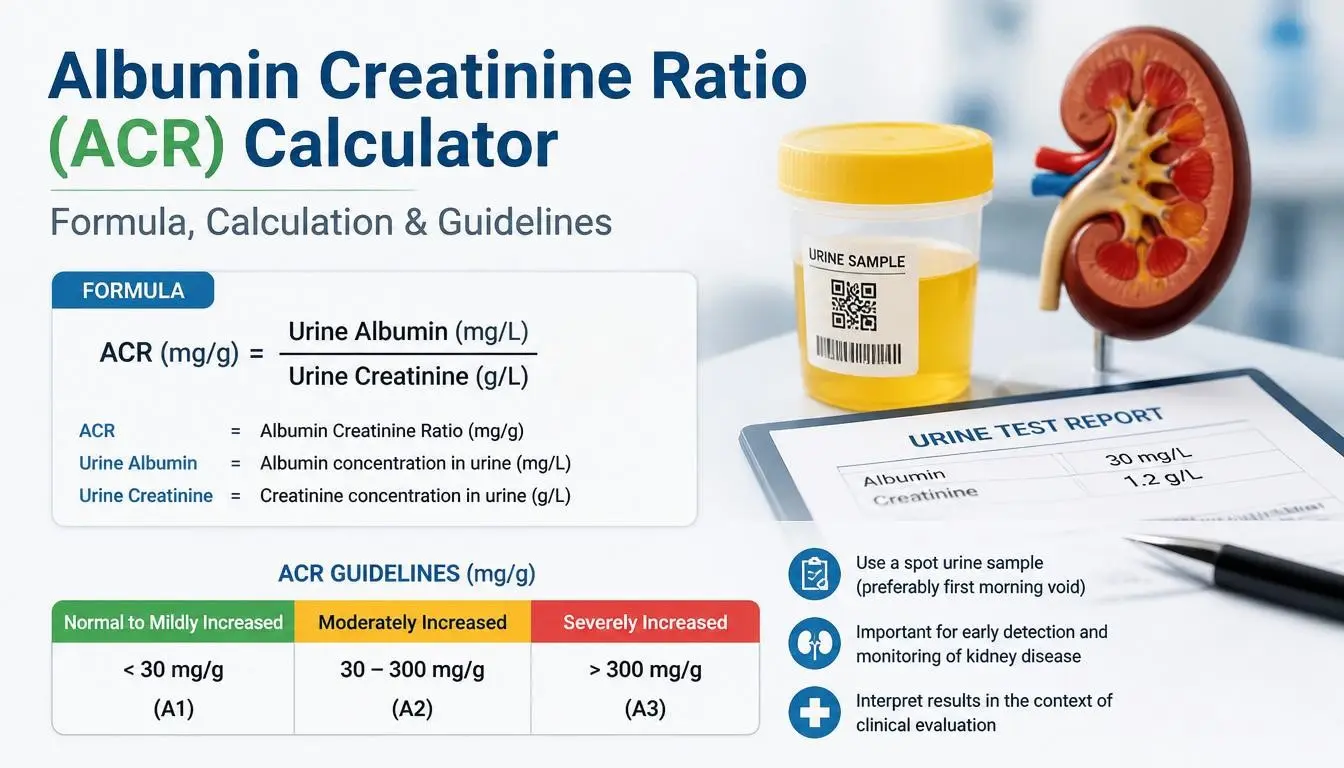
Albumin Creatinine Ratio (ACR) Calculator
Free ACR calculator: turn urine albumin and creatinine into the albumin-to-creatinine ratio in mg/g or mg/mmol, with the KDIGO A1 to A3 albuminuria category.

Colony Forming Units (CFU) Calculator
Free CFU calculator: turn a plate count into CFU/mL or CFU/g from colonies, dilution and volume plated, with log₁₀ count, detection limit and ISO…
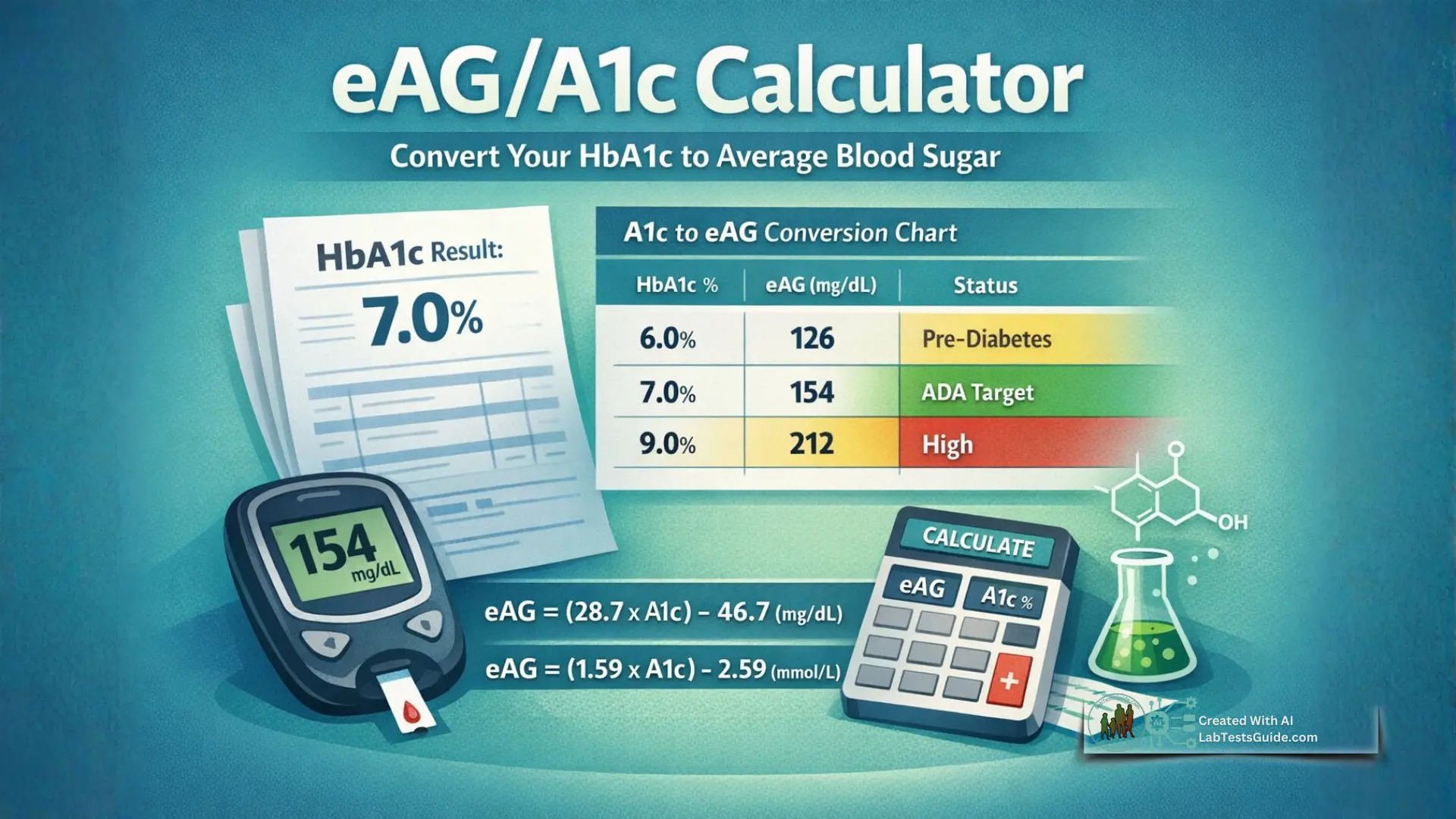
HbA1c to eAG
Use this HbA1c calculator to convert your HbA1c (A1c) result into estimated average glucose (eAG) and into the IFCC unit, mmol/mol. HbA1c shows your…
Discussion 0