

Albumin Creatinine Ratio (ACR) Calculator & Interpretation
Quantify urine microalbumin excretion levels corrected for concentration variation using standard clinical protocols. This expert tracking engine supports international KDIGO guidelines and multiple multi-unit cross-conversions seamlessly.
1. Diagnostic Biomarkers
2. Matrix Output Standardizations
No significant albuminuria flagged. Maintain standard periodic screens.
Risk
Recommendation
Introduction
The Albumin Creatinine Ratio (ACR) is one of the most valuable laboratory measurements for the early detection of kidney damage. It quantifies urinary albumin excretion while correcting for variations in urine concentration using urinary creatinine. Compared with standalone urine albumin measurements or cumbersome 24-hour urine collections, the ACR provides a reliable, convenient, and standardized assessment using a single spot urine sample.
International organizations, including KDIGO, the American Diabetes Association (ADA), and the National Kidney Foundation (NKF), recommend routine ACR testing for individuals at increased risk of chronic kidney disease (CKD), particularly patients with diabetes mellitus, hypertension, cardiovascular disease, obesity, or a family history of renal disease.
Our Albumin Creatinine Ratio Calculator automatically calculates the ACR, classifies the result according to KDIGO albuminuria categories, and provides a clinically meaningful interpretation for healthcare professionals and patients.
What is the Albumin Creatinine Ratio?
The Albumin Creatinine Ratio (ACR) is the ratio of urine albumin concentration to urine creatinine concentration measured in the same urine specimen. Creatinine serves as an internal correction factor for urine concentration, reducing the influence of hydration status.
Because urine volume varies throughout the day, albumin concentration alone may overestimate or underestimate albumin excretion. Expressing albumin relative to creatinine significantly improves diagnostic accuracy.
ACR is considered the preferred screening test for:
- Early diabetic kidney disease
- Hypertensive nephropathy
- Chronic kidney disease
- Cardiovascular risk assessment
- Monitoring disease progression
- Evaluating treatment effectiveness
Clinical Significance
Albumin is a plasma protein normally retained by the glomerular filtration barrier. Damage to the glomerular basement membrane or podocytes increases permeability, allowing albumin to pass into urine. Persistent albuminuria is one of the earliest biomarkers of chronic kidney disease and frequently precedes reductions in glomerular filtration rate (eGFR).
Elevated ACR has been associated with:
- Diabetic nephropathy, Hypertensive nephrosclerosis
- Glomerulonephritis, Lupus nephritis, IgA nephropathy
- Polycystic kidney disease
- Cardiovascular disease and increased mortality metrics
Principle of the Albumin Creatinine Ratio
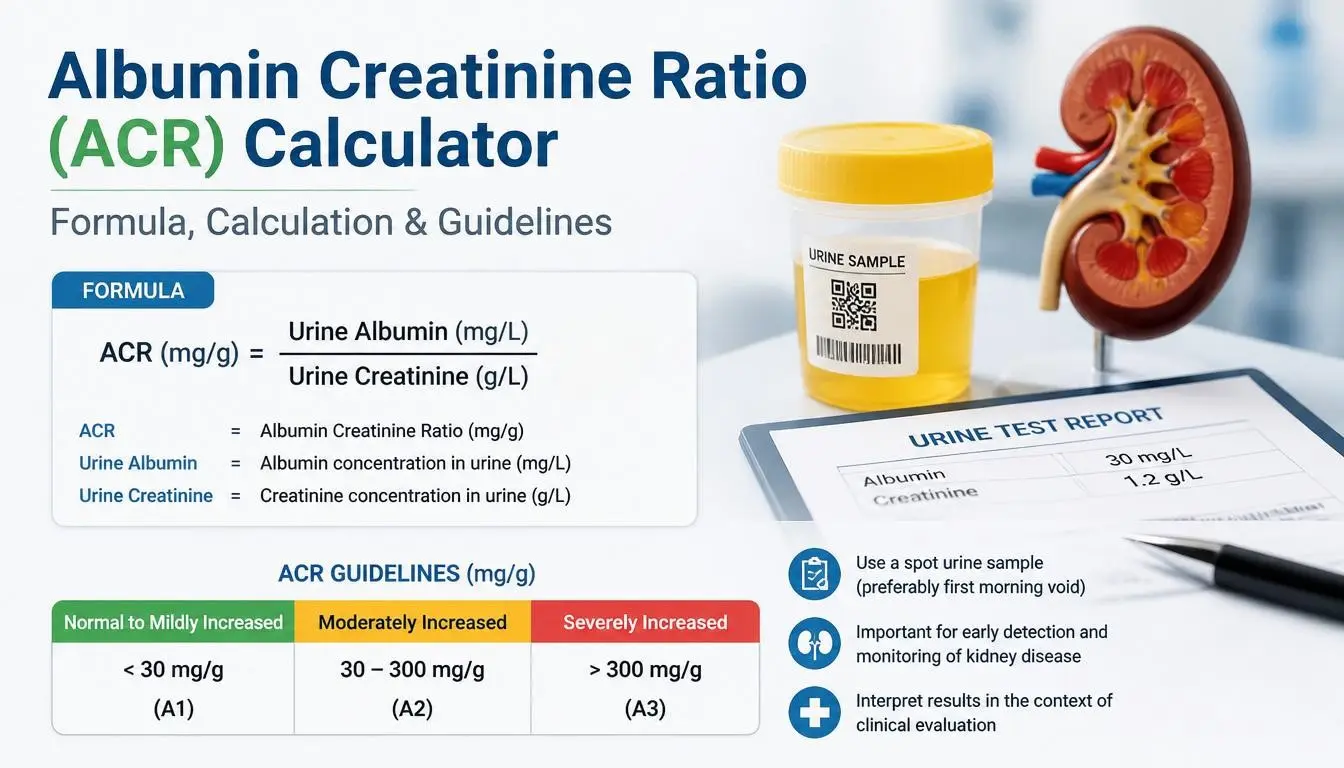
Urinary albumin and urinary creatinine are measured independently using validated laboratory methods. The ratio is then calculated as: ACR = Urine Albumin ÷ Urine Creatinine. The creatinine concentration compensates for urine dilution or concentration, making the result more representative of true albumin excretion.
Mathematical Formulas
SI Units: $$ACR\ (mg/mmol) = \frac{Albumin\ (mg/L)}{Creatinine\ (mmol/L)}$$
Conventional Units: $$ACR\ (mg/g) = \frac{Albumin\ (mg/dL) \times 1000}{Creatinine\ (mg/dL)}$$
Laboratory Reference Values & Data
Table 1: Normal Urine Albumin Reference Ranges
| Measurement Type | Reference Range |
|---|---|
| Random urine albumin | <20 mg/L |
| 24-hour urine albumin | <30 mg/day |
| Albumin excretion rate | <20 µg/min |
Table 2: Microalbuminuria (Moderately Increased Albuminuria)
| Measurement Type | Value Threshold Range |
|---|---|
| Random urine | 20–200 mg/L* |
| 24-hour urine | 30–300 mg/day |
| Albumin excretion rate | 20–200 µg/min |
*Many laboratories now prefer reporting ACR categories rather than isolated urine albumin concentrations because concentration alone is affected by urine dilution.
Table 3: Macroalbuminuria (Severely Increased)
| Measurement Type | Value Threshold |
|---|---|
| 24-hour urine | >300 mg/day |
| Albumin excretion rate | >200 µg/min |
Table 4: Normal Urine Creatinine Values
| Patient Cohort Group | Spot Urine Range | 24-Hour Urine Range |
|---|---|---|
| Adult Male | 20–320 mg/dL | 800–2,000 mg/day |
| Adult Female | 20–275 mg/dL | 600–1,800 mg/day |
Table 5: Normal Albumin Creatinine Ratio (KDIGO Guidelines)
| Category | mg/g Range | mg/mmol Range | Clinical Interpretation |
|---|---|---|---|
| A1 | <30 | <3 | Normal to mildly increased |
| A2 | 30–300 | 3–30 | Moderately increased (Microalbuminuria) |
| A3 | >300 | >30 | Severely increased (Macroalbuminuria) |
Specimen Requirements
| Parameter | Clinical Protocols & Stability Standardizations |
|---|---|
| Preferred Specimen | First morning urine (preferred) or random spot urine collection |
| Acceptable Specimen | Fresh urine, midstream clean-catch urine sample matrix |
| Specimen Volume | 10–20 mL required capacity volume |
| Container | Sterile, leak-proof urine plastic specimen container |
| Stability Profile | Room Temp: 2–4 hours | Refrigerated (2–8°C): 7 days | Frozen (-20°C): Months (Avoid cycles) |
Laboratory Methods & Precision Matrices
Albumin Measurement: Analytical methods include Immunoturbidimetric assays, Immunonephelometric assays, Immunoassays, and High-sensitivity immunochemical methods.
Creatinine Measurement: Laboratories rely mostly on Jaffe kinetic methods and enzymatic creatinine assays. Enzymatic configurations provide significantly higher specificity and lower interference profiles.
Quality Control Guidelines:
- Daily QC checks execution using two absolute concentration levels.
- Continuous active participation in External Quality Assessment programs (EQA/PT).
- Acceptable analytical precision margins: Albumin CV <5% | Creatinine CV <3%.
Pre-Analytical Considerations & Limitations
Several transient physiological conditions can artificially inflate urinary albumin levels. Testing windows should be deferred if a patient experiences vigorous exercise, high fever, acute infection or UTI, menstruation, heavy pregnancy stress, severe sudden hypertension, unmanaged acute heart failure, or severe dehydration cascades.
Interpretation & Reporting Paradigms
- Normal (A1): No significant albuminuria flagged. Recommend typical routine periodic screening workflows.
- Moderately Increased (A2): Schedule dynamic confirmation re-test windows within 3–6 months. Persistent confirmation across 2 out of 3 total tests over time establishes chronic microalbuminuria diagnosis. Correlate carefully alongside eGFR, Serum Creatinine, and HbA1c metrics.
- Severely Increased (A3): Consistent clear indicator of significant operational renal damage. Immediate nephrology referral, comprehensive target organ checks, and active structural diagnostic evaluation are highly recommended.
Frequently Asked Questions
ACR stands for Albumin-to-Creatinine Ratio, which tracks only albumin—the highly specific tiny protein that spills into urine during early kidney stress. PCR stands for Protein-to-Creatinine Ratio, which measures all proteins in the urine. ACR is preferred for early screening, whereas PCR is more useful for advanced or severe kidney disease diagnostics.
Standard dipstick tests can easily miss low concentrations of protein (microalbuminuria) and are highly prone to false positives or negatives depending on how hydrated you are. The ACR is highly sensitive and directly corrects for your hydration level using your urine creatinine concentration as an internal baseline.
A first-morning sample is more concentrated and less affected by variations in daytime physical activity or fluid intake. This minimizes transient spikes in protein excretion and provides a stable, reproducible baseline configuration.
Creatinine is a byproduct of muscle breakdown that is filtered out by your body at a relatively steady rate. By dividing your urine albumin by urine creatinine, the calculator cancels out variations caused by high fluid intake or mild dehydration, keeping the final reading highly accurate.
Yes. Red blood cells and menstrual fluids contain albumin. If they contaminate a urine collection, they can cause a false-positive reading. Testing should be delayed until after your menstrual cycle has completely finished.
Yes. Strenuous physical exertion transiently changes how your kidneys filter blood, which can lead to mild, harmless protein leakage. It is best to avoid intense workouts for 24 hours before your urine collection.
While dehydration increases the concentration of both albumin and creatinine, the mathematical ratio between them remains mostly steady. However, severe dehydration can impact kidney blood flow and may require cautious interpretation.
An elevated reading should be confirmed with a follow-up test within 3 to 6 months. A formal diagnosis of microalbuminuria generally requires at least two out of three abnormal spot samples over this period.
No fasting is required for a random spot urine collection. However, maintaining your typical, steady daily hydration routine is highly recommended to avoid extreme readings.
Major medical guidelines recommend an ACR check at the time of your type 2 diabetes diagnosis, followed by routine annual screenings to catch early signs of diabetic kidney complications.
Yes, for most screening scenarios. 24-hour urine collections are cumbersome and frequently prone to missing samples or collection timing errors. A random spot morning ACR test delivers comparable diagnostic accuracy with far more convenience.
Yes. Blood pressure medications like ACE inhibitors and ARBs, as well as modern diabetes medications like SGLT2 inhibitors, help protect your kidneys and can actively lower your urinary albumin levels.
References and Sources
- KDIGO 2024 Clinical Practice Guideline for the Evaluation and Management of Chronic Kidney Disease. Kidney Disease: Improving Global Outcomes (KDIGO). KDIGO CKD Guidelines – (accessed on July 04, 2026)
- American Diabetes Association (2026). Standards of Care in Diabetes—2026. Diabetes Care. ADA Standards of Care – (accessed on July 04, 2026)
- National Kidney Foundation (NKF). Urine Albumin-Creatinine Ratio (uACR) Test Information. NKF uACR Guide – (accessed on July 04, 2026)
- National Institute for Health and Care Excellence (NICE). Chronic Kidney Disease: Assessment and Management (NG203). NICE CKD Guideline NG203 – (accessed on July 04, 2026)
- National Institute of Diabetes and Digestive and Kidney Diseases (NIDDK). Urine Albumin-Creatinine Ratio (uACR). NIDDK Kidney Information – (accessed on July 04, 2026)
- Clinical and Laboratory Standards Institute (CLSI). Urinalysis; Approved Guideline (GP16). CLSI GP16 Guideline – (accessed on July 04, 2026)
- International Federation of Clinical Chemistry (IFCC). Recommendations for Urinary Albumin Measurement Standardization. IFCC Official Site – (accessed on July 04, 2026)
- World Health Organization (WHO). Prevention and Control of Chronic Kidney Disease in Adults. WHO Health Information – (accessed on July 04, 2026)
- European Federation of Clinical Chemistry and Laboratory Medicine (EFLM). Biological Variation Database and Urine Analytes. EFLM Resources – (accessed on July 04, 2026)
- UK Kidney Association. Clinical Practice Guideline on the Detection and Management of Chronic Kidney Disease. UKKA Guidelines – (accessed on July 04, 2026)
- National Institute of Health (NIH). Kidney Disease and Albuminuria Clinical Overview. NIH Official Portal – (accessed on July 04, 2026)
- Urine Albumin-Creatinine Ratio (uACR). Cleveland Clinic – (accessed on July 04, 2026)
- Microalbumin: Reference Range, Interpretation, Collection and Panels. Medscape – (accessed on July 04, 2026)
- Albumin Creatinine Ratio Calculator. Omni Calculator – (accessed on July 04, 2026)
