
- Questions0
- LevelIntermediate
- FlashcardsAvailable
- AccessFree
- Section
- Laboratory
- Subject
- Hematology
- Best for
- StudentsLab ProfessionalsExam Candidates
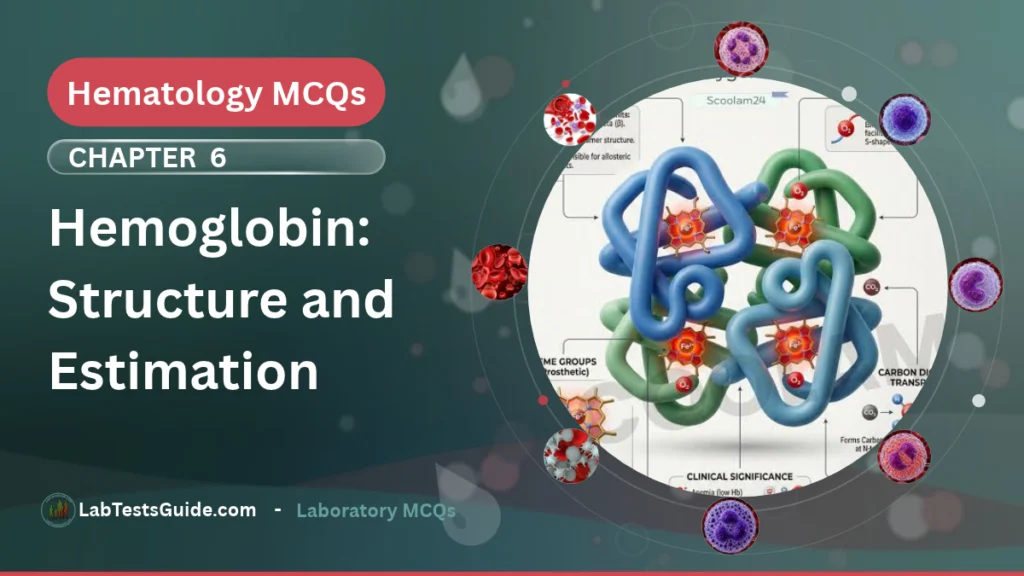
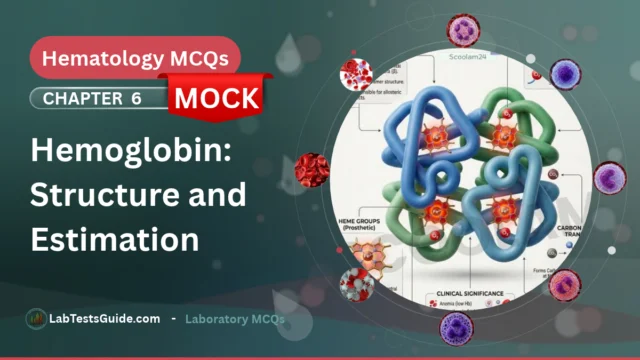
This chapter has 50 MCQs on hemoglobin and how it is measured. Questions cover the structure of hemoglobin (heme, iron and four globin chains), the normal hemoglobins of adults, the fetus and the embryo, an overview of heme and globin synthesis, oxygen transport and the oxygen dissociation curve with 2,3-BPG and the Bohr effect, the abnormal pigments methemoglobin, carboxyhemoglobin and sulfhemoglobin, and the methods for estimating hemoglobin: cyanmethemoglobin (Drabkin’s), sodium lauryl sulfate, alkaline hematin, Sahli’s acid hematin, point-of-care meters and copper sulfate screening, with their sources of error.
It is written for lab students, practising hematology staff and exam candidates. Answer each question first, then read the explanation. When you finish, take the mock test.
Notes
- Each hemoglobin molecule has four globin chains and four heme groups; each heme holds one iron atom in the ferrous (Fe2+) state, so one molecule can carry four oxygen molecules.
- Normal adult hemoglobins: HbA (α2β2) about 95–98%, HbA2 (α2δ2) about 2–3.5%, HbF (α2γ2) under 1%. HbF is the main hemoglobin before birth and holds oxygen more tightly.
- The curve shifts to the right (oxygen released more easily) with more 2,3-BPG, acid (low pH), high CO2 and high temperature; it shifts to the left with HbF, carbon monoxide and alkalosis.
- Cyanmethemoglobin method: Drabkin's reagent (potassium ferricyanide and potassium cyanide) converts hemoglobin to cyanmethemoglobin, read at 540 nm. It measures all forms except sulfhemoglobin and is the international reference method. Cyanide reagent needs safe handling and disposal.
- Turbidity from very high white cell counts, lipemia or abnormal proteins gives a falsely high result; Sahli's acid hematin method is simple but inaccurate, because it is read by eye and misses some pigments.
Related Chapters
Hematology MCQs: Hematopoiesis and Bone Marrow Structure
This chapter has 50 MCQs on hematopoiesis, the making of blood cells, and the structure of the bone marrow. Questions cover the hematopoietic stem…
Hematology MCQs: Blood Cell Counts and Hemocytometer
This chapter has 50 MCQs on manual blood cell counts. Questions cover the improved Neubauer counting chamber (ruling, squares, area and depth), charging the…
Hematology MCQs: Staining Techniques
This chapter has 50 MCQs on the staining techniques used in hematology. Questions cover Romanowsky stains (Leishman, Giemsa, Wright and Field), the role of…
Hematology MCQs: Blood Specimens and Anticoagulants
This chapter has 50 MCQs on the specimens and anticoagulants used in hematology. Questions cover whole blood, venous and capillary samples, how each anticoagulant…
Discussion 0