
- Questions0
- LevelIntermediate
- FlashcardsAvailable
- AccessFree
- Section
- Laboratory
- Subject
- Hematology
- Best for
- StudentsLab ProfessionalsExam Candidates
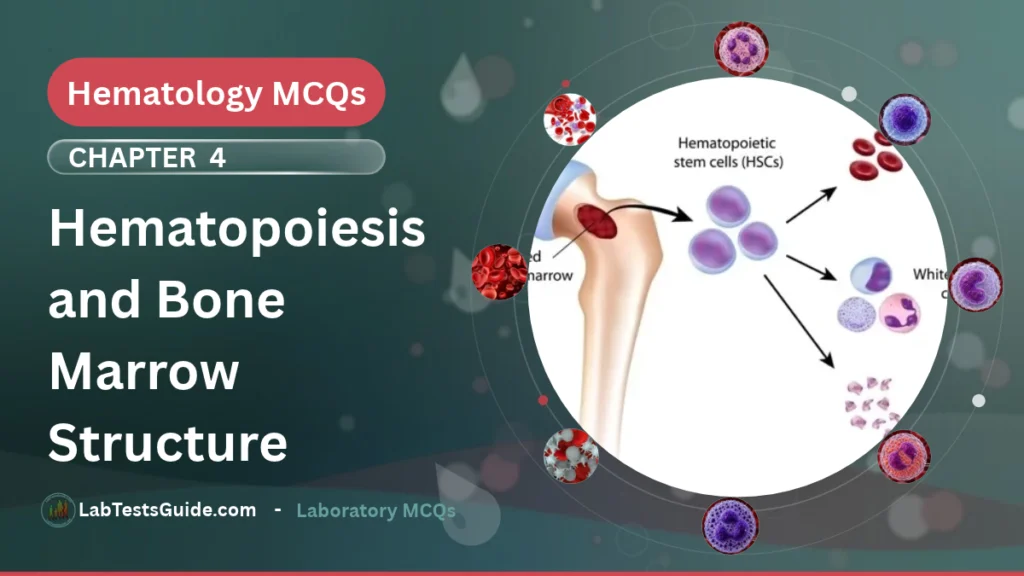
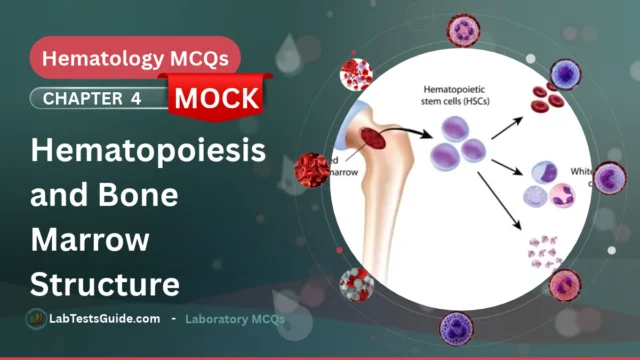
This chapter has 50 MCQs on hematopoiesis, the making of blood cells, and the structure of the bone marrow. Questions cover the hematopoietic stem cell and its CD34 marker, the sites of blood formation from the embryo to the adult, red and yellow marrow, the marrow stroma and stem cell niche, extramedullary hematopoiesis, growth factors such as erythropoietin, thrombopoietin and the colony-stimulating factors, the myeloid and lymphoid lines, the maturation stages of red cells, granulocytes, monocytes and megakaryocytes, and the changes a cell goes through as it matures.
It is written for lab students, practising hematology staff and exam candidates. Answer each question first, then read the explanation. When you finish, take the mock test.
Notes
- Sites by age: yolk sac in the early embryo, then liver (with some spleen) in the fetus, then bone marrow from mid-pregnancy onwards. In adults, active red marrow is mainly in the skull, vertebrae, ribs, sternum, pelvis and the ends of the long bones.
- Erythropoietin is made mainly by the kidney in response to low oxygen; thrombopoietin, made mainly by the liver, drives platelet production; G-CSF stimulates neutrophil production.
- Learn the red cell series in order: pronormoblast, basophilic normoblast, polychromatic normoblast, orthochromatic normoblast, reticulocyte, mature red cell. The nucleus is pushed out at the orthochromatic stage.
- Learn the granulocyte series in order: myeloblast, promyelocyte, myelocyte, metamyelocyte, band, segmented neutrophil. Specific granules first appear at the myelocyte stage.
- As cells mature they become smaller, the nucleus condenses and loses its nucleoli, the nucleus-to-cytoplasm ratio falls and the cytoplasm becomes less blue. Megakaryocytes are the exception: they grow larger by endomitosis and shed platelets.
Related Chapters
Hematology MCQs: Hemoglobin: Structure and Estimation
This chapter has 50 MCQs on hemoglobin and how it is measured. Questions cover the structure of hemoglobin (heme, iron and four globin chains),…
Hematology MCQs: Blood Cell Counts and Hemocytometer
This chapter has 50 MCQs on manual blood cell counts. Questions cover the improved Neubauer counting chamber (ruling, squares, area and depth), charging the…
Hematology MCQs: Staining Techniques
This chapter has 50 MCQs on the staining techniques used in hematology. Questions cover Romanowsky stains (Leishman, Giemsa, Wright and Field), the role of…
Hematology MCQs: Blood Specimens and Anticoagulants
This chapter has 50 MCQs on the specimens and anticoagulants used in hematology. Questions cover whole blood, venous and capillary samples, how each anticoagulant…
Discussion 0