

Quick Overview
Calcitonin vs Parathyroid Hormone: Calcitonin and parathyroid hormone are two hormones that play opposite roles in regulating calcium levels in the body.
- CategoryDifference Between
- Read time12 min
- UpdatedApr 2023
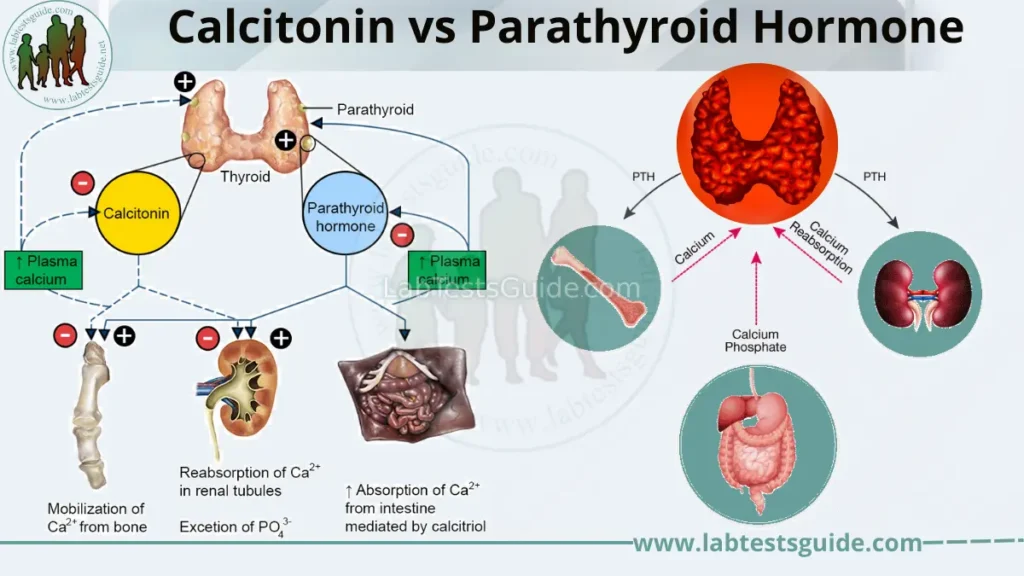
Table of Contents
Differences | Similarities | Definations | Functions | Clinical Significance
Calcitonin vs Parathyroid Hormone: Calcitonin and parathyroid hormone are two hormones that play opposite roles in regulating calcium levels in the body. Calcitonin works to decrease blood calcium levels by inhibiting bone breakdown and increasing calcium excretion by the kidneys, while parathyroid hormone works to increase blood calcium levels by stimulating bone breakdown and increasing calcium absorption by the intestines and kidneys.

Calcitonin:
Definition of Calcitonin:
Calcitonin is a hormone produced by the thyroid gland that works to decrease blood calcium levels by inhibiting bone breakdown and increasing calcium excretion by the kidneys.
Functions of Calcitonin:
- Decrease blood calcium levels: Calcitonin works to lower the concentration of calcium in the blood by reducing bone resorption, which is the process of breaking down bone tissue and releasing calcium into the blood.
- Inhibit osteoclast activity: Calcitonin inhibits the activity of osteoclasts, which are cells responsible for breaking down bone tissue.
- Increase calcium excretion by the kidneys: Calcitonin increases the amount of calcium excreted by the kidneys, which helps to decrease calcium levels in the blood.
- Stimulate bone formation: Although not as well understood as its other functions, calcitonin may also play a role in stimulating bone formation.
Regulations of Calcitonin:
- Blood calcium levels: Calcitonin secretion is primarily regulated by the concentration of calcium in the blood. When blood calcium levels rise, calcitonin secretion increases, which helps to bring the levels back down.
- Vitamin D: High levels of vitamin D can increase calcitonin secretion.
- Estrogen: Estrogen can stimulate calcitonin secretion, and postmenopausal women have been found to have lower calcitonin levels than premenopausal women.
- Glucocorticoids: Glucocorticoids, such as cortisol, can inhibit calcitonin secretion.
- Gastrin-releasing peptide (GRP): GRP can stimulate calcitonin secretion in certain types of lung cancer.
Effects on the Body:
- Decreased blood calcium levels: Calcitonin works to decrease blood calcium levels by inhibiting bone resorption and increasing calcium excretion by the kidneys.
- Inhibition of osteoclast activity: Calcitonin inhibits the activity of osteoclasts, the cells responsible for breaking down bone tissue, thereby decreasing bone resorption.
- Increased bone mineral density: Because calcitonin inhibits bone resorption, it can increase bone mineral density and help to prevent osteoporosis.
- Decreased calcium absorption in the intestines: Calcitonin can reduce calcium absorption in the intestines, which can help to lower blood calcium levels.
- Reduced kidney stone formation: Calcitonin can reduce the formation of kidney stones by decreasing the amount of calcium in the urine.
- Analgesic effects: Calcitonin has been found to have analgesic (pain-relieving) effects in certain conditions, such as osteoporotic fractures and cancer-related bone pain.
Parathyroid Hormone:
Definition of Parathyroid Hormone:
Parathyroid hormone (PTH) is a hormone produced by the parathyroid glands that helps to regulate calcium and phosphorus levels in the body.
Functions of Parathyroid Hormone:
- Increase blood calcium levels: Parathyroid hormone works to increase blood calcium levels by stimulating the release of calcium from bone tissue and increasing calcium absorption in the intestines.
- Decrease blood phosphorus levels: PTH decreases blood phosphorus levels by promoting excretion of phosphorus by the kidneys and reducing its absorption in the intestines.
- Stimulate osteoclast activity: PTH stimulates the activity of osteoclasts, the cells responsible for breaking down bone tissue and releasing calcium into the blood.
- Increase kidney reabsorption of calcium: PTH increases the reabsorption of calcium in the kidneys, which helps to conserve calcium in the body.
- Activate vitamin D: PTH stimulates the conversion of vitamin D to its active form, which increases calcium absorption in the intestines and helps to maintain calcium homeostasis.
- Regulate muscle and nerve function: Calcium plays a crucial role in muscle and nerve function, and PTH helps to regulate these processes by maintaining appropriate levels of calcium in the blood.
Regulations of Parathyroid Hormone:
- Blood calcium levels: Parathyroid hormone secretion is primarily regulated by the concentration of calcium in the blood. When blood calcium levels drop, parathyroid hormone secretion increases, which helps to bring the levels back up.
- Vitamin D: Vitamin D can indirectly regulate parathyroid hormone secretion by increasing calcium absorption in the intestines, which can help to reduce the need for parathyroid hormone secretion.
- Magnesium: Magnesium can regulate parathyroid hormone secretion by binding to and activating the calcium-sensing receptor, which inhibits parathyroid hormone secretion.
- Phosphate: High levels of phosphate can suppress parathyroid hormone secretion.
- Calcitriol: Calcitriol (the active form of vitamin D) can suppress parathyroid hormone secretion by inhibiting parathyroid hormone gene transcription.
Effects on the Body:
- Increased blood calcium levels: Parathyroid hormone works to increase blood calcium levels by promoting the release of calcium from bone tissue, increasing calcium absorption in the intestines, and increasing the reabsorption of calcium in the kidneys.
- Decreased blood phosphorus levels: Parathyroid hormone decreases blood phosphorus levels by promoting the excretion of phosphorus by the kidneys and reducing its absorption in the intestines.
- Stimulated bone resorption: Parathyroid hormone stimulates the activity of osteoclasts, the cells responsible for breaking down bone tissue and releasing calcium into the blood.
- Increased vitamin D activation: Parathyroid hormone promotes the conversion of vitamin D to its active form, which increases calcium absorption in the intestines and helps to maintain calcium homeostasis.
- Regulated muscle and nerve function: Calcium plays a crucial role in muscle and nerve function, and parathyroid hormone helps to regulate these processes by maintaining appropriate levels of calcium in the blood. However, excessive parathyroid hormone secretion can lead to hypercalcemia, which can cause muscle weakness, fatigue, and other symptoms.
Differences between Calcitonin and Parathyroid Hormone:
- Source: Calcitonin is produced by the C-cells of the thyroid gland, while parathyroid hormone is produced by the parathyroid glands.
- Function: Calcitonin primarily works to decrease blood calcium levels, while parathyroid hormone primarily works to increase blood calcium levels.
- Regulation: Calcitonin secretion is primarily regulated by high blood calcium levels, while parathyroid hormone secretion is primarily regulated by low blood calcium levels.
- Target organs/tissues: Calcitonin acts primarily on bone tissue and the kidneys, while parathyroid hormone acts on bone tissue, the kidneys, and the intestines.
- Effects on bone tissue: Calcitonin inhibits osteoclast activity and bone resorption, while parathyroid hormone stimulates osteoclast activity and bone resorption.
- Effects on calcium absorption: Calcitonin decreases calcium absorption in the intestines, while parathyroid hormone increases calcium absorption in the intestines.
- Effects on calcium excretion: Calcitonin increases calcium excretion by the kidneys, while parathyroid hormone decreases calcium excretion by the kidneys.
- Effects on phosphorus levels: Calcitonin has little effect on phosphorus levels, while parathyroid hormone decreases blood phosphorus levels.
- Effects on vitamin D: Calcitonin has little effect on vitamin D, while parathyroid hormone promotes the activation of vitamin D.
- Role in bone metabolism: Calcitonin plays a minor role in bone metabolism, while parathyroid hormone is a key regulator of bone metabolism.
- Role in calcium homeostasis: Calcitonin and parathyroid hormone have opposing effects on calcium metabolism and work together to maintain calcium homeostasis in the body.
- Clinical use: Calcitonin is used clinically to treat hypercalcemia and some types of bone loss disorders, while parathyroid hormone is used clinically to treat hypocalcemia and osteoporosis.
- Associated diseases: Calcitonin is associated with medullary thyroid carcinoma (MTC), while parathyroid hormone is associated with hyperparathyroidism and hypoparathyroidism.
- Molecular structure: Calcitonin is a peptide hormone composed of 32 amino acids, while parathyroid hormone is a peptide hormone composed of 84 amino acids.
- Evolutionary history: Calcitonin is found in fish, amphibians, and some reptiles, while parathyroid hormone is only found in mammals and evolved relatively recently in mammalian evolution.
- Effect on bone resorption: Calcitonin inhibits bone resorption by decreasing the number and activity of osteoclasts, while parathyroid hormone stimulates bone resorption by increasing the number and activity of osteoclasts.
- Effect on bone formation: Calcitonin may promote bone formation by stimulating the activity of osteoblasts, while parathyroid hormone also has some stimulatory effects on osteoblasts, but mainly acts on osteoclasts.
- Regulation by other hormones: Calcitonin secretion may be inhibited by other hormones such as glucocorticoids and estrogen, while parathyroid hormone secretion may be stimulated by low levels of magnesium and phosphate ions.
Table of Differences:
| Feature | Calcitonin | Parathyroid Hormone |
|---|---|---|
| Source | C-cells of thyroid gland | Parathyroid glands |
| Function | Decrease blood calcium levels | Increase blood calcium levels |
| Regulation | High blood calcium levels | Low blood calcium levels |
| Target organs/tissues | Bone tissue and kidneys | Bone tissue, kidneys, and intestines |
| Effects on bone tissue | Inhibits osteoclast activity and bone resorption | Stimulates osteoclast activity and bone resorption |
| Calcium absorption | Decreases calcium absorption in the intestines | Increases calcium absorption in the intestines |
| Calcium excretion | Increases calcium excretion by the kidneys | Decreases calcium excretion by the kidneys |
| Phosphorus levels | Little effect | Decreases blood phosphorus levels |
| Vitamin D | Little effect | Promotes activation of vitamin D |
| Role in bone metabolism | Minor role | Key regulator |
| Role in calcium homeostasis | Opposing effects, work together to maintain calcium balance | Opposing effects, work together to maintain calcium balance |
| Clinical use | Treat hypercalcemia and bone loss disorders | Treat hypocalcemia and osteoporosis |
| Associated diseases | Medullary thyroid carcinoma (MTC) | Hyperparathyroidism and hypoparathyroidism |
| Molecular structure | 32 amino acids | 84 amino acids |
| Evolutionary history | Found in fish, amphibians, and some reptiles | Only found in mammals, evolved relatively recently |
| Effect on bone resorption | Inhibits bone resorption | Stimulates bone resorption |
| Effect on bone formation | May promote bone formation | Has some stimulatory effects on osteoblasts, mainly acts on osteoclasts |
| Regulation by other hormones | Inhibited by glucocorticoids and estrogen | Stimulated by low levels of magnesium and phosphate ions |
Similarities between Calcitonin and Parathyroid Hormone:
- Both hormones are involved in the regulation of calcium levels in the body.
- They are both peptide hormones that are synthesized in specific glands.
- Both hormones are released in response to changes in blood calcium levels.
- They both have effects on bone tissue, with calcitonin inhibiting osteoclast activity and parathyroid hormone stimulating it.
- Both hormones have effects on the kidneys, with calcitonin increasing calcium excretion and parathyroid hormone decreasing it.
- Both hormones have some effects on the intestines, with calcitonin decreasing calcium absorption and parathyroid hormone increasing it.
- Both hormones are involved in maintaining calcium balance in the body.
- Both hormones are regulated by feedback mechanisms to maintain appropriate blood calcium levels.
- Both hormones have clinical uses in the treatment of bone disorders.
- They both play a role in the regulation of vitamin D metabolism.
- Both hormones have been identified in non-mammalian species, indicating a conserved function throughout evolution.
- Both hormones have been found to have some effects on bone formation, although the mechanisms are not well understood.
- They are both part of a complex system of hormonal and cellular interactions that regulate bone metabolism.
- Both hormones have been studied extensively in the context of osteoporosis and bone loss disorders.
- Both hormones have been associated with diseases of the parathyroid gland, including hyperparathyroidism and hypoparathyroidism.
Table of Similarities:
| Feature | Similarity |
|---|---|
| Regulation of calcium levels | Both hormones regulate calcium levels in the body |
| Peptide hormone | Both hormones are peptide hormones |
| Synthesized in specific glands | Calcitonin is synthesized in the C-cells of the thyroid gland, while parathyroid hormone is synthesized in the parathyroid glands |
| Response to changes in blood calcium levels | Both hormones are released in response to changes in blood calcium levels |
| Effects on bone tissue | Calcitonin inhibits osteoclast activity and parathyroid hormone stimulates it |
| Effects on the kidneys | Calcitonin increases calcium excretion and parathyroid hormone decreases it |
| Effects on the intestines | Calcitonin decreases calcium absorption and parathyroid hormone increases it |
| Role in maintaining calcium balance | Both hormones play a role in maintaining calcium balance in the body |
| Feedback mechanisms | Both hormones are regulated by feedback mechanisms to maintain appropriate blood calcium levels |
| Clinical uses | Both hormones have clinical uses in the treatment of bone disorders |
| Regulation of vitamin D metabolism | Both hormones are involved in the regulation of vitamin D metabolism |
| Evolutionary conservation | Both hormones have been identified in non-mammalian species, indicating a conserved function throughout evolution |
| Effects on bone formation | Both hormones have been found to have some effects on bone formation, although the mechanisms are not well understood |
| Complex regulation of bone metabolism | Both hormones are part of a complex system of hormonal and cellular interactions that regulate bone metabolism |
| Associated diseases | Both hormones have been associated with diseases of the parathyroid gland, including hyperparathyroidism and hypoparathyroidism |
Clinical Significance:
Disorders of Calcitonin:
- Medullary thyroid carcinoma (MTC): a rare type of thyroid cancer that can cause an overproduction of calcitonin
- Hypocalcemia: low calcium levels in the blood due to overproduction of calcitonin or other factors
- Osteoporosis: a condition where bones become weak and brittle due to reduced bone density, which can be a side effect of long-term use of calcitonin for treatment
Disorders of Parathyroid Hormone:
- Hyperparathyroidism: a condition where the parathyroid gland produces too much PTH, resulting in high levels of calcium in the blood
- Hypoparathyroidism: a condition where the parathyroid gland does not produce enough PTH, resulting in low levels of calcium in the blood
- Osteoporosis: chronic hyperparathyroidism can cause bone loss and increase the risk of fractures
FAQs:
What is calcitonin?
A: Calcitonin is a hormone that regulates calcium levels in the body. It is produced by the C-cells of the thyroid gland.
What is parathyroid hormone?
A: Parathyroid hormone is a hormone that regulates calcium levels in the body. It is produced by the parathyroid glands.
How do calcitonin and parathyroid hormone regulate calcium levels?
A: Calcitonin lowers blood calcium levels by inhibiting osteoclast activity and increasing calcium excretion in the kidneys, while parathyroid hormone raises blood calcium levels by stimulating osteoclast activity and decreasing calcium excretion in the kidneys.
What are the clinical uses of calcitonin?
A: Calcitonin is used clinically to treat osteoporosis, hypercalcemia, and Paget’s disease of bone.
What are the clinical uses of parathyroid hormone?
A: Parathyroid hormone is used clinically to treat osteoporosis and hypoparathyroidism.
How are calcitonin and parathyroid hormone regulated?
A: Both hormones are regulated by feedback mechanisms in response to changes in blood calcium levels.
What is the role of vitamin D in calcium regulation?
A: Vitamin D helps to increase calcium absorption in the intestines and decreases calcium excretion in the kidneys.
How do calcitonin and parathyroid hormone affect vitamin D metabolism?
A: Calcitonin inhibits vitamin D synthesis in the kidneys, while parathyroid hormone stimulates it.
What are the effects of calcitonin on bone tissue?
A: Calcitonin inhibits osteoclast activity, which decreases bone resorption and turnover.
What are the effects of parathyroid hormone on bone tissue?
A: Parathyroid hormone stimulates osteoclast activity, which increases bone resorption and turnover.
What are the effects of calcitonin and parathyroid hormone on the kidneys?
A: Calcitonin increases calcium excretion in the kidneys, while parathyroid hormone decreases it.
What are the effects of calcitonin and parathyroid hormone on the intestines?
A: Calcitonin decreases calcium absorption in the intestines, while parathyroid hormone increases it.
Are calcitonin and parathyroid hormone related to each other?
A: Calcitonin and parathyroid hormone have opposite effects on calcium regulation and are produced by different glands in the body.
Are calcitonin and parathyroid hormone peptide hormones?
A: Yes, both hormones are peptide hormones.
What are the associated diseases of the parathyroid gland?
A: Hyperparathyroidism and hypoparathyroidism are diseases associated with the parathyroid gland.
Do calcitonin and parathyroid hormone have effects on bone formation?
A: Both hormones have been found to have some effects on bone formation, although the mechanisms are not well understood.
Are calcitonin and parathyroid hormone conserved throughout evolution?
A: Yes, both hormones have been identified in non-mammalian species, indicating a conserved function throughout evolution.
Conclusion:
In conclusion, calcitonin and parathyroid hormone are both important hormones involved in the regulation of calcium levels in the body. They have distinct functions and are produced by different glands, but they work together in a feedback mechanism to maintain homeostasis. Understanding the similarities and differences between these two hormones is important for understanding their role in health and disease, as well as the potential therapeutic applications of their manipulation.
Related
Liquid Chromatography (LC) vs Gas Chromatography (GC)
Liquid chromatography (LC) vs gas chromatography (GC), these are both widely used analytical techniques in chemistry and biochemistry for separating and analyzing compounds in…
Good vs Bad Cholesterol (HDL vs LDL): Key Differences & Heart Health
Discover the key differences between HDL (Good) and LDL (Bad) cholesterol. Learn how they function, optimal levels, and how to improve your heart health.

Agglutination vs Haemagglutination
Agglutination vs Haemagglutination: Agglutination and hemagglutination are both processes where particles clump together, but they differ in their specific contexts.
Discussion 0