

Common Insomnia Causes: What Lab Tests Can Reveal
I hear the same sentence almost every week in the clinic: “I’m exhausted, but I just can’t sleep.”
Sometimes it’s a busy professional in Sydney who lies awake thinking about work. Sometimes it’s a parent who wakes at 3 a.m. and can’t get back to sleep. And sometimes it’s someone who has done everything right, cut back on coffee, gone to bed earlier, but still feels wired at night.
If this sounds familiar, you’re definitely not alone. Sleep problems are incredibly common. Research from the Sleep Health Foundation shows that more than half of Australian adults have regular sleep symptoms, and around 1 in 7 people experience ongoing insomnia.
But many people don’t realise that insomnia usually has a reason. It’s rarely random. Your body is trying to tell you something, and once you understand insomnia causes, sleep becomes much easier.
What Insomnia Really Looks Like
When people think of insomnia, they imagine staying awake all night. But in real life, it shows up in different ways. You might:
- Take a long time to fall asleep
- Wake up in the middle of the night
- Wake too early and feel wide awake
- Feel tired even after sleeping
I often tell clients that sleep is like a conversation between your brain and your body. When something is out of balance, stress, hormones, diet, or routine, that conversation gets disrupted.
And in a busy place like Sydney, that happens more than you’d expect.
The Most Common Insomnia Causes I See in Practice
Over the years, I’ve noticed patterns. People come in thinking their sleep problem is mysterious, but it usually comes down to a few very familiar insomnia causes. Let’s talk about the ones I see most of the time.
1. Stress Is the Biggest One
This is the number one cause of insomnia in my clinic. Not caffeine. Not screens. Stress.
It doesn’t always feel dramatic. Sometimes it’s just a mind that won’t slow down. You go to bed, turn off the lights, and suddenly your brain starts replaying the day. Or planning tomorrow. Or worrying about something small that somehow feels huge at midnight.
I had a client recently, a manager in the city, who told me she felt tired all day but “switched on” the moment her head hit the pillow. Her body was exhausted, but her nervous system was still in work mode.
That’s very common. When stress hormones stay high, your body stays alert. And an alert body doesn’t sleep well.
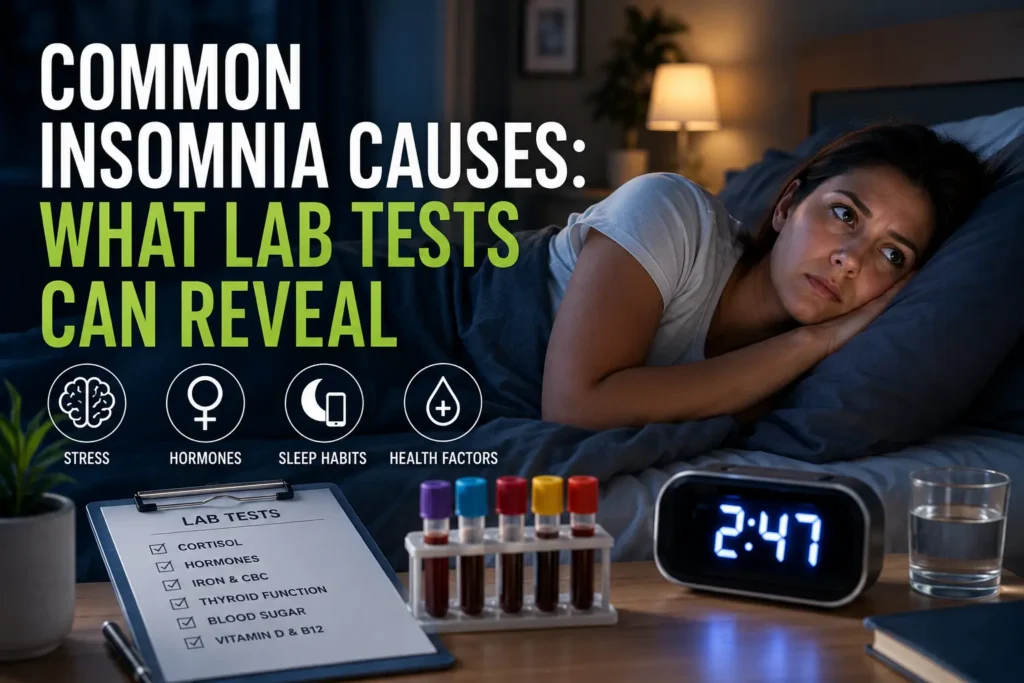
A Cortisol test – particularly a late-night salivary sample – can confirm whether stress hormones are staying raised into the evening when they should be winding down.
2. Poor Sleep Habits Sneak Up on You
Another thing is what we call sleep drift. Life gets busy, routines slip, and suddenly bedtime is all over the place.
You might:
- Stay up scrolling on your phone
- Fall asleep on the couch
- Sleep in on weekends
- Drink coffee late in the day
- Watch TV in bed
None of these habits seems like a big deal on its own. But together, they confuse your body clock. Your body loves rhythm. When that rhythm disappears, sleep usually follows. The encouraging news is that this is one of the easiest problems to fix once you notice it.
3. Hormones Play a Bigger Role Than Most People Think
I work with many women in their late 30s, 40s, and 50s who suddenly develop sleep problems out of nowhere. Often, hormones are the missing piece. Changes during perimenopause, menopause, pregnancy, or even monthly cycles can affect sleep more than people expect. Night sweats, anxiety, and temperature changes can all wake you up, sometimes multiple times a night.
A hormonal panel including Oestrogen, Progesterone, and DHEA can confirm whether these shifts are driving the sleep disruption, helping guide the right treatment approach.
4. Screens and Late-Night Stimulation Keep the Brain Awake
Modern life makes this one hard to avoid. Phones, laptops, and tablets are everywhere. Many people in Sydney finish work on a screen and then relax on another screen. The problem is that screens do two things at once: They stimulate the brain. And they delay melatonin, the hormone that helps you fall asleep. I often suggest a simple experiment: Turn off screens 30 to 60 minutes before bed for one week. Most people notice a difference surprisingly quickly.
5. Physical Health Issues Can Disrupt Sleep Quietly
Sometimes, insomnia isn’t about stress or habits at all. It’s about the body. Pain, digestion problems, breathing issues, and inflammation can all interfere with sleep, even if the symptoms seem mild during the day.
I’ve seen people struggle with sleep for years, only to discover the cause was:
- Chronic back pain
- Reflux or indigestion
- Low iron levels
- Thyroid imbalance
- Sleep apnoea
If a physical cause is suspected, a few targeted tests can help identify it. A Complete Blood Count (CBC) and Ferritin check iron stores and anaemia, TSH, Free T3, and Free T4 assess thyroid function, and a Fasting Blood Glucose (FBG) or HbA1c can reveal blood sugar issues that cause night waking. For suspected sleep apnoea, a Polysomnography (PSG) or Home Sleep Test (HST) is the next step.
6. Busy Schedules and Shift Work Make Sleep Harder
Sydney is a fast-moving city. Many people work long hours, rotating shifts, or unpredictable schedules. That kind of routine can confuse the body clock. Even small changes, such as staying up late during the week and sleeping in on weekends, can throw off your sleep rhythm.
Your body doesn’t know what time zone it’s in. And when your body clock feels lost, sleep becomes inconsistent.
Why Ignoring Insomnia Isn’t a Good Idea
Occasional sleepless nights happen to everyone. That’s normal. But ongoing sleep problems can affect your health more than people realise.
I often see clients who come in for fatigue, brain fog, or mood changes, and sleep turns out to be the real issue.
Poor sleep can lead to:
- Low energy
- Irritability
- Trouble concentrating
- Weakened immunity
- More frequent illness
Sleep is basic maintenance for your body.
Simple Things That Genuinely Help
People sometimes expect complicated solutions. But in my experience, small changes done consistently make the biggest difference. Here are the strategies I recommend most often.
Keep Your Sleep Time Consistent
Go to bed and wake up at roughly the same time each day. Your body works best when it has a steady routine.
Make Your Bedroom Sleep-Friendly
Think cool, dark, and quiet. Even small changes, like blackout curtains or a fan, can help.
Watch Your Caffeine
Many people are surprised to learn caffeine can stay in the body for 6 to 8 hours. That afternoon coffee might still be affecting your sleep.
Create a Wind-Down Routine
Your body needs a signal that the day is ending.
This might be:
- Reading
- Gentle stretching
- A warm shower
- Deep breathing
- Listening to calm music
When to See a Doctor About Insomnia
Sleep problems, or chronic insomnia, is rarely treated on its own. It is connected to stress, nutrition, hormones, and daily habits. If sleep problems are persistent, it may be worth requesting a targeted blood panel. Key markers to discuss with your doctor include Ferritin, TSH, Cortisol, Vitamin D, B12, Magnesium, and HbA1c. These cover the most common physical contributors to insomnia and are straightforward to test.
Stop Guessing. Start Sleeping.
If you’re struggling with sleep, the cause is rarely mysterious. It’s usually one of the patterns above. The first step is noticing which ones apply to you. From there, simple habit changes can make a meaningful difference, and where a physical cause is suspected, targeted lab testing can point you in the right direction. Better sleep is usually closer than it feels.
Ready to take action? Start with these 7 practical steps to fix insomnia tonight, or reach out to Kathleen McFarlane for personalised support. Naturopath Kathleen McFarlane focuses on the bigger picture.
References
- American Academy of Sleep Medicine. (2014). International classification of sleep disorders (3rd ed.). American Academy of Sleep Medicine.
- American Psychiatric Association. (2013). Diagnostic and statistical manual of mental disorders (5th ed.). https://doi.org/10.1176/appi.books.9780890425596
- Lola Health. (2026, March 16). Blood test for insomnia: The hidden physical causes of poor sleep. https://lolahealth.com/blogs/longevity/blood-test-for-insomnia
- National Heart, Lung, and Blood Institute. (n.d.). Insomnia: Diagnosis. U.S. Department of Health and Human Services. https://www.nhlbi.nih.gov/health/insomnia/diagnosis
- National Institute of Mental Health. (n.d.). Sleep disorders. U.S. Department of Health and Human Services. https://www.nimh.nih.gov/health/topics/sleep-disorders
- Sleep Health Foundation. (2019). Asleep on the job: Costs of inadequate sleep in Australia. https://www.sleephealthfoundation.org.au
- Sleep Foundation. (2025, July 10). Diagnosing insomnia. https://www.sleepfoundation.org/insomnia/diagnosis
- Stanford Health Care. (2018). Insomnia: Diagnosis. https://stanfordhealthcare.org/medical-conditions/sleep/insomnia/diagnosis.html University Hospitals. (n.d.). Overview of tests and procedures for sleep disorders. https://www.uhhospitals.org/health-information/health-and-wellness-library/article/adult-diseases-and-conditions-v1/overview-of-tests-and-procedures-for-sleep-disorders


