

- CategoryLaboratory Tests
- Read time2 min
- UpdatedJul 2024
Table of Contents
Investigation of possible acute interstitial nephritis
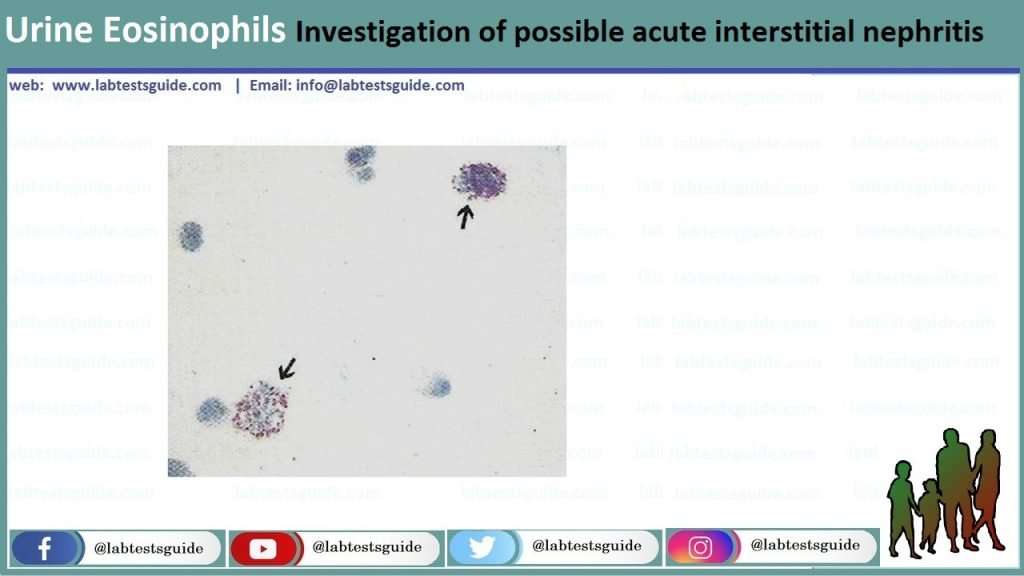
Eosinophils are white blood cells that normally do not appear in urine. The presence of eosinophils in the urine is seen in acute interstitial nephritis, which is caused by an allergic reaction, typically to drugs.
Specimen Type
Urine
Specimen Required
Container/Tube: Unstained slide
Specimen Volume: 1 slide
Collection Instructions:
- Collect a random urine specimen.
- Spin 10 mL of a random urine collection in centrifuge.
- Pour off supernatant. Assess urine sediment for presence of white blood cells (WBC). If no WBCs are seen, the eosinophil test can’t be performed. If WBCs are present, prepare slides using the spun sediment.
- Unstained slide should be prepared within 2 hours of collection.
- Centrifuge urine in cytospin centrifuge at speed of 750 rpm for 5 minutes.
- Guidelines for slide preparation. Use the sediment to prepare slides as follows:
- 150 mcL of sample for 1 to 3 WBC/high power field (hpf).
- 100 mcL of sample for moderate to normal sediment (<50 cell/hpf).
- 50 mcL of sample for heavier sediment (>50 cells/hpf).
- 25 mcL for packed fields of sediment.
Reference Values
None seen
Interpretation
Greater than 5% eosinophils indicates acute interstitial nephritis; 1% to 5% eosinophils is indeterminant.
Cautions
No significant cautionary statements.
Clinical Reference
1. Hansel FK: In Clinical Allergy. CV Mosby Co. St. Louis, 1953
2. Brunzel NA: Chapter 8: Microscopic Examination of Urine Sediment. In Fundamentals of Urine and Body Fluids Analysis. Third edition. Edited by NA Brunzel. Elsevier Saunders. St. Louis, MO, 2012, pp 171-172
Method Description
Hansel stain.(Brunzel NA: Chapter 8: Microscopic Examination of Urine Sediment. In Fundamentals of Urine and Body Fluids Analysis. Third edition. Edited by NA Brunzel. Elsevier Saunders. St. Louis, MO, 2012, pp 171-172)
PDF Report
No
Day(s) and Time(s) Test Performed
Monday through Sunday; Continuously
Analytic Time
Same day/1 day
Maximum Laboratory Time
1 day
Related Articles:
- Learn Brilliant Green Agar with 50 FAQs and 30 MCQs covering composition, principle, colony morphology, […]
- Take this Brilliant Green Agar Mock Test with 30 questions covering composition, principle, colony appearance, […]
- Learn Hektoen Enteric Agar with 50 FAQs and 30 MCQs covering composition, principle, colony characteristics, […]
- Take this Hektoen Enteric Agar Mock Test with 30 questions covering composition, principle, colony appearance, […]
- Learn Lysine Iron Agar (LIA) with 50 FAQs and 30 MCQs covering composition, principle, reactions, […]
- Take this Lysine Iron Agar (LIA) Mock Test with 30 practice questions covering lysine metabolism, […]
- Take this Martin Lewis Agar Mock Test with 30 practice questions covering composition, selective agents, […]
- Learn Martin Lewis Agar with 50 FAQs and 30 MCQs covering composition, principle, preparation, uses, […]
Related
Brilliant Green Agar FAQs and MCQs
Learn Brilliant Green Agar with 50 FAQs and 30 MCQs covering composition, principle, colony morphology, and isolation of Salmonella species.
Brilliant Green Agar MCQs Mock Test
Take this Brilliant Green Agar Mock Test with 30 questions covering composition, principle, colony appearance, and isolation of Salmonella species.

Hektoen Enteric Agar FAQs and MCQs
Learn Hektoen Enteric Agar with 50 FAQs and 30 MCQs covering composition, principle, colony characteristics, and isolation of enteric pathogens.
Discussion 0