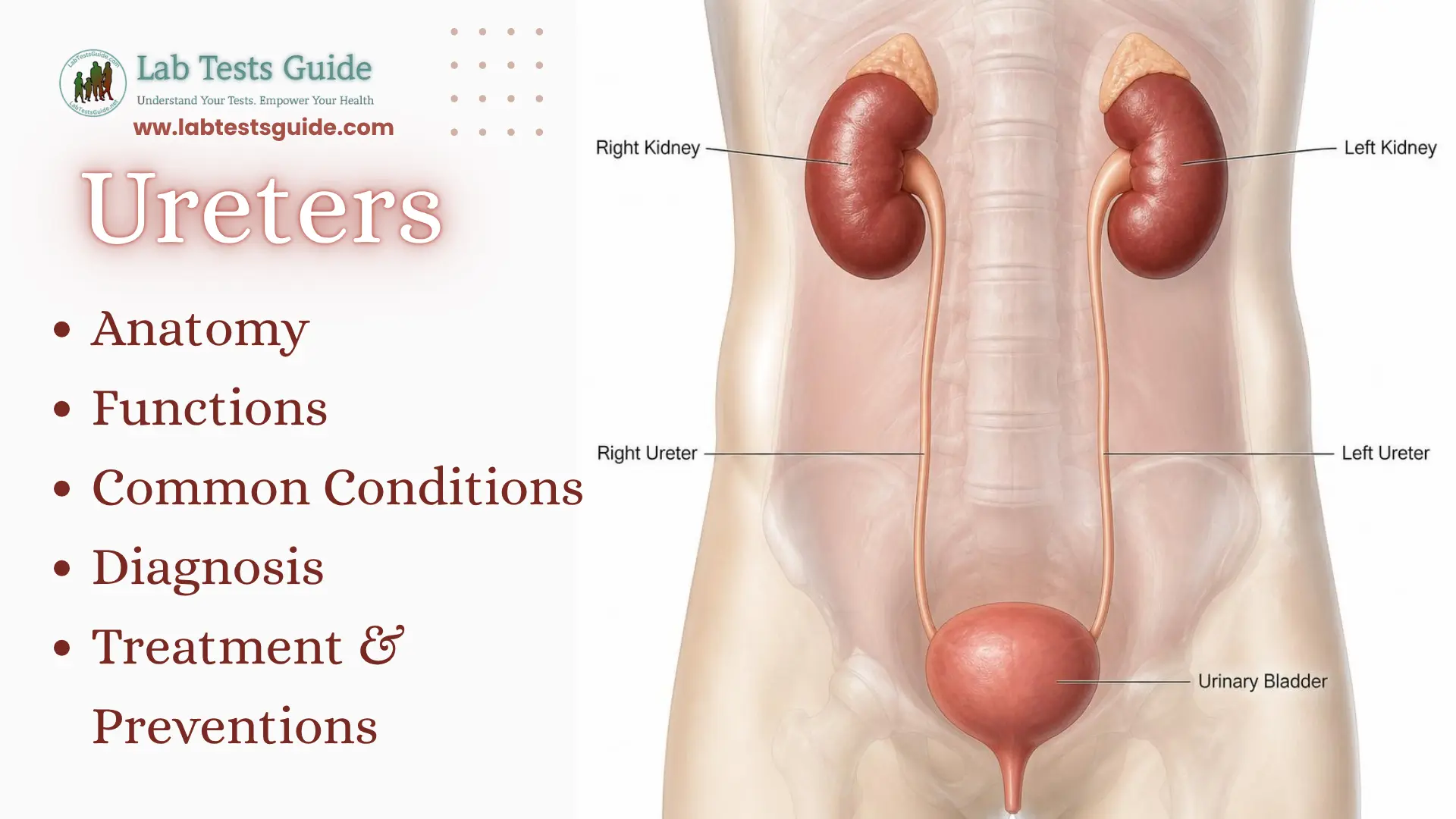
The ureters are paired muscular tubes that transport urine from the kidneys to the urinary bladder. Learn about their anatomy, functions, common problems, symptoms, diagnosis, laboratory tests, treatment, and prevention.
Ureters: Anatomy, Functions & Common Conditions
ANATOMY & CLINICAL LABORATORY GUIDE
Ureters: Anatomy, Functions & Common Conditions
The ureters are narrow muscular tubes that carry urine from the kidneys to the urinary bladder, using coordinated muscular contractions to support continuous urine transport.
01
Ureter StructurePaired muscular tubes that extend from the renal pelvis to the urinary bladder.
02
Main RoleTransport urine from the kidneys to the bladder through coordinated muscular contractions.
03
Clinical RelevanceUreteral stones, obstruction, infection, and structural abnormalities may affect normal urine flow.
Laboratory focus:
This guide provides a concise overview of ureter anatomy, function, common problems, and the laboratory tests that may be relevant when urinary tract obstruction, infection, or kidney-related problems are suspected.
01
What Are the Ureters?
The ureters are a pair of narrow, muscular tubes that carry urine from the kidneys to the urinary bladder. Each ureter begins at the renal pelvis and travels downward through the abdomen and pelvis before entering the bladder.
The ureter wall contains smooth muscle that produces coordinated contractions called peristalsis. These contractions help move urine toward the bladder even when a person is not standing or moving.
LocationExtend from the renal pelvis of each kidney through the abdomen and pelvis to the urinary bladder.
Clinical importanceUreteral stones, obstruction, infection, or structural abnormalities can interfere with normal urine flow and may affect kidney function.
02
Parts and Functions of the Ureters
Renal PelvisThe funnel-shaped area of the kidney that collects urine and continues into the ureter.
Abdominal UreterThe upper portion that descends from the renal pelvis through the abdominal region.
Pelvic UreterThe lower portion that travels through the pelvis toward the urinary bladder.
Ureterovesical JunctionThe point where the ureter enters the urinary bladder and helps limit backward flow of urine.
What do the ureters do?
The ureters transport urine from the kidneys to the urinary bladder through coordinated rhythmic contractions of their smooth muscle walls. Their passage through the bladder wall also helps reduce the backward flow of urine toward the kidneys.
03
Common Ureter Problems
Ureteral Stones
Mineral deposits that can become lodged within the ureter and obstruct the normal flow of urine from the kidney to the bladder.
Ureteral Obstruction
A blockage of the ureter that may result from stones, scar tissue, tumors, blood clots, or external pressure and can cause urine to back up toward the kidney.
Ureteritis
Inflammation of the ureter that may occur in association with urinary tract infection, irritation, or other urinary tract conditions.
Vesicoureteral Reflux
A condition in which urine flows backward from the bladder toward the ureters and, in some cases, toward the kidneys.
Clinical note:
Symptoms such as severe flank or abdominal pain, blood in the urine, painful urination, fever, nausea, or reduced urine output may occur with ureteral problems. Persistent or severe symptoms require appropriate clinical assessment.
04
Laboratory Tests and Diagnosis
Ureteral problems are evaluated using the patient’s symptoms, physical examination, urine testing, blood tests, and appropriate imaging. Laboratory testing can help identify infection, blood in the urine, impaired kidney function, or other abnormalities that may occur with obstruction or urinary tract disease.
Urinalysis
May detect blood, white blood cells, bacteria, crystals, protein, and other abnormalities that can help evaluate urinary tract problems.
Urine Culture
Helps identify bacteria causing a urinary tract infection and may guide appropriate antibiotic treatment when infection is suspected.
Kidney Function Tests
Serum creatinine and estimated glomerular filtration rate may help assess kidney function when ureteral obstruction or other urinary tract problems are suspected.
Important:
Imaging such as ultrasound, CT, or other urinary tract studies is not a laboratory test, but it may be essential for detecting ureteral stones, obstruction, dilation of the urinary tract, or structural abnormalities.
05
Ureter Symptoms and When to Seek Care
Flank or Side PainSharp or severe pain in the side or back may occur when a ureter is obstructed, particularly by a urinary stone.
Blood in UrinePink, red, or brown urine, or microscopic blood detected on urinalysis, may occur with stones or other urinary tract problems.
Painful or Frequent UrinationBurning, urgency, or increased frequency of urination may occur when a urinary tract infection or lower urinary tract irritation is present.
Nausea or VomitingNausea and vomiting may accompany severe ureteral pain, particularly during an episode of urinary stone obstruction.
When should medical advice be considered?
Seek prompt medical evaluation for severe or persistent flank pain, fever or chills with urinary symptoms, visible blood in the urine, repeated vomiting, difficulty passing urine, markedly reduced urine output, or symptoms suggesting urinary obstruction or infection. These problems may require timely assessment to protect kidney function and prevent complications.
06
How Are Ureter Problems Diagnosed?
Ureter problems are evaluated using the patient’s symptoms, medical history, physical examination, urine and blood tests, and appropriate imaging. The diagnostic approach depends on whether a urinary stone, infection, obstruction, or another structural problem is suspected.
Clinical Examination
A healthcare professional assesses pain location, urinary symptoms, fever, abdominal or flank tenderness, and other clinical findings.
Laboratory Testing
Urinalysis, urine culture, CBC, serum creatinine, and other blood tests may be considered to evaluate infection, bleeding, inflammation, or kidney function.
Imaging
Ultrasound, CT, or other urinary tract imaging may be used to identify stones, obstruction, urinary tract dilation, or structural abnormalities.
Laboratory perspective:
Urine and blood test results can provide important information about infection, bleeding, and kidney function, but laboratory findings should always be interpreted together with symptoms, examination findings, and imaging when appropriate.
07
Treatment and Prevention
Common Management
Ureteral stones may be managed with hydration, pain relief, medical therapy, or procedures depending on their size, location, and clinical circumstances.
Urinary tract infections are treated with appropriate antimicrobial therapy when infection is confirmed or clinically suspected.
Significant ureteral obstruction may require procedures to restore urine flow and protect kidney function.
Persistent, recurrent, or complicated ureteral problems may require evaluation by a urologist.
Prevention & Self-Care
Maintain adequate fluid intake unless a healthcare professional has advised fluid restriction.
Follow dietary and lifestyle recommendations appropriate for the type of urinary stone when applicable.
Seek timely evaluation for symptoms of urinary infection or possible obstruction.
Follow recommended monitoring when there is a history of recurrent stones or other urinary tract problems.
Important:
Treatment depends on the underlying cause and severity of the ureter problem. A blocked ureter, particularly when accompanied by infection or impaired kidney function, can require urgent medical treatment. More Detail about Treatment and Prevention Click Here
08
Key Takeaways & Related Laboratory Tests
The ureters are paired muscular tubes that transport urine from the kidneys to the urinary bladder. Ureteral problems such as stones, obstruction, and infection may affect normal urine flow and kidney function. Laboratory testing can help evaluate infection, blood in the urine, and kidney function when clinically indicated.
Two UretersOne ureter extends from each kidney to the urinary bladder and transports urine through coordinated muscular contractions.
Common ProblemsUreteral stones, obstruction, inflammation, and vesicoureteral reflux can interfere with normal urinary flow.
Laboratory RoleUrinalysis, urine culture, CBC, creatinine, and other kidney function tests may support evaluation when clinically indicated.
Medical Disclaimer:
This article is for general educational and laboratory information only. It does not replace professional medical advice, diagnosis, or treatment. Laboratory tests should be interpreted together with symptoms, medical history, and clinical findings by a qualified healthcare professional.
References and Sources
The Urinary Tract & How It Works. National Institute of Diabetes and Digestive and Kidney Diseases (NIDDK).
NIDDK
– (accessed on August 24, 2026)
Anatomy, Abdomen and Pelvis: Ureter. StatPearls. NCBI Bookshelf.
NCBI Bookshelf
– (accessed on August 24, 2026)
EAU Guidelines on Urolithiasis. European Association of Urology.
EAU Guidelines
– (accessed on August 24, 2026)
Urinalysis. MedlinePlus, U.S. National Library of Medicine.
MedlinePlus
– (accessed on August 24, 2026)
Ureters: Anatomy, Location, Function & Conditions. Cleveland Clinic.
Cleveland Clinic
– (accessed on August 24, 2026)
Kidney Stones: Diagnosis and Treatment. Mayo Clinic.
Mayo Clinic
– (accessed on August 24, 2026)
Obstructive Uropathy. MSD Manual Professional Edition.
MSD Manual
– (accessed on August 24, 2026)
📚 This article may have been prepared using trusted medical literature, clinical guidelines, textbooks, and peer-reviewed sources.
The website covers a wide range of lab tests, including blood tests, urine tests, stool tests, and imaging tests such as X-rays and CT scans. It also provides information about different health conditions and diseases, as well as tips for maintaining good health.
It's important to note that while labtestsguide.com may provide valuable information about lab tests and their interpretation, it's always best to consult with a healthcare professional if you have any concerns or questions about your lab results. We can provide personalized guidance and advice based on your individual health status and medical history.