

Quick Overview
Free RDW calculator: get RDW-CV from the SD of red cell size and the MCV, or the SD from RDW-CV, with MCV and RDW anemia patterns and a size distribution graph.
- Results4
- Inputs4
- Units5
- CategoryHematology
Calculator
Enter your values and choose the unit of each one. Results update as you type.

Table of Contents
The Red Cell Distribution Width (RDW) Calculator shows how much your red blood cells vary in size. Choose a Calculation: find the RDW-CV from the standard deviation (SD) of red cell volume and the mean corpuscular volume (MCV), or work back from RDW-CV to the SD. The calculator also shows the MCV category and draws the red cell size distribution.
Volumes are in femtolitres (fL), the same as cubic micrometres (µm³). Results update as you type.
What is RDW?
The MCV is the average size of your red cells. The RDW shows how much the sizes vary around that average. When red cells are all about the same size, the RDW is low; when there is a mix of small and large cells (anisocytosis), it is high.
Blood analysers measure the size of thousands of red cells and draw a size histogram. They report RDW in one or both ways:
- RDW-CV (%): the SD of red cell size divided by the MCV, × 100. This calculator works with RDW-CV.
- RDW-SD (fL): the width of the histogram measured at 20% of its height. It is measured directly and cannot be worked out exactly from RDW-CV.
RDW is most useful together with MCV. It helps to tell iron deficiency (high RDW) from thalassemia trait (often normal RDW) when red cells are small, and it often rises early in iron, vitamin B12 or folate deficiency, before the MCV changes.
How to use the calculator
- Choose a Calculation: Find RDW-CV (enter SD and MCV) or Find the SD (enter RDW-CV and MCV).
- Enter the Standard deviation of red cell volume or the RDW-CV, depending on the mode.
- Enter the MCV in fL (or µm³).
- Read the main result, the RDW category and the MCV category.
- Look at the graph: a wider bell means more variation in cell size (a higher RDW).
Practical tip
RDW ranges depend on the analyser, so compare results from the same laboratory. A blood transfusion in the last few months mixes two red cell populations and raises the RDW, so mention it to your doctor.
Formulas Explained
1. Red cell distribution width (RDW-CV)
RDW-CV (%) = SD of red cell volume (fL) ÷ MCV (fL) × 100
CV stands for coefficient of variation: the spread (SD) as a percentage of the average.
What it means: how much red cell sizes vary, as a percentage of the average size.
When it is valid: MCV above 0; SD and MCV from the same analyser run. It is less reliable when the red cell count is very low or red cell fragments or clumps are present.
Example (default values: SD 11.7 fL, MCV 90 fL): 11.7 ÷ 90 × 100 = 13%. Within the usual range.
2. Standard deviation of red cell volume (SD)
SD (fL) = RDW-CV (%) × MCV (fL) ÷ 100
What it means: the spread of red cell sizes in fL. About two thirds of red cells lie within one SD of the MCV.
Example (mode 2, RDW-CV 13%, MCV 90 fL): 13 × 90 ÷ 100 = 11.7 fL. Note that this SD is not the same as the RDW-SD on some reports, which is measured at 20% of the histogram height and is usually larger.
3. MCV category
The MCV you entered is shown with its category: microcytic (below 80 fL), normocytic (80 to 100 fL) or macrocytic (above 100 fL).
Unit conversion
| Item | Conversion | Back | Example |
|---|---|---|---|
| Volume (MCV, SD) | fL = µm³ | µm³ = fL | 90 fL = 90 µm³ |
| RDW-CV | % ÷ 100 = fraction | fraction × 100 = % | 13% = 0.13 |
Worked Example
Example 1: default values
| Result | Working | Value (SI and conventional) | Category |
|---|---|---|---|
| RDW-CV | 11.7 ÷ 90 × 100 | 13% | Within usual range |
| MCV | entered | 90 fL 90 µm³ | Normocytic |
Example 2: two people with small red cells
| Person | Working | Value | Category |
|---|---|---|---|
| A: SD 13.5 fL, MCV 70 fL | 13.5 ÷ 70 × 100 | RDW-CV 19.3% | High; microcytic |
| B: SD 9 fL, MCV 65 fL | 9 ÷ 65 × 100 | RDW-CV 13.8% | Within usual range; microcytic |
Both have small red cells. Person A's cells vary a lot in size, the usual pattern of iron deficiency. Person B's cells are small but uniform, which suggests thalassemia trait. Ferritin and hemoglobin electrophoresis confirm the cause.
Mode 2: RDW-CV 16% with MCV 105 fL gives SD = 16 × 105 ÷ 100 = 16.8 fL; high RDW with large cells suggests vitamin B12 or folate deficiency.
Interpretation
RDW-CV in adults
| RDW-CV | Category | Meaning |
|---|---|---|
| below 11.5% | Below usual range | No known clinical importance |
| 11.5% to 14.5% | Within usual range | Red cells of similar size |
| above 14.5% | High (anisocytosis) | Mixed sizes; read with MCV |
RDW-SD is usually about 39 to 46 fL. Ranges vary with the analyser.
MCV and RDW together (Bessman classification)
| MCV | Normal RDW | High RDW |
|---|---|---|
| Low (below 80 fL) | Thalassemia trait, anemia of chronic disease | Iron deficiency, sickle cell–beta thalassemia, red cell fragmentation |
| Normal (80 to 100 fL) | Anemia of chronic disease, acute blood loss, kidney disease | Early iron, B12 or folate deficiency, mixed deficiency, sickle cell anemia |
| High (above 100 fL) | Liver disease, alcohol, aplastic anemia | Vitamin B12 or folate deficiency, hemolysis with reticulocytes, myelodysplasia |
This classification is a guide only; doctors confirm the cause with other tests.
When the result is not reliable
- Recent blood transfusion (two red cell populations).
- Red cell clumps (cold agglutinins), fragments or very high white cell counts.
- SD and MCV taken from different analysers or samples.
- Comparing RDW-CV with RDW-SD (different measures).
This calculator is for education only. It does not diagnose any condition and does not replace your laboratory report or advice from your doctor.
FAQ
What is RDW in a blood test?
RDW (red cell distribution width) shows how much your red blood cells vary in size. A high RDW means there is a mix of small and large red cells.
How is RDW-CV calculated?
RDW-CV (%) = standard deviation of red cell volume ÷ MCV × 100. For example, 11.7 ÷ 90 × 100 = 13%.
What is a normal RDW?
RDW-CV is usually about 11.5% to 14.5% in adults, and RDW-SD about 39 to 46 fL. Ranges vary with the analyser.
What does a high RDW mean?
Red cells vary more than usual in size. Common causes are iron deficiency, vitamin B12 or folate deficiency, recent bleeding or transfusion. It is read together with the MCV.
What is the difference between RDW-CV and RDW-SD?
RDW-CV is the spread of sizes as a percentage of the average size. RDW-SD is the width of the size histogram in fL, measured directly. They are different measures and cannot be exactly converted.
How do MCV and RDW help tell iron deficiency from thalassemia?
Both cause small red cells. In iron deficiency the RDW is usually high; in thalassemia trait the red cells are small but uniform, so the RDW is often normal.
Is a low RDW a problem?
No. A low RDW means the red cells are very uniform in size and has no known clinical importance.
Can RDW be high with a normal MCV?
Yes. It can be an early sign of iron, B12 or folate deficiency, or a mix of small and large cells that averages out to a normal MCV.
References
- Bessman JD, Gilmer PR Jr, Gardner FH. Improved classification of anemias by MCV and RDW. Am J Clin Pathol. 1983;80(3):322-326. doi:10.1093/ajcp/80.3.322
- Salvagno GL, Sanchis-Gomar F, Picanza A, Lippi G. Red blood cell distribution width: a simple parameter with multiple clinical applications. Crit Rev Clin Lab Sci. 2015;52(2):86-105. doi:10.3109/10408363.2014.992064
- Bain BJ, Bates I, Laffan MA, eds. Dacie and Lewis Practical Haematology. 12th ed. London: Elsevier; 2017.
- Camaschella C. Iron-deficiency anemia. N Engl J Med. 2015;372(19):1832-1843. doi:10.1056/NEJMra1401038
- MedlinePlus. RDW (Red Cell Distribution Width). National Library of Medicine. https://medlineplus.gov/lab-tests/rdw-red-cell-distribution-width/
This page is for educational purposes only and is not a substitute for professional medical advice, diagnosis or treatment. Read the full disclaimer
More Calculators

Hemolysis Percentage Calculator
Free hemolysis calculator: get percent hemolysis of a stored red cell unit from hematocrit, free and total hemoglobin, or of a lab assay from…

Hemocytometer (Neubauer) Calculator
Free hemocytometer calculator: turn a Neubauer chamber count into cells/µL, ×10⁹/L or ×10⁶/mL, with trypan blue viability and the counting error of your count.
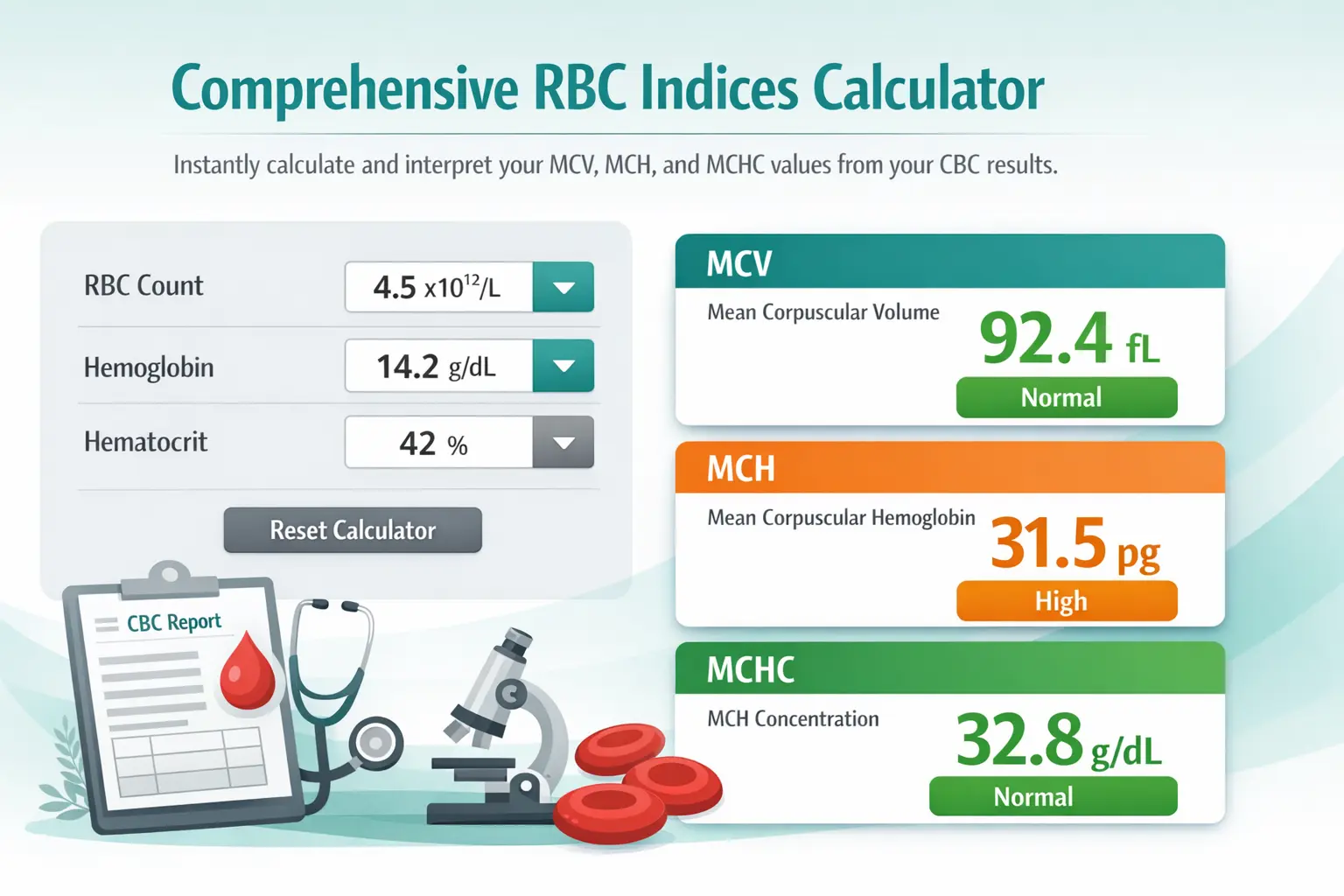
RBC Indices Calculator (MCV, MCH, MCHC)
Free RBC indices calculator: get MCV, MCH and MCHC from hemoglobin, hematocrit and red cell count, in SI and conventional units, with the Mentzer…
Discussion 0