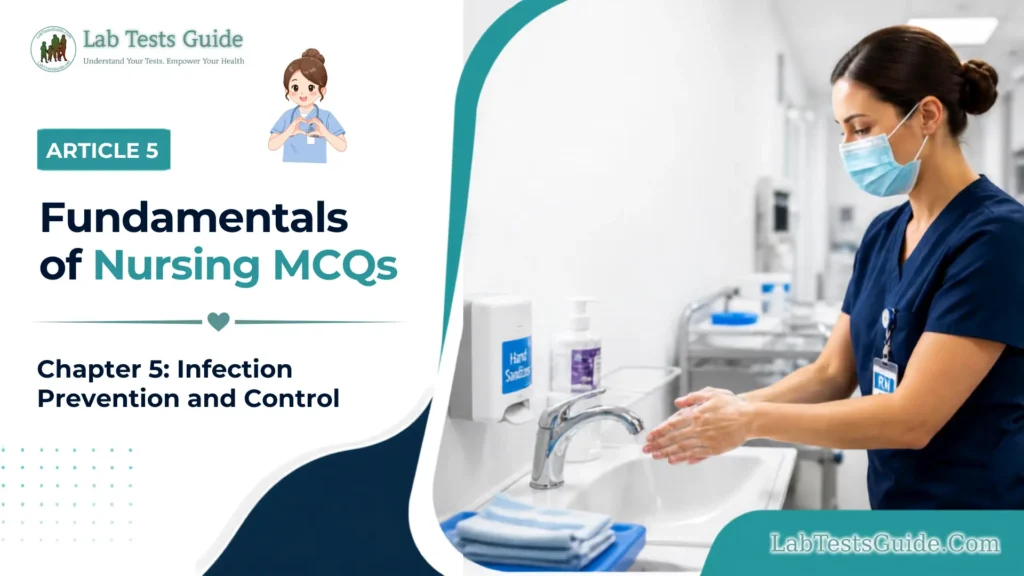
Fundamentals of Nursing MCQs – Chapter 5: Infection Prevention and Control
Editorial StaffUpdated 18 min read
Quick Overview
Practice Fundamentals of Nursing MCQs on infection prevention and control, including hand hygiene, standard precautions, PPE, isolation, aseptic technique, and healthcare-associated infection prevention.
CategoryNursing Fundamentals
Read time18 min
UpdatedSep 2026
Table of Contents
Fundamentals of Nursing MCQs – Chapter 5: Infection Prevention and Control
Infection prevention and control is an essential part of safe nursing practice. Nurses play an important role in preventing the transmission of microorganisms between patients, healthcare workers, and the environment.
Infection Prevention and Control MCQs for Fundamentals of Nursing Chapter 5.
This chapter covers important concepts such as hand hygiene, standard precautions, transmission-based precautions, personal protective equipment (PPE), aseptic technique, isolation practices, and prevention of healthcare-associated infections.
These MCQs are useful for nursing students preparing for nursing school examinations, NCLEX-style questions, staff nurse exams, and clinical practice.
Topics Covered
Hand hygiene and infection prevention
Standard precautions
Transmission-based precautions
Personal protective equipment (PPE)
Medical and surgical asepsis
Isolation precautions
Healthcare-associated infections
Safe handling of specimens and contaminated materials
Fundamentals of Nursing MCQs – Chapter 5: Infection Prevention, Control & Standard Precautions
Choose the best answer for each question and test your knowledge of infection prevention and control.
0Total MCQs
0 / 0Correct / Tracked
Advertisement (Google)
Fundamentals of Nursing: Infection Prevention and Control
Explanation: Wound care aims to prevent infection, protect tissues from further damage, and promote optimal conditions for early healing. Therefore, all the listed purposes are correct.Why other options are incorrect:
• Option A: Preventing wound infection is an important purpose, but it is not the only purpose.
• Option B: Preventing further tissue damage is important but represents only one aspect of wound care.
• Option C: Promoting early healing is a key goal, but wound care has additional purposes.
Fundamentals of Nursing: Infection Prevention and Control
Topical agent used for cleaning wound is-
a) Tincture iodine
b) Savlon
c) Hydrogen peroxide
d) All of the above
Correct Answer: Option D
Explanation: Tincture iodine, Savlon, and hydrogen peroxide have all been used as topical wound-cleaning agents. Therefore, all of the listed options are correct in the context of this question.Why other options are incorrect:
• Option A: Tincture iodine is only one of the agents listed.
• Option B: Savlon is only one of the agents listed.
• Option C: Hydrogen peroxide is only one of the agents listed.
Fundamentals of Nursing: Infection Prevention and Control
The Heimlich maneuver (abdominal thrust) is used for a client who has:
a) A bloody nose
b) Fall from bed
c) Impaired eyesight
d) A blocked airway
Correct Answer: Option D
Explanation: The Heimlich maneuver, now generally referred to as abdominal thrusts, is used to help relieve a severe airway obstruction caused by a foreign object.Why other options are incorrect:
• Option A: A bloody nose is managed with appropriate first-aid measures such as leaning forward and applying pressure.
• Option B: A fall from bed requires assessment for injuries and appropriate safety measures.
• Option C: Impaired eyesight does not indicate an airway obstruction requiring abdominal thrusts.
Fundamentals of Nursing: Infection Prevention and Control
An agent which kills pathogenic bacteria is called:
a) Asepsis
b) Fomite
c) Bacteriostat
d) Disinfectant
Correct Answer: Option D
Explanation: A disinfectant is a chemical agent used on inanimate objects and surfaces to destroy or inactivate pathogenic microorganisms, including pathogenic bacteria.Why other options are incorrect:
• Option A: Asepsis refers to practices or conditions that prevent contamination by microorganisms.
• Option B: A fomite is an inanimate object that can carry and transmit infectious microorganisms.
• Option C: A bacteriostat inhibits bacterial growth but does not necessarily kill the bacteria.
Fundamentals of Nursing: Infection Prevention and Control
Which of the following technique is appropriate for wound dressing?
a) Medical asepsis
b) Septic technique
c) Medical and surgical asepsis
d) Surgical asepsis
Correct Answer: Option D
Explanation: Surgical asepsis, or sterile technique, is used for wound dressing when maintaining a sterile field and preventing microorganisms from contaminating the wound are required.Why other options are incorrect:
• Option A: Medical asepsis reduces the number and spread of microorganisms but does not maintain complete sterility.
• Option B: Septic technique is not an appropriate infection-control technique for wound dressing.
Fundamentals of Nursing: Infection Prevention and Control
Inoculating loop is sterilized by:
a) Hot air oven
b) Autoclave
c) Radiation
d) Flaming
Correct Answer: Option D
Explanation: An inoculating loop is commonly sterilized by flaming it in a Bunsen burner flame until the wire becomes red hot, which destroys microorganisms present on the loop.Why other options are incorrect:
• Option A: A hot air oven is primarily used for sterilizing suitable glassware and dry materials.
• Option B: An autoclave uses pressurized steam and is not the routine method for sterilizing an inoculating loop between uses.
• Option C: Radiation is used for specific sterilization applications but is not the routine method for an inoculating loop.
Fundamentals of Nursing: Infection Prevention and Control
Which disinfectant is commonly used in hospital floor cleaning?
a) Pure glycerin drops
b) Vinegar only spray
c) Plain lemon water
d) Chlorine solution
Correct Answer: Option D
Explanation: Chlorine-based disinfectant solutions are commonly used for environmental cleaning in healthcare settings because they are effective against many pathogenic microorganisms when prepared and used at the appropriate concentration.Why other options are incorrect:
• Option A: Pure glycerin is not a routine hospital floor disinfectant.
• Option B: Vinegar is not the standard disinfectant for hospital floor cleaning.
• Option C: Plain lemon water does not provide reliable hospital-grade disinfection.
Fundamentals of Nursing: Infection Prevention and Control
The nurse has taken the blood pressure of a client hospitalized with methicillin-resistant staphylococcus aureus (MRSA). Which action by the nurse indicates an understanding regarding the care of clients with MRSA?
a) The nurse cleans the stethoscope with alcohol and returns it to the exam room.
b) The nurse leaves the stethoscope in the client’s room for future use.
c) The nurse cleans the stethoscope with water, dries it, and returns it to the nurse’s station.
d) The nurse uses the stethoscope to assess the blood pressure of other assigned clients.
Correct Answer: Option B
Explanation: Dedicated equipment should be kept in the room of a client with MRSA when possible to reduce the risk of transmitting the organism to other clients. The stethoscope should not be shared without appropriate disinfection.Why other options are incorrect:
• Option A: Although appropriate disinfectant may be used, returning shared equipment for general use can create a transmission risk.
• Option C: Water alone does not adequately disinfect equipment contaminated with MRSA.
• Option D: Using the same stethoscope for other clients without appropriate disinfection can transmit MRSA.
Fundamentals of Nursing: Infection Prevention and Control
A true pathogen will cause disease or infection:
a) only in an immuno-compromised person.
b) in persons with allergy to the pathogen.
c) in very few people.
d) in a healthy person.
Correct Answer: Option D
Explanation: A true pathogen is capable of causing disease in a healthy, susceptible host. Unlike opportunistic pathogens, it does not require the host to be immunocompromised.Why other options are incorrect:
• Option A: True pathogens are not restricted to immunocompromised individuals.
• Option B: Allergy is an immune response and is not the defining characteristic of pathogenicity.
• Option C: A true pathogen is capable of causing disease in susceptible healthy individuals.
Fundamentals of Nursing: Infection Prevention and Control
The compression to ventilation ratio in CPR (Cardiopulmonary Resuscitation) in case of single rescuer is:
a) 5:2
b) 15:2
c) 2:30
d) 30:2
Correct Answer: Option D
Explanation: For a single rescuer performing CPR on an adult, the standard compression-to-ventilation ratio is 30:2, meaning 30 chest compressions followed by 2 rescue breaths.Why other options are incorrect:
• Option A: 5:2 is not the standard compression-to-ventilation ratio for adult CPR.
• Option B: 15:2 may apply in specific pediatric two-rescuer CPR circumstances, not standard single-rescuer adult CPR.
• Option C: 2:30 reverses the correct order of compressions and ventilations.
Fundamentals of Nursing: Infection Prevention and Control
A client asks you to explain viruses. Which of the following statements would be true and therefore best to include in your answer?
a) Viruses are the most common agent causing infection.
b) Candida is one of the most common viruses.
c) Viruses are commonly found in the intestinal tract.
d) Viruses must enter into living cells to reproduce.
Correct Answer: Option D
Explanation: Viruses are obligate intracellular infectious agents. They lack the cellular machinery needed for independent reproduction and must enter a living host cell to replicate.Why other options are incorrect:
• Option A: Viruses are important causes of infection, but this broad statement is not a defining characteristic of viruses.
• Option B: Candida is a fungus, not a virus.
• Option C: Some viruses can infect the intestinal tract, but this is not a defining characteristic of all viruses.
Fundamentals of Nursing: Infection Prevention and Control
The nursing supervisor has asked the staff to reduce the number of iatrogenic infections on the unit. Which of the following actions on your part would contribute to reducing iatrogenic infections?
a) Isolating a client who has just been diagnosed as having tuberculosis
b) Properly bagging soiled linens and disposed items used for a client in isolation
c) Teaching correct hand washing to assigned clients
d) Using correct procedures in starting and caring for an intravenous infusion
Correct Answer: Option D
Explanation: Iatrogenic infections are infections resulting from healthcare interventions or procedures. Using proper aseptic technique when starting and maintaining an intravenous infusion helps prevent microorganisms from entering the bloodstream.Why other options are incorrect:
• Option A: Isolating a client with tuberculosis helps prevent transmission but primarily addresses healthcare-associated spread between people.
• Option B: Proper handling of contaminated materials helps prevent transmission but is not specifically an invasive procedure causing iatrogenic infection.
• Option C: Teaching hand hygiene is important for infection prevention but does not directly address procedure-related iatrogenic infections.
Fundamentals of Nursing: Infection Prevention and Control
What is the correct sequence of providing perineal care to a female patient to reduce the risk of infection?
a) Wipe from side to side
b) Wipe in a circular motion
c) Wipe from back to front
d) Wipe from front to back
Correct Answer: Option D
Explanation: Female perineal care should be performed from front to back, moving from the cleaner urethral area toward the anus. This helps prevent fecal microorganisms from being carried toward the urethra and vagina.Why other options are incorrect:
• Option A: Wiping side to side does not maintain the appropriate clean-to-dirty direction.
• Option B: A circular motion does not provide the recommended front-to-back direction.
• Option C: Wiping from back to front can carry microorganisms from the anal area toward the urinary tract.
Fundamentals of Nursing: Infection Prevention and Control
Which of the following chemical is most powerful disinfectant?
a) Dettol
b) Lysol
c) KMnO4
d) Phenol
Correct Answer: Option D
Explanation: Phenol is a classic disinfectant and is traditionally considered a powerful disinfecting agent. Lysol contains phenolic compounds, while Dettol and potassium permanganate have different applications and levels of antimicrobial activity.Why other options are incorrect:
• Option A: Dettol is an antiseptic and disinfectant, but is not traditionally identified as the most powerful option here.
• Option B: Lysol is a phenolic disinfectant, but the question specifically identifies phenol as the answer.
• Option C: KMnO4 has antiseptic and disinfectant properties but is not considered the most powerful option in this list.
Fundamentals of Nursing: Infection Prevention and Control
What is the recommended pressure setting for autoclave for sterilization?
a) 15 lb
b) 5 lb
c) 10 lb
d) 20 lb
Correct Answer: Option A
Explanation: A standard autoclave sterilization cycle commonly uses **15 psi (lb/in²) of pressure**, which corresponds to approximately 121°C (250°F) for about 15–20 minutes, depending on the load and validated cycle.Why other options are incorrect:
• Option B: 5 lb is below the standard pressure used for routine steam sterilization.
• Option C: 10 lb is below the commonly used 15 psi setting for standard autoclave sterilization.
• Option D: 20 lb is higher than the commonly referenced standard pressure of 15 psi.
Fundamentals of Nursing: Infection Prevention and Control
Your assigned client has encephalitis, and there are other cases in the community. In a team meeting regarding your client and prevention of other cases of encephalitis, the nurse supervisor talks about breaking the chain of infection at the second link: the reservoir. You realize the nurse supervisor is talking about which of the following things?
a) A place where the microorganism enters the body
b) An area for the storage and filtering of water
c) The microorganism itself
d) The place where the microorganism naturally lives
Correct Answer: Option D
Explanation: The reservoir is the place where a microorganism normally lives, grows, and multiplies. Examples include humans, animals, soil, and water.Why other options are incorrect:
• Option A: This describes the portal of entry, where the microorganism enters a new host.
• Option B: This describes a water-storage or treatment area, not the general definition of a reservoir in the chain of infection.
• Option C: This describes the infectious agent, not its reservoir.
Fundamentals of Nursing: Infection Prevention and Control
A client asks you how to best prevent vaginal infections. Your best answer would include which of the following statements?
a) Drinking cranberry juice will prevent most all of the vaginal infections.
b) I would suggest a vinegar douche.
c) The pH of the vaginal secretions stops many disease-producing bacteria.
d) Your doctor can prescribe a medication that will prevent vaginal infections.
Correct Answer: Option C
Explanation: The normal acidic vaginal environment, maintained largely by Lactobacillus species, helps inhibit the growth of many disease-producing microorganisms and provides a natural defense against infection.Why other options are incorrect:
• Option A: Cranberry products may be discussed in relation to urinary tract health, but they do not prevent most vaginal infections.
• Option B: Vaginal douching is not recommended because it can disrupt the normal vaginal flora and pH.
• Option D: Preventive medication is not routinely prescribed for all vaginal infections; prevention depends on the specific cause and risk factors.
Fundamentals of Nursing: Infection Prevention and Control
Which of the following situations represents the best example of passive immunity?
a) Production of antibodies by a person with infection
b) A child receiving a vaccination for measles
c) A person receiving antibiotics for an infection
d) An infant receiving breast milk from the mother
Correct Answer: Option D
Explanation: Passive immunity occurs when a person receives antibodies made by another individual rather than producing the antibodies themselves. Breast milk, especially colostrum, contains maternal antibodies such as IgA that provide passive protection to the infant.Why other options are incorrect:
• Option A: Producing antibodies after an infection is an example of active immunity.
• Option B: Vaccination stimulates the person’s own immune system to produce an immune response, resulting in active immunity.
• Option C: Antibiotics treat bacterial infections but do not provide passive immunity.
Fundamentals of Nursing: Infection Prevention and Control
In which of the following situations should hand hygiene be performed?
a) Before direct contact with a patient
b) Prior to inserting a urinary catheter
c) After removing a bed pan
d) All of the above
Correct Answer: Option D
Explanation: Hand hygiene should be performed before patient contact, before aseptic procedures such as urinary catheter insertion, and after contact with potentially contaminated materials such as a bed pan. Therefore, all of the listed situations require hand hygiene.Why other options are incorrect:
• Option A: This is a correct indication for hand hygiene, but it does not include the other listed situations.
• Option B: Hand hygiene is required before an aseptic procedure, but this is not the only situation listed.
• Option C: Hand hygiene is required after handling potentially contaminated items, but this is not the only situation listed.
Fundamentals of Nursing: Infection Prevention and Control
How are antibiotic-resistant pathogens most commonly spread from one patient to another in healthcare settings?
a) Cross-infection
b) Patients coming into contact with contaminated equipment
c) Airborne spread
d) Poor environmental cleaning
Correct Answer: Option A
Explanation: Cross-infection refers to the transmission of an infectious organism from one patient to another within a healthcare setting. Antibiotic-resistant pathogens are commonly transmitted through contact, particularly via contaminated hands, equipment, or other surfaces.Why other options are incorrect:
• Option B: Contaminated equipment can transmit pathogens, but it is one possible route contributing to cross-infection rather than the broader concept.
• Option C: Airborne transmission occurs with certain pathogens but is not the usual route for most antibiotic-resistant organisms.
• Option D: Poor environmental cleaning can contribute to transmission but is a contributing factor rather than the overall process of patient-to-patient spread.
Fundamentals of Nursing: Infection Prevention and Control
What is the most important reason for healthcare workers to practise good hand hygiene?
a) To remove visible soiling from hands
b) To comply with legislation
c) To protect staff
d) To prevent infections that patients acquire in the hospital or residential care setting
Correct Answer: Option D
Explanation: Good hand hygiene is one of the most important measures for preventing healthcare-associated infections (HAIs). It reduces the transfer of microorganisms between healthcare workers, patients, equipment, and the environment.Why other options are incorrect:
• Option A: Hand hygiene can remove visible soil, but preventing transmission of microorganisms is the more important purpose.
• Option B: Following legislation or workplace requirements may be necessary, but it is not the primary clinical purpose.
• Option C: Hand hygiene can protect healthcare workers, but preventing infections in patients is the key objective in healthcare settings.
Fundamentals of Nursing: Infection Prevention and Control
Which hand hygiene method is best at killing bacteria?
a) Alcohol-based hand rub
b) Hot running water
c) None of the above
d) Antimicrobial soap and water
Correct Answer: Option A
Explanation: Alcohol-based hand rubs are highly effective at rapidly killing many bacteria and are generally preferred for routine hand hygiene when hands are not visibly soiled. They provide broad antimicrobial activity and act quickly.Why other options are incorrect:
• Option B: Hot running water alone does not effectively kill or remove microorganisms and may cause skin irritation or burns.
• Option C: An effective hand hygiene method is available, so this option is incorrect.
• Option D: Antimicrobial soap and water can effectively reduce microorganisms, but alcohol-based hand rub is generally more effective and convenient for routine hand hygiene when hands are not visibly dirty.
Fundamentals of Nursing: Infection Prevention and Control
On a home visit, you notice some dust on a vent in your client’s room and on the windowsill. Which of the following methods would you teach the family to use for removing dust?
a) Use a broom covered with a cloth.
b) Vacuum up the dust.
c) Use a feather duster to remove dust.
d) Use a damp cloth to remove the dust.
Correct Answer: Option D
Explanation: A damp cloth is preferred for routine dusting because it traps dust rather than dispersing it into the air. This helps reduce airborne dust and potential microorganism transmission.Why other options are incorrect:
• Option A: A broom can disturb and disperse dust into the air, even when covered with a cloth.
• Option B: Vacuuming may be appropriate for some surfaces, but it is not the preferred method for routine dusting of vents and windowsills.
• Option C: A feather duster can disperse dust into the air rather than effectively trapping it.
Infection Prevention and Control: Key Points to Remember
Infection prevention aims to reduce the spread of infectious microorganisms and protect patients and healthcare workers.
Hand hygiene: One of the most important measures for preventing transmission of microorganisms.
Standard precautions: Used for all patients and include appropriate hand hygiene, PPE based on anticipated exposure, respiratory hygiene, and safe handling of potentially infectious materials.
Transmission-based precautions: Additional precautions used when specific routes of infection transmission require further measures.
PPE: Gloves, gowns, masks, eye protection, and other protective equipment are selected according to the anticipated exposure.
Aseptic technique: Practices used to reduce contamination by microorganisms during clinical procedures.
Quick Exam Tip
When answering infection-control questions, first identify how the microorganism may be transmitted and what type of exposure is expected. Then select the appropriate precaution or PPE.
Hand hygiene remains a fundamental infection-prevention practice and should be performed at the appropriate moments during patient care.
Frequently Asked Questions
Why is infection prevention important in nursing? It helps reduce the transmission of infectious microorganisms and supports patient and healthcare-worker safety.
What are standard precautions? Standard precautions are basic infection-prevention practices applied to the care of all patients, regardless of their known or suspected infection status.
What is PPE in nursing? PPE refers to personal protective equipment such as gloves, gowns, masks, and eye protection used according to the anticipated risk of exposure.
What is the purpose of transmission-based precautions? They provide additional measures for patients with known or suspected infections that require precautions beyond standard precautions.
Disclaimer: This content is provided for educational and exam-preparation purposes only. It does not replace professional nursing education, clinical training, institutional policies, or guidance from qualified healthcare professionals.
Practice Fundamentals of Nursing MCQs on oxygenation, including respiratory assessment, oxygen saturation, oxygen therapy, airway management, hypoxia, positioning, and nursing interventions.
Practice Fundamentals of Nursing MCQs on fluid and electrolyte balance, including dehydration, fluid overload, sodium, potassium, calcium, intake and output, and nursing assessment.
Practice Fundamentals of Nursing MCQs on pain management, including pain assessment, acute and chronic pain, pain scales, pharmacological and non-pharmacological interventions, and evaluation.



Discussion 0