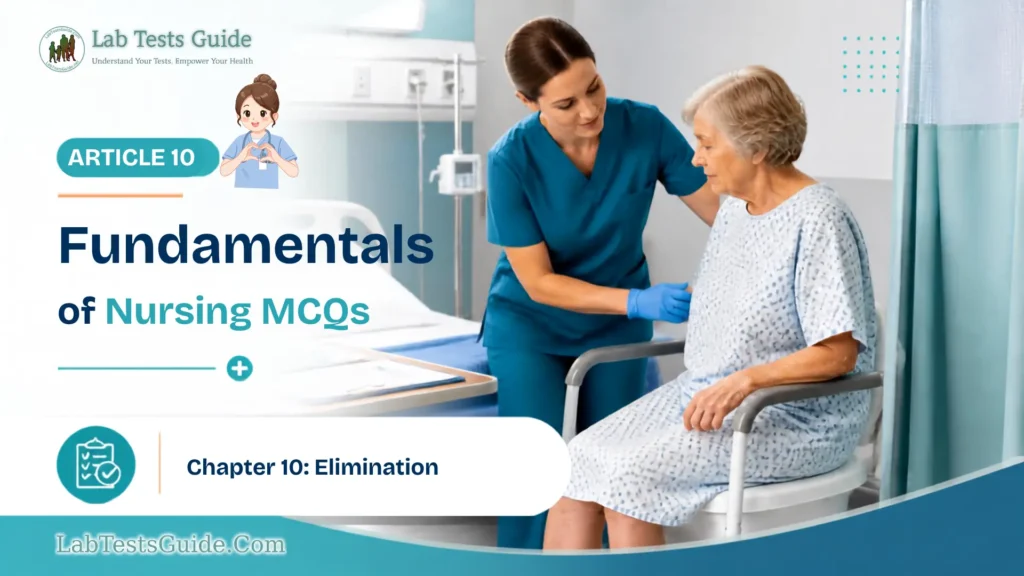
Fundamentals of Nursing MCQs – Chapter 10: Elimination
Editorial StaffUpdated 18 min read0views
Quick Overview
Practice Fundamentals of Nursing MCQs on elimination, including urinary and bowel function, constipation, diarrhea, urinary retention, incontinence, catheter care, and intake and output.
CategoryNursing Fundamentals
Read time18 min
UpdatedSep 2026
Table of Contents
Elimination MCQs – Chapter 10 | Fundamentals of Nursing
Elimination is an essential physiological function involving the removal of waste products from the body through the urinary and gastrointestinal systems. Nurses assess elimination patterns and provide care when illness, medications, mobility limitations, or other factors affect normal bowel or urinary function.
Elimination MCQs for Fundamentals of Nursing Chapter 10.
This chapter covers important concepts related to urinary elimination, bowel elimination, constipation, diarrhea, urinary retention, incontinence, catheter care, and elimination assessment.
These MCQs are useful for nursing students preparing for nursing examinations, NCLEX-style questions, staff nurse exams, and clinical practice.
Topics Covered
Normal bowel and urinary elimination
Elimination assessment
Constipation and diarrhea
Urinary retention and incontinence
Factors affecting elimination
Urinary catheter care
Bedpans and urinals
Intake and output monitoring
Fundamentals of Nursing MCQs – Chapter 10: Elimination, Bowel and Bladder Care Practice Questions
Choose the best answer for each question and test your knowledge of elimination in nursing care.
0Total MCQs
0 / 0Correct / Tracked
Advertisement (Google)
Fundamentals of Nursing: Elimination
For giving evacuant enema to infants, the amount of the solution should be-
a) 500-1000 ml
b) 250–500 ml
c) Less than 20 ml
d) 250 ml or less
Correct Answer: Option C
Explanation: In traditional nursing exam guidance, an evacuant enema for an infant uses a very small volume, generally less than 20 mL, to reduce the risk of fluid and electrolyte complications.Why other options are incorrect:
• Option A: 500–1000 mL is far too large for an infant.
• Option B: 250–500 mL is excessive for an infant and may cause complications.
• Option D: 250 mL or less is still too large for an infant compared with the traditional recommended volume.
Fundamentals of Nursing: Elimination
The enema given to relieve gaseous distention is which of the following?
a) Cold enema
b) Anthelmintic enema
c) Purgative enema
d) Carminative enema
Correct Answer: Option D
Explanation: A carminative enema is used to help relieve intestinal gas and gaseous abdominal distention by promoting the expulsion of flatus.Why other options are incorrect:
• Option A: A cold enema is not specifically used to relieve gaseous distention.
• Option B: An anthelmintic enema is intended to help eliminate intestinal worms.
• Option C: A purgative enema is primarily used to stimulate bowel evacuation.
Fundamentals of Nursing: Elimination
Management of constipation includes, except:
a) Increased fluid intake
b) Adequate intake of roughage in the diet
c) Establishing a habit pattern
d) Decreased fluid intake
Correct Answer: Option D
Explanation: Decreased fluid intake is not part of constipation management. Adequate hydration helps soften stool and supports regular bowel movements.Why other options are incorrect:
• Option A: Increased fluid intake can help prevent hard, dry stools.
• Option C: Establishing a regular bowel routine can encourage consistent elimination.
Fundamentals of Nursing: Elimination
The nurse is checking the placement of a nasogastric tube prior to giving medication and a feeding. Which of the following is the preferred and most accurate method of testing?
a) Insert 5 to 20 mm of air into the tube while listening over the stomach with a stethoscope.
b) Insert 15 to 20 cc of water into the stomach and listen with the stethoscope.
c) Place an open end of the tube into a glass of water and check for bubbles.
d) Aspirate 20 to 30 ml of gastrointestinal secretions and test the pH.
Correct Answer: Option D
Explanation: Aspirating gastric contents and checking the pH provides a more reliable bedside method for confirming gastric tube placement before feeding or medication administration. Initial placement may require radiographic confirmation according to clinical policy.Why other options are incorrect:
• Option A: The air insufflation or auscultation method is unreliable for confirming tube placement.
• Option B: Instilling water and listening with a stethoscope does not reliably confirm tube location.
• Option C: Bubbles in water cannot reliably distinguish gastric placement from respiratory tract placement.
Fundamentals of Nursing: Elimination
The enema given to soften hard fecal matter is known as:
a) Cold enema
b) Anthelmintic enema
c) Carminative enema
d) Oil enema
Correct Answer: Option D
Explanation: An oil enema is used to lubricate and soften hard, impacted fecal matter, making it easier to pass during bowel evacuation.Why other options are incorrect:
• Option A: A cold enema is not primarily used to soften hard fecal matter.
• Option B: An anthelmintic enema is intended to help eliminate intestinal worms.
• Option C: A carminative enema is used to relieve intestinal gas and gaseous distention.
Fundamentals of Nursing: Elimination
A drug that relieves flatulence is known as
a) carminatives
b) purgatives
c) antacids
d) astringents
Correct Answer: Option A
Explanation: Carminatives are agents used to relieve flatulence by helping reduce intestinal gas and discomfort.Why other options are incorrect:
• Option B: Purgatives promote bowel evacuation and are not primarily used to relieve flatulence.
• Option C: Antacids primarily neutralize or reduce stomach acid.
• Option D: Astringents cause tissue contraction and are not used specifically to relieve intestinal gas.
Fundamentals of Nursing: Elimination
Cone-shaped medicated solid mass which is introduced into the rectum is known as:
a) Enema
b) Catheterization
c) Bolus
d) Suppository
Correct Answer: Option D
Explanation: A suppository is a solid dosage form designed to be inserted into the rectum, where it dissolves or melts and releases medication.Why other options are incorrect:
• Option A: An enema is a liquid preparation introduced into the rectum, usually to promote evacuation or deliver medication.
• Option B: Catheterization involves inserting a catheter into a body cavity, commonly the urinary bladder.
• Option C: A bolus is a rounded mass of food or medication, not a cone-shaped rectal dosage form.
Fundamentals of Nursing: Elimination
Drugs used to cause intestinal evacuation is:
a) Cathartics
b) Carminatives
c) Astringents
d) Antimycotics
Correct Answer: Option A
Explanation: Cathartics are drugs that promote intestinal evacuation by stimulating bowel movements or increasing stool passage.Why other options are incorrect:
• Option B: Carminatives are used to relieve intestinal gas and flatulence.
• Option C: Astringents cause contraction of tissues and are not used primarily to promote bowel evacuation.
• Option D: Antimycotics are antifungal agents used to treat fungal infections.
Fundamentals of Nursing: Elimination
Difficult evacuation of hard faecal matter is known as-
a) Diarrhoea
b) Defaecation
c) Enema
d) Constipation
Correct Answer: Option D
Explanation: Constipation is characterized by infrequent or difficult bowel movements, often involving hard, dry stools that are difficult to evacuate.Why other options are incorrect:
• Option A: Diarrhoea involves frequent passage of loose or watery stools.
• Option B: Defaecation is the process of eliminating faeces from the body.
• Option C: An enema is a procedure in which fluid is introduced into the rectum and colon.
Fundamentals of Nursing: Elimination
The condition in which the urine cannot be expelled from the bladder is known as:
a) Incontinence of urine
b) Micturition
c) Suppression
d) Retention of urine
Correct Answer: Option D
Explanation: Urinary retention is the inability to empty the bladder completely or at all, resulting in urine remaining in the bladder.Why other options are incorrect:
• Option A: Urinary incontinence is the involuntary leakage of urine.
• Option B: Micturition is the normal process of emptying urine from the bladder.
• Option C: Urinary suppression refers to markedly reduced or absent urine production, not inability to expel urine from the bladder.
Fundamentals of Nursing: Elimination
Constipation can occur in:
a) Only in those over 60 years
b) Those who are immobile
c) Children and adults only
d) Babies, children and adults
Correct Answer: Option D
Explanation: Constipation can occur at any age, including in babies, children, and adults. Causes vary with age and may include diet, fluid intake, medications, illness, and changes in bowel habits.Why other options are incorrect:
• Option A: Constipation is not limited to people over 60 years of age.
• Option B: Immobility can contribute to constipation, but it is not the only group affected.
• Option C: Constipation can also occur in babies, so this option is incomplete.
Fundamentals of Nursing: Elimination
Causes of constipation are, except:
a) Insufficient intake of roughage
b) Intestinal obstruction
c) Lack of privacy
d) Increased fluid intake
Correct Answer: Option D
Explanation: Increased fluid intake generally helps prevent or relieve constipation by keeping stools softer and supporting normal bowel function. It is therefore the exception.Why other options are incorrect:
• Option A: Insufficient dietary roughage or fiber can contribute to constipation.
• Option B: Intestinal obstruction can interfere with normal bowel elimination and cause constipation.
• Option C: Lack of privacy may cause a person to suppress the urge to defecate, contributing to constipation.
Fundamentals of Nursing: Elimination
Faecal impaction refers to:
a) Loose stools collecting in the rectum
b) Hard dry stools collecting in the ascending colon
c) Hard dry stools collecting in the descending colon
d) Hard dry stools collecting in the rectum
Correct Answer: Option D
Explanation: Faecal impaction is a mass of hard, dry stool that becomes lodged in the rectum and cannot be expelled normally.Why other options are incorrect:
• Option A: Loose stools in the rectum do not constitute faecal impaction.
• Option B: Hard stool may occur elsewhere in the colon, but the classic definition describes impaction in the rectum.
• Option C: Hard stool in the descending colon alone does not define faecal impaction.
Fundamentals of Nursing: Elimination
Constipation is usually caused by:
a) Cancer
b) Diverticulosis
c) Appendicitis
d) The slow movement of stool through the colon
Correct Answer: Option D
Explanation: Constipation commonly occurs when stool moves slowly through the colon, allowing more water to be absorbed and producing harder, drier stools that are difficult to pass.Why other options are incorrect:
• Option A: Cancer can cause constipation in some cases, but it is not the usual cause.
• Option B: Diverticulosis may be associated with altered bowel habits but is not the usual cause of constipation.
• Option C: Appendicitis is an acute inflammatory condition and is not the usual cause of constipation.
Fundamentals of Nursing: Elimination
Which of the following patient activities helps to relax the external anal sphincter, while administering enema?
a) Separating the buttocks
b) Lubricating the catheter tip
c) Inserting the catheter slowly
d) Breathing out through the mouth.
Correct Answer: Option D
Explanation: Asking the patient to breathe out slowly through the mouth helps promote relaxation of the external anal sphincter, making insertion of the enema tube more comfortable.Why other options are incorrect:
• Option A: Separating the buttocks provides access to the anus but does not directly relax the external anal sphincter.
• Option B: Lubricating the catheter reduces friction and discomfort but does not relax the sphincter.
• Option C: Slow insertion can reduce discomfort, but controlled exhalation specifically promotes sphincter relaxation.
Fundamentals of Nursing: Elimination
The nurse is doing bowel and bladder retraining for the client with paraplegia. Which of the following is not a factor for the nurse to consider?
a) Dietary patterns
b) Mobility
c) Fluid intake
d) Sexual function
Correct Answer: Option D
Explanation: Dietary patterns, mobility, and fluid intake directly affect bowel and bladder function and are important considerations during retraining. Sexual function is not a primary factor in bowel and bladder retraining.Why other options are incorrect:
• Option B: Mobility affects bowel motility and the client’s ability to access toileting facilities.
• Option C: Fluid intake affects urine production and stool consistency.
Fundamentals of Nursing: Elimination
Normal process of urine output from the bladder is known as:
a) Enuresis
b) Elimination
c) Defacation
d) Micturition
Correct Answer: Option D
Explanation: Micturition is the normal physiological process of emptying urine from the urinary bladder through the urethra.Why other options are incorrect:
• Option A: Enuresis refers to involuntary urination, commonly used for nighttime bedwetting.
• Option B: Elimination is a broader term for the removal of waste products from the body.
• Option C: Defecation is the process of eliminating feces from the gastrointestinal tract.
Fundamentals of Nursing: Elimination
Abnormal frequency and liquefaction of faeces is known as-
a) Constipation
b) Defaecation
c) Enema
d) Diarrhoea
Correct Answer: Option D — Diarrhoea
Explanation: Diarrhoea is characterized by frequent passage of loose or watery faeces, reflecting increased stool frequency and liquefaction.Why other options are incorrect:
• Option A: Constipation involves infrequent or difficult passage of hard stools.
• Option B: Defaecation is the normal process of eliminating faeces from the rectum.
• Option C: An enema is a solution introduced into the rectum for therapeutic or diagnostic purposes.
Fundamentals of Nursing: Elimination
Involuntary passing of urine is known as-
a) Enuresis
b) Elimination
c) Micturition
d) Defaecation
Correct Answer: Option A — Enuresis
Explanation: Enuresis refers to involuntary urination, particularly when it occurs during sleep or beyond the age when bladder control is normally established.Why other options are incorrect:
• Option B: Elimination is the general process of removing waste products from the body.
• Option C: Micturition is the normal process of voluntarily or reflexively emptying the bladder.
• Option D: Defaecation is the process of expelling faeces from the rectum.
Fundamentals of Nursing: Elimination
Causes for urinary incontinence are except-
a) Sphincter damage
b) Urinary tract infection
c) Weak perineal muscles
d) Urethral obstruction
Correct Answer: Option D — Urethral obstruction
Explanation: Urethral obstruction interferes with urine outflow and is more commonly associated with urinary retention rather than urinary incontinence.Why other options are incorrect:
• Option A: Sphincter damage can impair bladder control and cause involuntary urine leakage.
• Option B: Urinary tract infections can cause urgency, frequency, and temporary incontinence.
• Option C: Weak perineal muscles can reduce support for the bladder and urethra, contributing to incontinence.
Fundamentals of Nursing: Elimination
Expulsion of the wastes from the body by way of lungs, skin, rectum and bladder is known as-
a) Enuresis
b) Micturition
c) Defaecation
d) Elimination
Correct Answer: Option D — Elimination
Explanation: Elimination is the process of removing metabolic wastes from the body through organs such as the lungs, skin, rectum, and bladder.Why other options are incorrect:
• Option A: Enuresis refers to involuntary urination, commonly occurring during sleep.
• Option B: Micturition is the process of emptying urine from the bladder.
• Option C: Defaecation is the expulsion of faeces from the rectum.
Fundamentals of Nursing: Elimination
Appropriate size of rectal tube for giving enema for infant is-
a) No – 22-24
b) No – 12
c) No – 16
d) No – 8-10
Correct Answer: Option D — No – 8-10
Explanation: A small rectal tube, typically No. 8–10, is appropriate for administering an enema to an infant to minimize discomfort and reduce the risk of rectal injury.Why other options are incorrect:
• Option A: No. 22–24 is considerably larger than the size generally used for an infant.
• Option B: No. 12 is larger than the commonly recommended infant rectal tube size.
• Option C: No. 16 is larger than the appropriate size for an infant.
Fundamentals of Nursing: Elimination
Appropriate size of rectal tube for giving enema for adult is-
a) No – 22-24
b) No – 12
c) No – 16
d) No – 8-10
Correct Answer: Option A — No – 22-24
Explanation: For an adult enema, a larger rectal tube, commonly No. 22–24, is used to allow appropriate instillation of the enema solution.Why other options are incorrect:
• Option B: No. 12 is smaller than the commonly recommended adult rectal tube size.
• Option C: No. 16 is smaller than the commonly recommended adult size.
• Option D: No. 8–10 is a smaller size commonly used for infants or small children.
Fundamentals of Nursing: Elimination
The enema given to relieve inflammation is-
a) Astringent enema
b) Cold enema
c) Barium enema
d) Anaesthetic enema
Correct Answer: Option A — Astringent enema
Explanation: An astringent enema is traditionally described as an enema used to reduce inflammation and irritation of the rectal or intestinal mucosa.Why other options are incorrect:
• Option B: A cold enema is primarily associated with stimulating the bowel or reducing body temperature in older nursing texts.
• Option C: A barium enema is used as a contrast study to visualize the large intestine.
• Option D: An anaesthetic enema is used to provide local anaesthetic effects rather than primarily treating inflammation.
Fundamentals of Nursing: Elimination
In following which is not an example of retained enema-
a) Nutrient enema
b) Anaesthetic enema
c) Oil enema
d) Emollient enema
Correct Answer: Option A — Nutrient enema
Explanation: Nutrient enemas are traditionally classified as nutritive enemas rather than retained enemas. Retention enemas are designed to be retained in the rectum for a period to produce a therapeutic effect, such as softening stool or providing local medication.Why other options are incorrect:
• Option B: An anaesthetic enema may be retained to provide a local therapeutic effect.
• Option C: An oil enema is a type of retention enema used to soften hard stool.
• Option D: An emollient enema may be retained to soften and lubricate fecal matter.
Fundamentals of Nursing: Elimination
Example of the enema given to make diagnosis is-
a) Astringent enema
b) Cold enema
c) Anaesthetic enema
d) Barium enema
Correct Answer: Option D — Barium enema
Explanation: A barium enema is a diagnostic procedure in which barium contrast is introduced into the rectum to help visualize the large intestine during imaging.Why other options are incorrect:
• Option A: An astringent enema is traditionally used to reduce intestinal or rectal irritation and inflammation.
• Option B: A cold enema is used for therapeutic purposes rather than as a diagnostic contrast study.
• Option C: An anaesthetic enema is intended to provide a local anaesthetic effect rather than visualize the bowel.
Fundamentals of Nursing: Elimination
The enema given to induce anaesthesia is-
a) Astringent enema
b) Cold enema
c) Barium enema
d) Anaesthetic enema
Correct Answer: Option D — Anaesthetic enema
Explanation: An anaesthetic enema contains a local anaesthetic agent and is traditionally used to produce a local anaesthetic effect in the rectal area.Why other options are incorrect:
• Option A: An astringent enema is traditionally used to reduce inflammation and irritation.
• Option B: A cold enema is used for therapeutic purposes, such as stimulating the bowel or reducing temperature in older nursing texts.
• Option C: A barium enema is primarily used as a diagnostic contrast examination of the large intestine.
Fundamentals of Nursing: Elimination
Contraindication for colonic irrigation is-
a) Painful & bleeding haemorrhoids
b) Fistula in anus
c) Rectal infections
d) All of the above
Correct Answer: Option D — All of the above
Explanation: Colonic irrigation is contraindicated in conditions such as painful or bleeding haemorrhoids, anal fistulas, and rectal infections because inserting a rectal tube and introducing fluid may worsen tissue injury, bleeding, or infection.Why other options are incorrect:
• Option A: Painful or bleeding haemorrhoids can be aggravated by rectal instrumentation.
• Option B: An anal fistula may be irritated or injured by insertion of a rectal tube.
• Option C: Rectal infections can be worsened by rectal instrumentation and fluid administration.
Elimination: Key Points to Remember
Normal bowel and urinary elimination can vary between individuals. Nurses assess the patient’s usual pattern and identify changes that may indicate a health problem.
Urinary elimination: Assess frequency, amount, color, odor, discomfort, and other relevant changes.
Bowel elimination: Consider frequency, stool characteristics, abdominal symptoms, and the patient’s usual bowel pattern.
Constipation: May be associated with reduced mobility, inadequate fluid or fiber intake, medications, and changes in routine.
Diarrhea: Can contribute to fluid and electrolyte losses and requires appropriate assessment.
Urinary retention: Involves incomplete or inadequate emptying of the bladder and requires further assessment.
Incontinence: Involuntary loss of urine or stool that may require individualized nursing care.
Catheter care: Appropriate technique and hygiene help reduce the risk of complications associated with urinary catheters.
Quick Exam Tip
When answering elimination questions, assess the patient’s usual pattern, current symptoms, fluid intake, diet, mobility, medications, and relevant medical history. Changes in elimination should be assessed rather than automatically assumed to be abnormal.
Frequently Asked Questions
Why is elimination assessment important in nursing? It helps identify changes in bowel and urinary function and can provide important information about a patient’s health status.
What factors can affect bowel elimination? Diet, fluid intake, physical activity, medications, illness, stress, and changes in routine can affect bowel function.
What is urinary retention? Urinary retention is difficulty emptying the bladder completely or inability to urinate adequately.
Why is intake and output monitoring important? It helps evaluate fluid balance and may provide useful information about a patient’s hydration and renal function.
Disclaimer: This content is provided for educational and exam-preparation purposes only. It does not replace professional nursing education, clinical training, institutional policies, or guidance from qualified healthcare professionals.
Practice Fundamentals of Nursing MCQs on oxygenation, including respiratory assessment, oxygen saturation, oxygen therapy, airway management, hypoxia, positioning, and nursing interventions.
Practice Fundamentals of Nursing MCQs on fluid and electrolyte balance, including dehydration, fluid overload, sodium, potassium, calcium, intake and output, and nursing assessment.
Practice Fundamentals of Nursing MCQs on pain management, including pain assessment, acute and chronic pain, pain scales, pharmacological and non-pharmacological interventions, and evaluation.



Discussion 0