

Quick Overview
Free Neubauer chamber calculator: turn the cells counted, squares, sides and dilution into cells/µL, ×10⁹/L or ×10⁶/mL, with the counting error of your count.
- Results4
- Inputs4
- Units2
- CategoryHematology MCQs
Calculator
Enter your values and choose the unit of each one. Results update as you type.
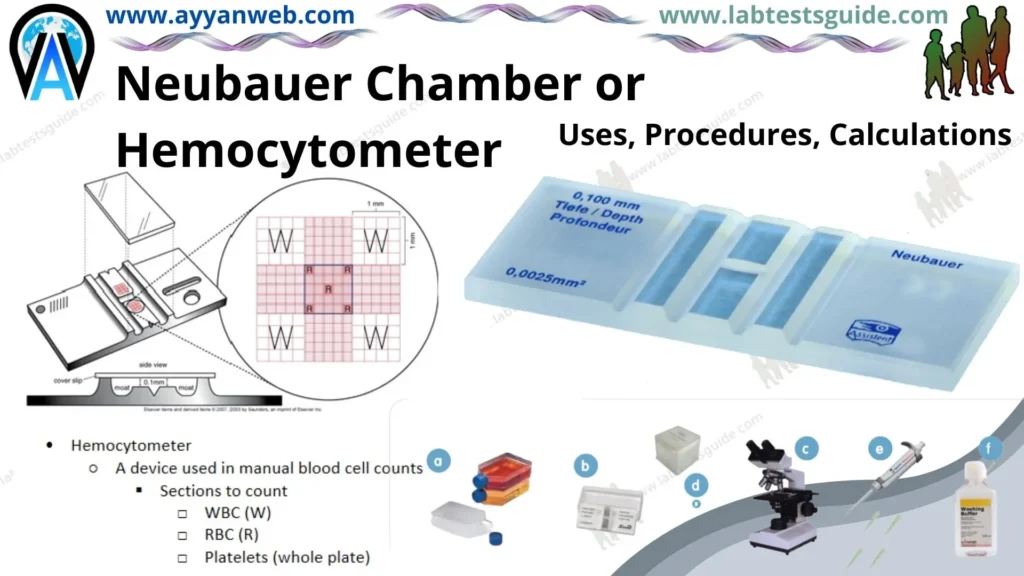
Table of Contents
The Neubauer Counting Chamber Calculator turns a manual count on a hemocytometer into the number of cells in the original sample. Enter the total cells counted, choose which squares and how many sides of the chamber you counted, and type the dilution factor. The calculator gives the cell count in cells/µL, the same count in ×10⁹/L, ×10⁶/mL and ×10¹²/L, the volume you counted and the counting error of your count.
It works for any cell counted on an Improved Neubauer chamber: white cells, red cells and platelets in blood, cells in cerebrospinal fluid (CSF) and other body fluids, sperm, and cells in culture. Results update as you type.
What is the Neubauer counting chamber?
The Improved Neubauer chamber is a thick glass slide with a ruled grid and a raised edge that holds a cover glass exactly 0.1 mm above the grid. The grid is 3 mm × 3 mm and is divided into 9 large squares of 1 mm × 1 mm (1 mm²) each.
- The 4 corner large squares are each divided into 16 squares. They are used for white cells.
- The centre large square is divided into 25 medium squares of 0.2 mm × 0.2 mm (0.04 mm²), and each of these into 16 small squares of 0.05 mm × 0.05 mm (0.0025 mm²). Five medium squares (the 4 corners and the centre of the centre square) are used for red cells; the whole centre square is often used for platelets.
Because the depth is 0.1 mm, each large square holds 1 mm² × 0.1 mm = 0.1 mm³ = 0.1 µL of fluid. Knowing the volume counted and the dilution, the number of cells per µL of the original sample can be calculated. Most chambers have two identical grids (two sides), so the count can be done twice.
How to use the calculator
- Dilute the sample (for example 1:20 for white cells) and fill the chamber. Wait 2 to 3 minutes for the cells to settle.
- Count the cells in the squares you chose, using the “L rule” for cells on the lines (see the tip below). Type the total in Total cells counted.
- Choose the squares you counted from the Squares counted (on one side) list, for example “4 large corner squares (4 mm²)”.
- Choose One side or Both sides from the Chamber sides counted list. If you counted both sides, add the two counts together before you type them.
- Type the Dilution factor: 20 for 1:20, 200 for 1:200, 1 for an undiluted sample such as CSF.
- Read the Cell count in cells/µL, the SI units line, the volume counted and the Counting error. If the error is above 10%, count more squares or both sides.
Practical tip: the L rule
Cells that touch the boundary lines of a square must be counted only once. Use the L rule: count the cells that touch the top and left lines, and do not count those that touch the bottom and right lines (or the other way round, as long as you are consistent). Check that the cells are evenly spread: the counts in the different squares should not differ by more than about 10 to 20% for white cells [review]. If they differ a lot, clean and refill the chamber.
Formulas Explained
1. Cell count (cells/µL)
Cells/µL = Cells counted × Dilution factor ÷ (Area counted (mm²) × Depth (0.1 mm))
Area counted = area of the squares on one side × number of sides. Area × depth is the volume counted in mm³, and 1 mm³ = 1 µL.
What it means: the number of cells in each microlitre of the original, undiluted sample.
When it is valid: only for a chamber with a depth of 0.1 mm (Neubauer or Improved Neubauer), filled correctly with no air bubbles, overfilling or underfilling, and with cells evenly spread. Other chambers (for example Fuchs-Rosenthal, depth 0.2 mm, or Makler) need a different formula.
Example (default values: 100 cells in 4 large squares, one side, dilution 1:20): 100 × 20 ÷ (4 × 1 × 0.1) = 2,000 ÷ 0.4 = 5,000 cells/µL.
Short cuts: for white cells (1:20, 4 large squares) the result is cells counted × 50. For red cells (1:200, 5 medium squares) it is cells counted × 10,000.
2. Cell count (SI units and per mL)
×10⁹/L = cells/µL ÷ 1,000; ×10⁶/mL = cells/µL ÷ 1,000; ×10¹²/L = cells/µL ÷ 1,000,000
What it means: the same count in the units used on reports. White cells and platelets are reported in ×10⁹/L, red cells in ×10¹²/L, and sperm concentration in million per mL (×10⁶/mL, the same number as ×10⁹/L).
When it is valid: the same as the cell count. Very small counts, such as CSF cells, are clearer in cells/µL.
Example (default values): 5,000 ÷ 1,000 = 5.00 ×10⁹/L. Tap the value to see ×10⁶/mL or ×10¹²/L.
3. Volume of sample counted
Volume counted (µL) = Area counted (mm²) × 0.1 mm
What it means: how much diluted sample lay over the squares you counted. A larger volume gives a more reliable count.
When it is valid: for a 0.1 mm deep chamber.
Example (default values): 4 × 1 × 0.1 = 0.40 µL.
4. Counting error (coefficient of variation)
Counting error (CV %) = 100 ÷ √(Cells counted)
What it means: cells settle in the chamber at random, so even a perfect count has a built-in error that follows the Poisson distribution. The coefficient of variation (CV) is about 1 ÷ √n. About 95% of repeat counts fall within twice this percentage of the result. Counting more cells lowers the error: 100 cells give 10%, 400 cells give 5%.
When it is valid: this is the smallest possible error, from chance alone. Pipetting, mixing and filling errors add to it. The result stays empty when no cells were counted.
Example (default values): 100 ÷ √100 = 100 ÷ 10 = 10.0%. Acceptable precision; about 95% of repeat counts would fall between 4,000 and 6,000 cells/µL.
Common set-ups
| Cell type | Usual dilution | Squares counted | Short cut |
|---|---|---|---|
| White cells (blood) | 1:20 | 4 large corner squares (4 mm²) | cells × 50 = /µL |
| Red cells (blood) | 1:200 | 5 medium squares (0.2 mm²) | cells × 10,000 = /µL |
| Platelets (blood) | 1:100 (or 1:20) | Whole centre square (1 mm²) | cells × 1,000 = /µL (1:100) |
| CSF cells | Undiluted | All 9 large squares (9 mm²) | cells × 1.11 = /µL |
Unit conversion for the inputs
| Item | Conversion | Back | Example |
|---|---|---|---|
| Dilution | 1:20 = dilution factor 20 | factor 200 = 1:200 | 20 µL blood + 380 µL fluid = 1:20 |
| Volume | 1 mm³ = 1 µL | 1 µL = 1 mm³ | 1 large square = 0.1 µL |
| Result | cells/µL ÷ 1,000 = ×10⁹/L | ×10⁹/L × 1,000 = cells/µL | 5,000 cells/µL = 5.00 ×10⁹/L |
Worked Example
Example 1: white cell count (default values)
Blood diluted 1:20 in white cell diluting fluid. 100 white cells counted in the 4 large corner squares on one side.
| Result | Working | Value (both units) | Category |
|---|---|---|---|
| Cell count | 100 × 20 ÷ (4 × 1 × 0.1) | 5,000 cells/µL 5.00 ×10⁹/L | – |
| Volume counted | 4 × 1 × 0.1 | 0.40 µL | – |
| Counting error | 100 ÷ √100 | 10.0% | Acceptable precision |
Counting both sides (for example 100 + 110 = 210 cells, Both sides) gives 210 × 20 ÷ (4 × 2 × 0.1) = 5,250 cells/µL with a counting error of 6.9%.
Example 2: red cell count
Blood diluted 1:200 in red cell diluting fluid. 500 red cells counted in the 5 medium squares of the centre square on one side.
| Result | Working | Value (both units) | Category |
|---|---|---|---|
| Cell count | 500 × 200 ÷ (0.2 × 1 × 0.1) | 5,000,000 cells/µL (5 × 10⁶) 5.00 ×10¹²/L | – |
| Volume counted | 0.2 × 1 × 0.1 | 0.02 µL | – |
| Counting error | 100 ÷ √500 | 4.5% | Good precision |
Formula limit: for a CSF sample with only 12 cells counted in all 9 squares (undiluted), the count is 12 × 1 ÷ 0.9 = 13 cells/µL, but the counting error is 28.9%. The result is a rough estimate; a cytocentrifuge slide helps to confirm low counts.
Interpretation
How precise is your count?
| Cells counted | Counting error (CV) | 95% of repeats within | Precision |
|---|---|---|---|
| 400 or more | 5% or less | ±10% | Good |
| 100 to 399 | 5 to 10% | ±10 to 20% | Acceptable |
| below 100 | above 10% | more than ±20% | Poor |
These limits come from the Poisson counting error (CV = 1 ÷ √n). Laboratories may set their own minimum counts [review].
Typical adult reference ranges for blood counts
| Cell | cells/µL | SI units | Note |
|---|---|---|---|
| White cells | 4,000 to 11,000 | 4.0 to 11.0 ×10⁹/L | Varies by laboratory and ethnic group [review] |
| Red cells, men | 4.5 to 5.5 million | 4.5 to 5.5 ×10¹²/L | [review] |
| Red cells, women | 3.8 to 4.8 million | 3.8 to 4.8 ×10¹²/L | [review] |
| Platelets | 150,000 to 410,000 | 150 to 410 ×10⁹/L | [review] |
| CSF white cells, adults | 0 to 5 | 0 to 5 ×10⁶/L | Higher in newborns |
For semen, the WHO 2021 lower reference limit for sperm concentration is 16 million per mL (16 ×10⁶/mL).
When the count is not reliable
- The chamber was overfilled (fluid in the moats), underfilled, or has air bubbles, so the depth is not exactly 0.1 mm.
- The cover glass is not the special thick counting-chamber cover glass, or it is not pressed down properly (look for Newton's rings).
- Cells are clumped or unevenly spread; counts in the squares differ a lot.
- The dilution was wrong, the pipette was not wiped, or the sample was not mixed before filling.
- The chamber was counted too early (cells still moving) or too late (fluid drying).
- Too few cells were counted (see the precision table).
- For white cells, nucleated red cells were counted as white cells: correct the count with our Corrected WBC Count Calculator.
This calculator is for education and routine calculation only. It does not diagnose any condition and does not replace your laboratory report or advice from your doctor.
FAQ
What is the formula for a Neubauer chamber cell count?
Cells/µL = cells counted × dilution factor ÷ (area counted in mm² × 0.1 mm depth). For example, 100 white cells in 4 large squares at 1:20 give 100 × 20 ÷ 0.4 = 5,000 cells/µL.
What is the depth of the Neubauer chamber?
The Neubauer and Improved Neubauer chambers are 0.1 mm deep, so each 1 mm² large square holds 0.1 µL of fluid.
Which squares are used for the WBC count?
White cells are usually counted in the 4 large corner squares (4 mm² in total) at a 1:20 dilution. The quick formula is cells counted × 50 = cells/µL.
Which squares are used for the RBC count?
Red cells are counted in 5 medium squares of the centre square (0.2 mm² in total) at a 1:200 dilution. The quick formula is cells counted × 10,000 = cells/µL.
How do I count cells that touch the lines?
Use the L rule: count cells touching the top and left lines and leave out cells touching the bottom and right lines. This makes sure each cell is counted only once.
How many cells should I count?
Count at least 100 cells, and ideally 400 or more. The counting error is about 100 ÷ √n percent, so 100 cells give 10% and 400 cells give 5%.
What if I count both sides of the chamber?
Add the counts from both sides and choose Both sides. The calculator doubles the area, so the result is the average of the two sides.
How do I convert cells/µL to ×10⁹/L?
Divide cells/µL by 1,000. For example, 5,000 cells/µL = 5.0 ×10⁹/L. For red cells, divide by 1,000,000 to get ×10¹²/L.
Can I use this calculator for sperm counts?
Yes, if you use an Improved Neubauer chamber. Enter the sperm counted, the squares, the sides and the dilution; read the result in ×10⁶/mL (million per mL).
Why is the manual count different from the analyser count?
Manual counts have a larger random error, especially when few cells are counted, and depend on pipetting and filling. Differences of 10 to 20% are common with manual counts.
References
- Bain BJ, Bates I, Laffan MA, eds. Dacie and Lewis Practical Haematology. 12th ed. London: Elsevier; 2017.
- Berkson J, Magath TB, Hurn M. The error of estimate of the blood cell count as made with the hemocytometer. Am J Physiol. 1940;128(2):309-323.
- Clinical and Laboratory Standards Institute. H56-A: Body Fluid Analysis for Cellular Composition. Wayne (PA): CLSI; 2006.
- World Health Organization. WHO laboratory manual for the examination and processing of human semen. 6th ed. Geneva: WHO; 2021. https://www.who.int/publications/i/item/9789240030787
- McPherson RA, Pincus MR, eds. Henry's Clinical Diagnosis and Management by Laboratory Methods. 24th ed. Philadelphia: Elsevier; 2022.
- MedlinePlus. Complete Blood Count (CBC). National Library of Medicine. https://medlineplus.gov/lab-tests/complete-blood-count-cbc/
This page is for educational purposes only and is not a substitute for professional medical advice, diagnosis or treatment. Read the full disclaimer
More Calculators

Corrected WBC Count Calculator (When NRBCs Are Present)
Free corrected WBC calculator: correct the white cell count for nucleated red blood cells (NRBCs) and get the absolute NRBC count, in ×10⁹/L or…
Discussion 0