

Measles Deaths Plummet but Cases Surge WHO Warns Global Elimination Is a Distant Goal
Despite dramatic reductions in deaths thanks to vaccination, measles infections are rising globally threatening to erode decades of progress.
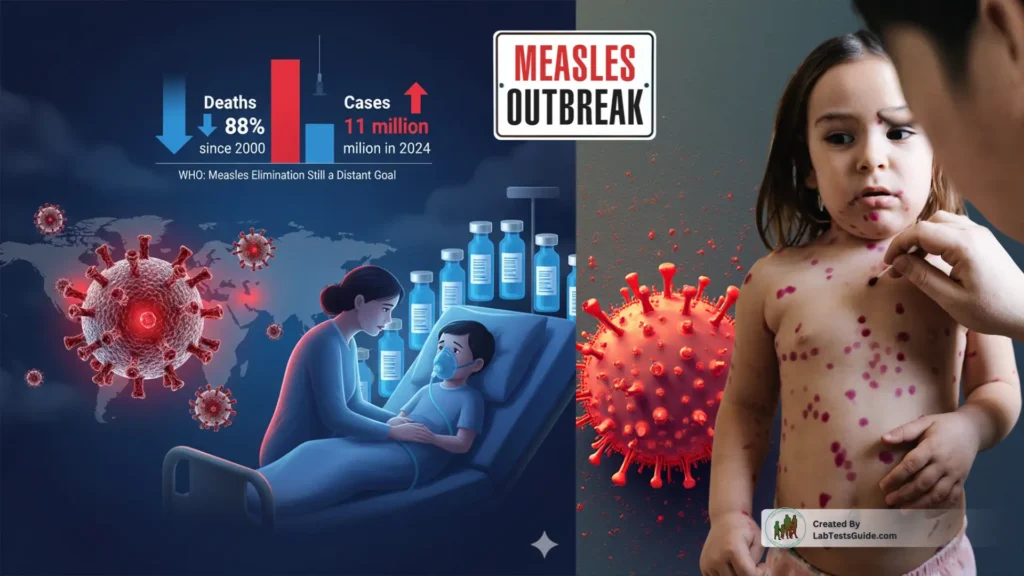
A new WHO report shows measles deaths have fallen 88% since 2000 yet 11 million cases occurred in 2024 alone. With 30 million children under-protected, global elimination of measles remains elusive.
Measles A Public Health Paradox: Fewer Deaths, More Infections
A new report from the World Health Organization (WHO) reveals a striking paradox: since the year 2000, deaths from Measles have dropped by 88 %, saving nearly 59 million lives globally.
Yet, despite these gains, measles is surging with an estimated 11 million infections worldwide in 2024, roughly 800,000 more than in 2019, the pre-pandemic benchmark.
An estimated 95,000 people, mostly children under five, succumbed to measles in 2024 the lowest annual death toll in decades, but still tragically high for a fully vaccine-preventable disease.
Where the Infections Are Rising Regional Trends
The 2024 surge in measles is not uniform. According to WHO:
- Cases rose 86% in the Eastern Mediterranean region compared to 2019.
- The European region saw a 47% increase, while the South-East Asian region experienced 42% more cases.
- In contrast, the African region recorded a 40% decline in cases and a 50% drop in deaths, mainly due to improved immunization coverage.
Still, 59 countries worldwide reported large or disruptive outbreaks in 2024 nearly three times the number reported in 2021, and the highest globally since the COVID-19 pandemic began.
These outbreaks hit even countries that once had measles under control signaling that no region is immune when vaccination gaps remain.
Why the Surge Immunization Gaps and Systemic Weaknesses
Central to the rebound in measles is insufficient immunisation coverage. In 2024, only 84% of children globally received the first dose of measles vaccine, while just 76% got the second dose.
But for herd immunity and to effectively block transmission, at least 95% of children need two doses.
As a result, more than 30 million children remained under-protected in 2024 many of them in vulnerable, conflict-affected, or under-served settings, especially across Africa and the Eastern Mediterranean.
The report also warns that the current surge exposes weaknesses in immunization programs and public health infrastructure worldwide especially as funding cuts and pandemic-era disruptions have hampered routine vaccination and surveillance.
Long-Term Goals at Risk: Is Measles Elimination Slipping Away?
The resurgence of measles threatens to undermine the long-term ambition set by Immunization Agenda 2030 (IA2030), which considers measles a key indicator of a health system’s ability to deliver essential childhood vaccines.
Although progress has been made as of the end of 2024, 81 countries (42 %) had eliminated measles; recent updates in 2025 brought the total to 96 countries globally.
But for many nations, elimination remains a distant goal. The rise in outbreaks, even in high-income countries, shows that pockets of low vaccination coverage can quickly reverse decades of progress.
To safeguard the gains, WHO calls for strong political commitment, sustained funding, high-quality routine immunization, and robust surveillance including outbreak detection and rapid response.
What This Means for Public Health And for Pakistan
For countries like Pakistan where public health systems already contend with multiple infectious diseases the resurgence of measles is a stark reminder that progress is fragile.
- Even though measles deaths worldwide dropped dramatically, the resurgence increases the risk of outbreaks, especially in under-vaccinated communities.
- Measles is highly contagious (one patient can infect many others), and even a small drop in vaccination coverage can trigger outbreaks.
- Children who contract measles remain at risk of serious complications such as pneumonia, blindness, or brain inflammation (encephalitis).
For Pakistan’s healthcare authorities and public health advocates, this underscores the urgent need to strengthen routine immunization services, ensure both vaccine doses reach every child, and keep vigilant surveillance especially in conflict-affected, remote or underserved areas.
Measles Victory Is Not Assured Collective Will Needed
The story of measles over the past two decades is one of remarkable success: millions of lives saved, countries achieving elimination, and once-common epidemics largely tamed.
Yet the recent surge shows how quickly that success can unravel. Until every child everywhere receives both recommended vaccine doses and until health systems are robust enough to catch and contain outbreaks measles remains a threat.
The world may have come close to consigning measles to history but only sustained commitment, equitable access to immunization, stable funding, and strong surveillance will guarantee that legacy.
References
- Measles deaths plummet but infections surge worldwide – Medical News – (Accessed on Dec 1, 2025)
- Measles cases are surging, making global elimination a ‘distant goal,’ WHO says – CNN – (Accessed on Dec 1, 2025)
- Global measles cases surge as 30 million children miss vaccines, UN health agency warns – United Nation – (Accessed on Dec 1, 2025)
