
Article

Blood Agar MCQs Mock Test

Editorial StaffUpdated 2 min read

Quick Overview

Test your expertise with 30 Blood Agar MCQs! Prep for exams & clinical lab work with key concepts, troubleshooting tips, and performance analysis.

  • CategoryMCQs
  • Read time2 min
  • UpdatedJan 2026
Blood Agar MCQs Mock Test
Table of Contents

Blood Agar MCQs Mock Test: Master Culture Media for Lab Techs & Med Students

Sharpen your microbiology knowledge with this Blood Agar MCQs Mock Test! Designed for medical laboratory professionals and students, this test covers hemolysis patterns, pathogen identification, media preparation, and clinical applications. Assess your skills before the test with targeted study tips, then validate your learning with detailed explanations. Ace your exams and boost lab confidence!

Blood agar is the cornerstone of bacteriology, enabling isolation of fastidious pathogens and hemolysis analysis. Whether you’re a medical student prepping for boards or a lab tech refining diagnostic skills, this 30-question mock test bridges theory and practice. Here’s how to maximize your learning:


Prep Like a Pro

  1. Core Concepts to Review:
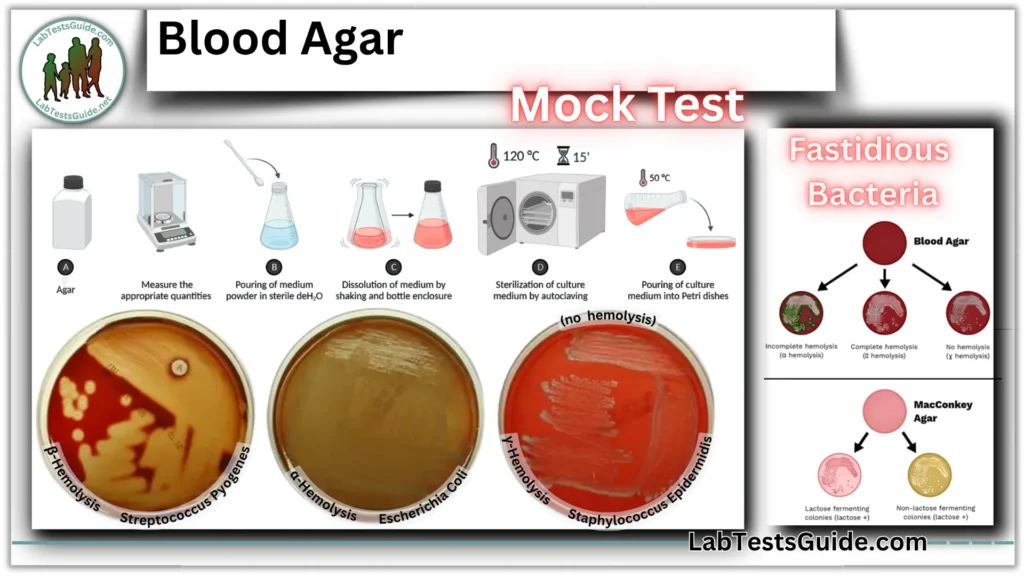
    • Hemolysis patterns (α, β, γ) and associated pathogens (e.g., Streptococcus pyogenes vs. pneumoniae).
    • Blood agar preparation: Base media (TSA vs. chocolate agar), anticoagulant choices (EDTA/heparin), and QC protocols.
    • Fastidious organism requirements (e.g., Haemophilus spp. requiring NAD).
  2. Clinical Pitfalls & Troubleshooting:
    • Contamination sources: Improper sterilization or expired sheep blood.
    • Misinterpretation: Partial vs. complete hemolysis; Staphylococcus aureus β-hemolysis vs. Enterococcus α-hemolysis.
    • Common errors: Over-incubation masking hemolysis, incorrect blood concentration (5-10%).
  3. Study Resources:
    • ASM’s Manual of Clinical Microbiology, CDC lab protocols.
    • Flowcharts for hemolysis differentiation.
0%
0 votes, 0 avg
3

Report a question

You cannot submit an empty report. Please add some details.

Microbiology Department

Blood Agar MCQs Mock Test

Blood Agar MCQs Mock Test

Blood agar is the cornerstone of clinical microbiology, enabling isolation and hemolysis-based differentiation of pathogens like Streptococcus, Staphylococcus, and fastidious organisms. Whether you’re interpreting beta-hemolysis or troubleshooting contaminants, mastering blood agar is non-negotiable. This mock test bridges textbook knowledge and real-world lab challenges.

Prep Like a Pro

Maximize your test performance with these evidence-backed strategies:

  1. Revise Hemolysis Patterns Visually:

    • Beta (β): Complete lysis → clear zones (e.g., S. pyogenes).

    • Alpha (α): Partial lysis → greenish zones (e.g., S. pneumoniae).

    • Gamma (γ): No lysis → no change (e.g., Enterococcus).
      Tip: Sketch patterns or use flashcards.

  2. Contextualize Clinical Scenarios:

    • Link organisms to diseases:

      • β-hemolysis + catalase-negative = Group A Strep (pharyngitis).

      • α-hemolysis + optochin-sensitive = S. pneumoniae (pneumonia).

  3. Anticipate Pitfalls:

    • Overlooked factors: Chocolate agar vs. blood agar for H. influenzae.

    • Contaminant red flags: Micrococcus (yellow colonies) vs. Staphylococcus.

  4. Speed-Drill Basics:

    • Composition (5% sheep blood), temperature (35–37°C), and atmospheric needs.

    • QC checks: Verify hemolysis with control strains (S. aureus β, S. viridans α).


Read More: Blood Agar FAQs and MCQs

1 / 30

Category: Clinical Laboratory

What is the primary use of Chocolate Agar?

2 / 30

Category: Clinical Laboratory

What is Blood Agar primarily used for?

3 / 30

Category: Clinical Laboratory

What is the purpose of the stab technique in Blood Agar?

4 / 30

Category: Clinical Laboratory

Who introduced agar to microbiology?

5 / 30

Category: Clinical Laboratory

What was used before agar in early microbiology?

6 / 30

Category: Clinical Laboratory

What is the role of agar in Blood Agar?

7 / 30

Category: Clinical Laboratory

Why is Blood Agar used for throat swabs?

8 / 30

Category: Clinical Laboratory

What does beta (β) hemolysis indicate?

9 / 30

Category: Clinical Laboratory

Which organism exhibits beta hemolysis?

10 / 30

Category: Clinical Laboratory

Gamma (γ) hemolysis means:

11 / 30

Category: Clinical Laboratory

Which component in Blood Agar maintains osmotic balance?

12 / 30

Category: Clinical Laboratory

What is the main limitation of sheep blood in Blood Agar?

13 / 30

Category: Clinical Laboratory

What happens if blood is added to hot agar?

14 / 30

Category: Clinical Laboratory

What is alpha-prime hemolysis?

15 / 30

Category: Clinical Laboratory

Why is human blood discouraged in Blood Agar preparation?

16 / 30

Category: Clinical Laboratory

At what temperature should blood be added to the agar base?

17 / 30

Category: Clinical Laboratory

Which of the following is NOT a base medium for Blood Agar?

18 / 30

Category: Clinical Laboratory

What percentage of blood is typically added to Blood Agar?

19 / 30

Category: Clinical Laboratory

What is the CAMP test used for?

20 / 30

Category: Clinical Laboratory

What does “fastidious bacteria” mean?

21 / 30

Category: Clinical Laboratory

Which organism is gamma-hemolytic?

22 / 30

Category: Clinical Laboratory

Which bacteria show double-zone hemolysis?

23 / 30

Category: Clinical Laboratory

Which toxin causes beta hemolysis in Staphylococcus aureus?

24 / 30

Category: Clinical Laboratory

Which bacterium is associated with alpha (α) hemolysis?

25 / 30

Category: Clinical Laboratory

Which organism produces streptolysin O?

26 / 30

Category: Clinical Laboratory

Which bacteria require Chocolate Agar instead of Blood Agar?

27 / 30

Category: Clinical Laboratory

How is Blood Agar sterilized?

28 / 30

Category: Clinical Laboratory

What is the final pH of Blood Agar?

29 / 30

Category: Clinical Laboratory

Which type of blood is commonly used in Blood Agar for Group A Streptococci?

30 / 30

Category: Clinical Laboratory

How should Blood Agar plates be stored?

If you want to download Certificates then Please Put your Name and Correct Email

Your score is

The average score is 24%

0%

Analyze & Improve

  1. Scoring Breakdown:
    • 25-30 Correct: Expert! Focus on rare edge cases (e.g., Aerococcus α-hemolysis).
    • 15-24 Correct: Solid foundation. Revisit hemolysis patterns and fastidious organisms.
    • <15 Correct: Review blood agar fundamentals: components, incubation, and organism behavior.
  2. Key Takeaways from Answers:
    • Hemolysis Nuances: β-hemolysis requires complete RBC lysis (e.g., Group A Strep); α-hemolysis shows partial lysis with green tint.
    • Media Limitations: Blood agar can’t grow Mycoplasma (requires cholesterol).
    • Clinical Correlations: Chocolate agar vs. blood agar for H. influenzae.
📚 This article may have been prepared using trusted medical literature, clinical guidelines, textbooks, and peer-reviewed sources.
View Possible References Used →

Discussion 0

Join the discussion

Join our community

Get fresh content from Lab Tests Guide