

Biochemical Test of Francisella Tularensis Subsp. Tularensis 50 FAQs and 30 MCQs:
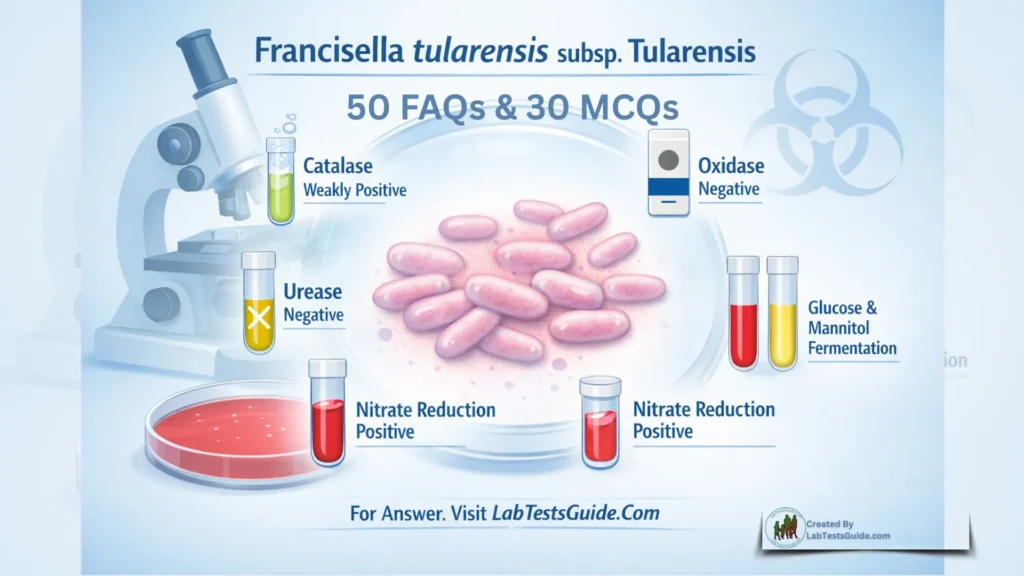
Biochemical Test of Francisella Tularensis Subsp. Tularensis 50 FAQs:
What bacterium causes tularemia?
Francisella tularensis subsp. tularensis.
What is tularemia also known as?
Rabbit fever or deer fly fever.
Why are biochemical tests important for F. tularensis? F
or identification and differentiation from other bacteria.
What is the Gram stain reaction of F. tularensis subsp. tularensis?
Gram-negative.
Why does F. tularensis stain faintly in Gram staining?
It has difficulty retaining the crystal violet stain.
What is the shape of F. tularensis subsp. tularensis?
Short rod-shaped or coccoid (pleomorphic coccobacillus).
What is the typical size of F. tularensis subsp. tularensis?
0.2-0.5 µm wide by 0.7-1.0 µm long.
Does F. tularensis subsp. tularensis have a capsule?
Yes (Capsule Positive).
Is F. tularensis subsp. tularensis motile?
No (Motility Negative).
Does F. tularensis subsp. tularensis produce spores?
No (Spore Negative).
Where is F. tularensis subsp. tularensis primarily found?
North America.
Is F. tularensis subsp. tularensis considered highly virulent?
Yes, it’s the most virulent subspecies.
hat is the catalase test result for F. tularensis subsp. tularensis?
Positive (slightly positive/weakly positive).
What does the slightly positive catalase test indicate?
It produces a small amount of catalase enzyme.
What is the oxidase test result for F. tularensis subsp. tularensis?
Negative.
What does a negative oxidase test indicate?
It lacks cytochrome c oxidase.
What is the urease test result for F. tularensis subsp. tularensis?
Negative.
What does a negative urease test indicate?
It cannot hydrolyze urea into ammonia and CO2.
What is the gelatin hydrolysis test result for F. tularensis subsp. tularensis?
Negative.
What does a negative gelatin hydrolysis test indicate?
It lacks gelatinase enzyme.
What is the nitrate reduction test result for F. tularensis subsp. tularensis?
Positive (converts nitrate to nitrite).
How is a positive nitrate reduction test detected?
Reagents produce a red color with nitrites.
Does F. tularensis subsp. tularensis produce gas from fermentation?
No (Gas Negative).
Does F. tularensis subsp. tularensis produce Indole?
No (Indole Negative).
Does F. tularensis subsp. tularensis produce NH3 in liquid media?
No (NH3 Negative).
Is F. tularensis subsp. tularensis soluble in sodium ricinoleate?
Yes (Positive).
Does F. tularensis subsp. tularensis produce Beta-Lactamase?
Yes (Positive).
What is the Citrulline ureidase (CTU) test result for F. tularensis subsp. tularensis?
Positive.
What is the H2S production result (in cysteine-supplemented medium) for F. tularensis subsp. tularensis?
Positive.
Does F. tularensis subsp. tularensis ferment glucose?
Yes (Positive).
Does F. tularensis subsp. tularensis produce gas when fermenting glucose?
No.
How is glucose fermentation detected?
Acid production turns the pH indicator yellow.
Does F. tularensis subsp. tularensis ferment mannitol?
Yes
Does F. tularensis subsp. tularensis produce gas when fermenting mannitol?
No.
Does F. tularensis subsp. tularensis ferment lactose?
No (Negative).
What does a negative lactose fermentation test look like?
No color change in the medium.
Does F. tularensis subsp. tularensis ferment sucrose?
No (Negative).
What does a negative sucrose fermentation test indicate?
It cannot use sucrose as a carbon source.
Does F. tularensis subsp. tularensis ferment maltose?
source 1 states Positive (+ve),spurce 2 states Negative.
What does a negative maltose fermentation test indicate?
It lacks enzymes to use maltose
Does F. tularensis subsp. tularensis ferment arabinose?
No
What does a negative arabinose fermentation test indicate?
It lacks enzymes to use arabinose.
Does F. tularensis subsp. tularensis ferment glycerol?
Yes
How does the faint Gram staining help differentiate F. tularensis?
It distinguishes it from strongly staining Gram-negative or Gram-positive bacteria.
How does the negative oxidase test help differentiate F. tularensis?
It distinguishes it from oxidase-positive bacteria like Neisseria or Pseudomonas.
How does the weak catalase test help differentiate F. tularensis?
It distinguishes it from strongly catalase-positive bacteria (e.g., Staph) or catalase-negative bacteria.
How does the negative urease test help differentiate F. tularensis?
It distinguishes it from urease-positive bacteria like Proteus or Helicobacter.
How does the positive nitrate reduction test help identify F. tularensis?
It is a key characteristic used in its identification scheme.
How does the pattern of sugar fermentation (Glucose+, Lactose-, Sucrose-, Maltose?/-, Arabinose-) help differentiate F. tularensis?
It provides a metabolic profile distinct from many Enterobacteriaceae or other Gram-negative rods.
Why is the positive Beta-Lactamase test clinically significant?
It indicates resistance to beta-lactam antibiotics (like penicillin).
Biochemical Test of Francisella Tularensis Subsp. Tularensis 30cMCQs:
- What disease is caused by Francisella tularensis subsp. tularensis?
a) Lyme disease
b) Tularemia (Rabbit fever)✔
c) Rocky Mountain spotted fever
d) Q fever - What is the Gram stain reaction of F. tularensis subsp. tularensis?
a) Gram-positive
b) Gram-negative (faintly stained)✔
c) Acid-fast
d) Gram-variable - What is the shape of F. tularensis subsp. tularensis?
a) Spherical
b) Short rod or coccoid (pleomorphic coccobacillus)✔
c) Spiral
d) Filamentous - What is the result of the catalase test for F. tularensis subsp. tularensis?
a) Strongly positive
b) Weakly positive✔
c) Negative
d) Variable - What is the oxidase test result for F. tularensis subsp. tularensis?
a) Positive
b) Negative✔
c) Delayed positive
d) Not applicable - What is the urease test result for F. tularensis subsp. tularensis?
a) Positive
b) Negative✔
c) Weakly positive
d) Positive only at 37°C - Does F. tularensis subsp. tularensis ferment glucose?
a) No
b) Yes, without gas production✔
c) Yes, with gas production
d) Only under anaerobic conditions - What is the lactose fermentation result for F. tularensis subsp. tularensis?
a) Positive
b) Negative✔
c) Positive with gas
d) Variable - What is the sucrose fermentation result for F. tularensis subsp. tularensis?
a) Positive
b) Negative✔
c) Positive only with cysteine
d) Weakly positive - What is the maltose fermentation result according to Article 1?
a) Negative
b) Positive✔
c) Variable
d) Not tested - What is the gelatin hydrolysis result for F. tularensis subsp. tularensis?
a) Positive
b) Negative✔
c) Slow positive
d) Requires specific media - What is the nitrate reduction test result?
a) Negative
b) Positive (reduces nitrate to nitrite)✔
c) Positive for denitrification
d) Only positive in aerobic conditions - Does F. tularensis subsp. tularensis produce spores?
a) Yes
b) No✔
c) Only under stress
d) Produces endospores - What is the H₂S production result (in cysteine-supplemented medium)?
a) Negative
b) Positive✔
c) Weakly positive
d) Requires lead acetate strip - What enzyme makes F. tularensis subsp. tularensis resistant to penicillins?
a) Penicillinase (type unspecified)
b) Beta-Lactamase✔
c) Carbapenemase
d) ESBL - What is the motility status of F. tularensis subsp. tularensis?
a) Motile with flagella
b) Non-motile✔
c) Motile via gliding
d) Temperature-dependent motility - Which sugar is fermented by F. tularensis subsp. tularensis according to both articles?
a) Lactose
b) Sucrose
c) Arabinose
d) Glucose✔ - What is the indole test result?
a) Positive
b) Negative✔
c) Weakly positive
d) Positive with Ehrlich’s reagent - What is the citrulline ureidase (CTU) test result?
a) Negative
b) Positive✔
c) Not applicable
d) Requires specific pH - Which geographic region is F. tularensis subsp. tularensis primarily associated with?
a) Europe
b) Asia
c) Africa
d) North America✔ - What is the capsule status of F. tularensis subsp. tularensis?
a) Negative
b) Positive✔
c) Only in virulent strains
d) Demonstrated only with India ink - How does F. tularensis subsp. tularensis appear after Gram staining?
a) Purple cocci
b) Faintly stained pink/red coccobacilli✔
c) Blue rods
d) Purple rods - What is the arabinose fermentation result?
a) Positive
b) Negative✔
c) Positive with acid only
d) Positive with acid and gas - What is the result of the sodium ricinoleate solubility test?
a) Negative
b) Positive✔
c) Not reported
d) Used for subtyping - Why is the faint Gram staining significant for identification?
a) Indicates acid-fastness
b) Helps differentiate from strongly staining bacteria✔
c) Confirms spore formation
d) Indicates capsule presence - What does a negative urease test help differentiate F. tularensis from?
a) Escherichia coli
b) Salmonella typhi
c) Urease-positive bacteria like Proteus✔
d) Pseudomonas aeruginosa - What does the positive nitrate reduction test produce?
a) Ammonia
b) Nitrogen gas
c) Nitrite (detected by red color)✔
d) Nitrous oxide - What is the glycerol fermentation result per Article 1?
a) Negative
b) Positive✔
c) Not tested
d) Variable - What is the mannitol fermentation result?
a) Negative
b) Positive (without gas)✔
c) Positive with gas
d) Negative with acid production - Why is F. tularensis subsp. tularensis considered highly dangerous?
a) Rapid environmental spread
b) High virulence (most virulent subspecies)✔
c) Antibiotic resistance to all drugs
d) Waterborne transmission
