

Biochemical Test of Mycobacterium tuberculosis 50 FAQs and 30 MCQs
Biochemical testing plays a crucial role in the identification and confirmation of Mycobacterium tuberculosis in the microbiology laboratory. Along with microscopy and culture, tests like niacin production, nitrate reduction, catalase activity, and susceptibility to specific inhibitors help differentiate M. tuberculosis from other mycobacterial species.
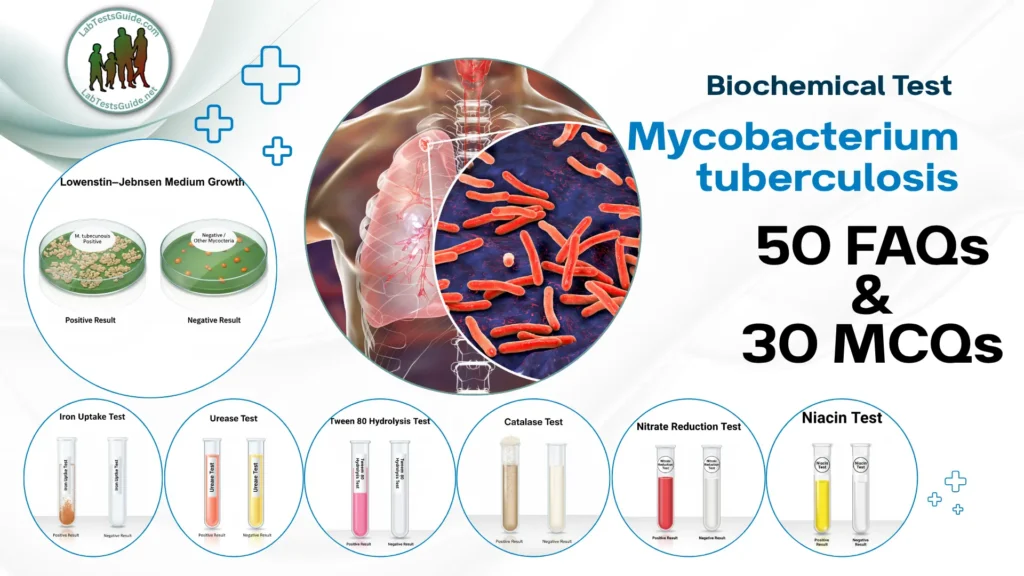
This article is designed for medical laboratory professionals and medical students who want a quick, exam-oriented and bench-oriented review. In the following sections, you will find 50 FAQs that explain the purpose, principle, and interpretation of common biochemical tests for M. tuberculosis, followed by 30 MCQs to assess your understanding and prepare for exams, viva, and interviews.
Biochemical Test of Mycobacterium tuberculosis 50 FAQs
Is M. tuberculosis acid-fast?
Yes, Acid Fast Stain is positive (+ve).
Does M. tuberculosis produce pigment?
No, pigmentation is negative (-ve).
Can M. tuberculosis grow at 22°C?
No, growth at 22°C is negative (-ve).
Can M. tuberculosis grow at 42°C?
No, growth at 42°C is negative (-ve).
Why is the niacin test important for M. tuberculosis?
M. tuberculosis accumulates more niacin than other mycobacteria.
What does a positive niacin test suggest?
It indicates a buff-colored, slow-growing rough colony may be M. tuberculosis.
Is M. tuberculosis niacin test positive?
Yes, positive (+ve).
What is the nitrate reduction result for M. tuberculosis?
Positive (+ve).
Which other mycobacteria are nitrate-positive?
M. kansasii, M. szulgai, and M. fortuitum.
How long should slow growers incubate for nitrate testing?
3–4 weeks after luxuriant growth.
How long for rapid growers (e.g., M. fortuitum)?
Within 2 weeks.
Is M. tuberculosis positive in the 68°C catalase test?
No, negative (-ve).
What does a semiquantitative catalase test detect?
Catalase enzyme splitting hydrogen peroxide into water/oxygen (bubbles = positive).
Which mycobacteria lack catalase?
Some isoniazid-resistant M. tuberculosis strains and M. gastri.
Is M. tuberculosis semiquantitative catalase positive?
No, negative (-ve).
What does Tween 80 hydrolysis test differentiate?
Photochromogens, scotochromogens, and nonchromogens.
Is M. tuberculosis Tween 80 hydrolysis positive?
No, negative (-ve).
Which mycobacteria hydrolyze Tween 80?
Nonpathogenic slow-growing scotochromogens/nonchromogens.
What is M. tuberculosis tellurite reduction result?
Negative (-ve).
How is tellurite reduction used diagnostically?
It distinguishes M. avium complex (reduces tellurite in 3–4 days).
Do rapid growers reduce tellurite?
Yes, within 3 days.
Is M. tuberculosis arylsulfatase positive?
No (arylsulphatase test negative, -ve).
What does a 3-day arylsulfatase test identify?
Rapid growers like M. fortuitum and M. chelonae.
Which slow growers are 14-day arylsulfatase positive?
M. marinum and M. szulgai.
Is M. tuberculosis urease positive?
Yes, positive (+ve).
How does urease hydrolysis work?
Urease breaks urea into ammonia/CO₂, turning the medium pink.
Can M. tuberculosis tolerate 5% NaCl?
No, negative (-ve).
Does M. tuberculosis grow on P-nitrobenzoic acid?
No, negative (-ve).
Does M. tuberculosis grow on TCH (10 mg/ml)?
Yes, positive (+ve).
Is M. tuberculosis acid phosphatase positive?
No, negative (-ve).
Is M. tuberculosis peroxidase positive?
Yes, positive (+ve).
Is M. tuberculosis pyrazinamidase positive?
Yes, positive (+ve).
What is the neutral red test result for M. tuberculosis?
Positive (+ve).
Does M. tuberculosis uptake iron?
No, negative (-ve).
Is pyruvate stimulation growth positive for M. tuberculosis?
No, negative (-ve).
How does niacin accumulation differentiate M. tuberculosis?
M. tuberculosis accumulates the most niacin.
How does nitrate reduction differentiate M. tuberculosis from M. avium?
M. tuberculosis is positive; M. avium complex is negative.
Why is Tween 80 hydrolysis negative in pathogenic species?
Pathogens lack the lipase to hydrolyze Tween 80.
How is the niacin test performed?
Detects accumulated niacin in colonies (colorimetric method).
How is nitrate reduction tested?
Using chemical procedures or commercial nitrate strips.
Why are controls needed in nitrate testing?
To validate results and avoid false positives/negatives.
How is urease hydrolysis detected?
pH increase turns indicator pink.
Which mycobacteria reduce nitrate rapidly?
M. fortuitum (a rapid grower).
Is M. szulgai nitrate-positive?
Yes.
Is M. fortuitum arylsulfatase positive?
Yes (3-day test).
Can M. tuberculosis grow at 25°C?
No (growth at 25°C negative, -ve).
Does M. tuberculosis require pyruvate for growth?
No (pyruvate stimulation negative, -ve).
Does M. tuberculosis produce arylsulfatase?
No (arylsulphatase test negative, -ve).
What does amidase positivity indicate in M. tuberculosis?
It aids in species identification (positive, +ve).
How do biochemical tests collectively identify M. tuberculosis?
By combining results (e.g., Niacin+, Nitrate+, 68°C Catalase-, Tween 80 Hydrolysis-).
Biochemical Test of Mycobacterium tuberculosis 30 MCQs
- What is the result of the Niacin Test for M. tuberculosis?
a) Negative
b) Positive
c) Variable
d) Positive✔ - Which mycobacterium accumulates the highest levels of niacin?
a) M. fortuitum
b) M. avium
c) M. tuberculosis✔
d) M. kansasii - The Nitrate Reduction Test for M. tuberculosis is:
a) Negative
b) Positive✔
c) Weakly positive
d) Inconclusive - Which species is NOT nitrate-positive?
a) M. tuberculosis
b) M. szulgai
c) M. fortuitum
d) M. avium✔ - The 68°C Catalase Test for M. tuberculosis is:
a) Negative✔
b) Positive
c) Variable
d) Not applicable - Which mycobacteria lack catalase enzyme?
a) M. fortuitum
b) M. chelonae
c) Isoniazid-resistant M. tuberculosis strains✔
d) M. kansasii - Tween 80 Hydrolysis in M. tuberculosis is:
a) Negative✔
b) Positive
c) Slow positive
d) Variable - Tween 80 Hydrolysis helps differentiate:
a) Rapid vs. slow growers
b) Photochromogens, scotochromogens, and nonchromogens✔
c) Acid-fast vs. non-acid-fast
d) Pathogenic vs. saprophytic - Which mycobacteria hydrolyze Tween 80?
a) M. tuberculosis
b) Nonpathogenic slow-growing scotochromogens✔
c) M. avium complex
d) Rapid growers - The Tellurite Reduction Test for M. tuberculosis is:
a) Negative✔
b) Positive in 3 days
c) Positive in 14 days
d) Weakly positive - Tellurite reduction distinguishes M. avium complex from:
a) Rapid growers
b) Other non-chromogenic species✔
c) Photochromogens
d) M. tuberculosis - Rapid growers reduce tellurite within:
a) 24 hours
b) 3 days✔
c) 14 days
d) 4 weeks - The Arylsulfatase Test for M. tuberculosis is:
a) Negative✔
b) Positive in 3 days
c) Positive in 14 days
d) Variable - The 3-day Arylsulfatase Test identifies:
a) M. tuberculosis
b) M. szulgai
c) M. fortuitum and M. chelonae✔
d) M. avium - The Urease Test for M. tuberculosis is:
a) Negative
b) Positive✔
c) Weakly positive
d) Not applicable - A positive Urease Test is indicated by:
a) Gas bubbles
b) Pink color (pH increase)✔
c) Blue precipitate
d) Turbidity - Growth of M. tuberculosis on P-Nitrobenzoic Acid is:
a) Negative✔
b) Positive
c) Slow
d) Variable - M. tuberculosis growth on TCH (10 mg/ml) is:
a) Negative
b) Positive✔
c) Inhibited
d) Variable - The Semiquantitative Catalase Test for M. tuberculosis is:
a) Negative✔
b) Positive
c) Strongly positive
d) Not defined - The Niacin Test provides preliminary identification for:
a) Rapid growers
b) Buff-colored, slow-growing rough colonies✔
c) Pigmented mycobacteria
d) Nonpathogenic species - Nitrate Reduction Test for slow growers should be performed after:
a) 1 week
b) 2 weeks
c) 3–4 weeks✔
d) 6 weeks - Acid Fast Stain for M. tuberculosis is:
a) Negative
b) Positive✔
c) Partially positive
d) Variable - Pyrazinamidase Test for M. tuberculosis is:
a) Negative
b) Positive✔
c) Species-dependent
d) Not reliable - Which test is negative for M. tuberculosis but positive for M. avium complex?
a) Niacin Test
b) Nitrate Reduction
c) Tellurite Reduction✔
d) Urease Test - Iron Uptake Test for M. tuberculosis is:
a) Negative✔
b) Positive
c) Weakly positive
d) Not tested - Growth of M. tuberculosis at 42°C is:
a) Negative✔
b) Positive
c) Slow
d) Temperature-dependent - The 14-day Arylsulfatase Test is positive for:
a) M. fortuitum
b) M. chelonae
c) M. marinum and M. szulgai✔
d) M. tuberculosis - Neutral Red Test for M. tuberculosis is:
a) Negative
b) Positive✔
c) Equivocal
d) Not mentioned - Pigmentation in M. tuberculosis is:
a) Negative✔
b) Positive (buff)
c) Scotochromogenic
d) Photochromogenic - A key test to differentiate M. tuberculosis from M. bovis is:
a) Acid Fast Stain
b) Growth on TCH (Thiophene-2-carboxylic acid hydrazide)✔
c) Catalase Test
d) Urease Test
- Read each question carefully before selecting your answer.
- Attempt all questions to get a better assessment of your knowledge.
- Avoid guessing blindly; think about the principle and expected reaction.
- Use this mock test for self-evaluation, not as a substitute for textbooks.
- After completing the test, review your wrong answers and revise the related topics.
- Try to complete the mock test in a fixed time to simulate exam conditions.
