

In the evolving landscape of medical science, peptides have emerged as a cornerstone of biochemical research and diagnostic testing. As short chains of amino acids—typically consisting of fewer than 100 amino acids—peptides act as vital signaling molecules in the body, influencing everything from hormone production to immune responses .
For followers of LabTestsGuide, understanding the intersection of peptides and clinical diagnostics is essential for grasping how modern therapies and diagnostic markers are developed. This comprehensive guide explores the critical role of peptides in medical research, the importance of quality verification, and the precision required in laboratory settings.
Understanding Peptides: The Building Blocks of Biological Signaling:
Peptides are fundamental to virtually every biological process. They function as hormones, neurotransmitters, and signaling molecules that regulate complex physiological functions. Therapeutic peptides have gained significant attention due to their high target specificity and favorable pharmacokinetic properties .
The significance of peptides in medicine cannot be overstated. From insulin—a well-known peptide hormone—to emerging therapeutic agents, peptides represent a bridge between basic science and clinical application. According to the Human Proteome Map, the human body contains approximately 300,000 peptides, highlighting their biological importance and potential as therapeutic targets.
Why Peptides Matter in Lab Diagnostics:
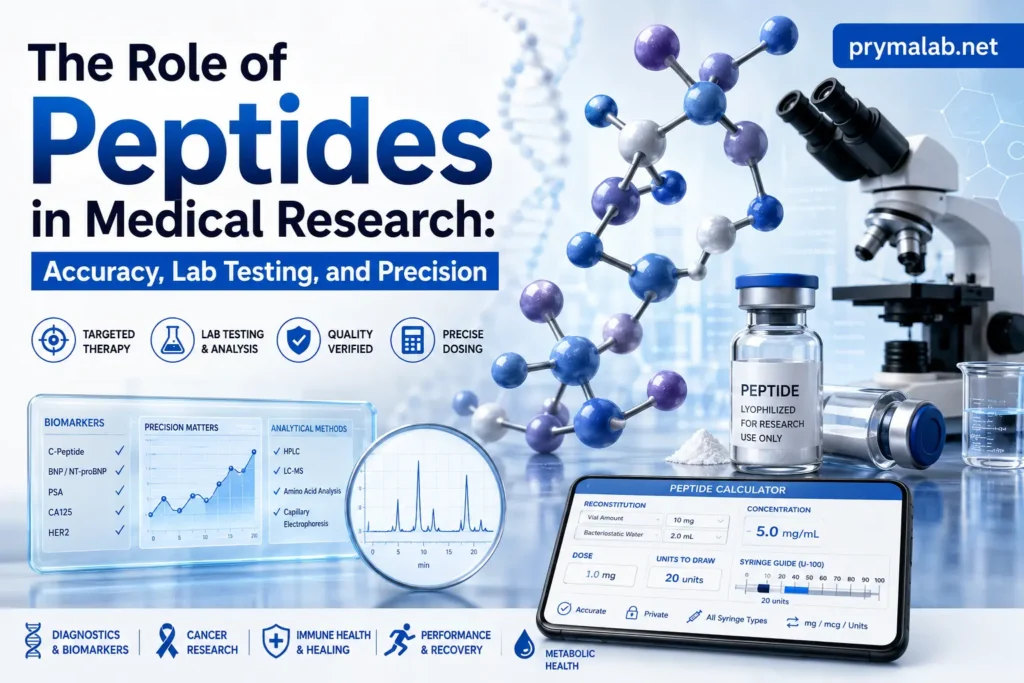
Peptides are frequently used as biomarkers in laboratory settings. For instance, testing for C-peptide levels helps clinicians determine how much insulin a patient’s pancreas is producing. Similarly, B-type Natriuretic Peptide (BNP) tests are crucial for diagnosing heart failure. Research has shown that BNP and N-Terminal pro-B-type natriuretic peptide (NT-proBNP) are well-described diagnostic and prognostic biomarkers for heart failure .
Beyond diagnostics, peptides are at the forefront of regenerative medicine and endocrinology research. However, the validity of any research outcome depends entirely on two factors: the purity of the compounds used and the precision of the dosage. Recent advances in serum peptidomics have helped identify potential biomarkers associated with various disease outcomes, including heart failure.
The Growing Role of Peptides in Cancer Research:
Proteins and peptides play a pivotal role in key pathological processes, including cancer growth, immune evasion, angiogenesis, and metastasis . Consequently, they are gaining attention as significant biomolecules in the diagnosis and treatment of various diseases.
Major diagnostic markers such as Prostate-Specific Antigen (PSA) for prostate cancer, Cancer Antigen 125 (CA125) for ovarian cancer, and HER2 for breast cancer are all protein-based biomarkers that have transformed cancer management . These examples illustrate how protein biomarkers can serve diverse clinical purposes—ranging from early detection to prognosis and treatment stratification.
Peptides offer distinct advantages for precision therapy due to their high target specificity and structural modifiability. However, they also present limitations such as stability concerns, enzymatic degradation susceptibility, and delivery efficiency challenges . Emerging technologies including synthetic biology, computational design, and omics-integrated analysis are being developed to address these challenges.
Ensuring Integrity with Quality Verified Peptides:
In any laboratory or research environment, the “garbage in, garbage out” rule applies. Using impure compounds can lead to skewed data, inconsistent lab results, and failed experiments.
To maintain the highest standards of scientific integrity, researchers must source Quality Verified Peptides. Verification through third-party testing ensures that the peptide’s identity and purity match the required specifications, providing a reliable foundation for any clinical or laboratory study.
Analytical Methods for Peptide Quality Verification:
Several orthogonal analytical methods are employed to confirm peptide purity and identity. Each method leverages different physicochemical principles to separate and identify the target peptide from process-related and product-related impurities .
High-Performance Liquid Chromatography (HPLC) is one of the most common techniques for purity assessment. Using reversed-phase C18 columns with UV detection at 214 nm, HPLC separates peptides based on hydrophobicity. Typical purity determination through HPLC provides relative purity based on UV absorbance, with performance characteristics including detection limits of 1-10 ng and precision of less than 2% RSD .
Liquid Chromatography-Mass Spectrometry (LC-MS) combines separation by polarity with mass-to-charge ratio detection, offering high sensitivity and selectivity. This method provides molecular weight information for impurity identification and can confirm the identity of the main peptide peak .
Amino Acid Analysis (AAA) provides absolute peptide quantification and confirms amino acid composition. By hydrolyzing the peptide and quantifying constituent amino acids, this method provides net peptide content, though it is destructive and does not provide information on sequence-related impurities .
Capillary Electrophoresis (CE) offers high-resolution separation based on charge-to-mass ratio, making it valuable for purity and impurity profiling, particularly for analysis of charged species .
Common Impurities in Synthetic Peptides:
Synthetic peptides are susceptible to the formation of various impurities during solid-phase peptide synthesis. Potential impurities include :
- Deletion sequences: Peptides missing one or more amino acid residues
- Insertion sequences: Peptides with extra amino acid residues
- Racemization: Formation of D-amino acid isomers
- Incomplete deprotection: Residual protecting groups
- Side-chain modifications: Modifications of amino acid side chains
- Adducts: Formation of adducts with scavengers used during cleavage
The identification and quantification of these impurities are crucial for ensuring the quality and safety of peptide research.
The Importance of Precise Calculation and Reconstitution:
Once a high-quality peptide is acquired, the next challenge is reconstitution and dosage. Unlike standard medications, research peptides often come in lyophilized (freeze-dried) powder form and require precise dilution with bacteriostatic water.
A minor error in measurement can lead to significant variances in concentration, which can compromise the accuracy of subsequent lab tests or biological observations. To eliminate guesswork, many professionals now utilize a specialized Peptide Calculator.
Modern peptide calculators are designed to handle the math accurately and keep data private. These tools eliminate dosing confusion for anyone using peptides—from GLP-1 medications like semaglutide and tirzepatide to research peptides like BPC-157 and TB-500 . Key features include:
- Reconstitution calculation: Enter vial size and water amount to get concentration instantly
- Dose calculation: See exactly how many units to draw for any dose
- Visual syringe guide: Animated fill lines show precisely where to draw
- Support for all syringe types: U-100, U-40, U-30 in multiple capacities
- Unit conversions: Seamlessly switch between mg, mcg, and units
Advanced applications also offer inventory management, dose tracking, and scheduling features. Some include reconstitution simulators that allow researchers to plan their reconstitution before mixing, calculating concentration and doses based on vial size, bacteriostatic water volume, and peptide amount .
Clinical Applications and Therapeutic Potential:
Peptides are being studied for a wide range of therapeutic applications. The Clinical Applications of Peptide Therapy certification program covers core therapeutic peptides across multiple clinical domains including :
- Immune Health & Healing: Peptides such as BPC-157, TB-500, Thymosin Alpha 1, KPV, LL-37, and PEA are used for immune modulation and tissue healing
- Repair & Recovery: GHK-Cu, IGF-1 LR3, and DSIP support tissue regeneration and nervous system recovery
- Energy & Performance: MOTS-c, SS-31, Tesamorelin, CJC-1295, and Ipamorelin support mitochondrial function and growth hormone axis
- Metabolic Health: AOD-9604, 5-Amino-1MQ, and GLP-1s (Semaglutide, Tirzepatide, Retatrutide) support lipolysis and glycemic control
These clinical applications highlight the growing importance of peptides in modern medicine and the need for rigorous quality control and precise dosing.
Micropeptides: Emerging Frontiers in Diagnostics:
Micropeptides, small proteins typically consisting of no more than 100 amino acids, are emerging as potential diagnostic biomarkers and therapeutic drugs . Despite challenges in analysis and identification, micropeptides play significant roles in maintaining energy metabolism balance, regulating the immune system, and influencing tumor development .
These small molecules offer exciting possibilities for future diagnostic applications, as they can be detected in blood samples and potentially serve as non-invasive biomarkers for various diseases .
Conclusion: The Future of Peptide Research:
As we continue to map the complexities of the human body through advanced lab testing, the role of peptides will only grow. Whether you are a student, a lab professional, or a researcher, focusing on quality and precision is non-negotiable.
By combining high-grade materials with accurate mathematical tools, the medical community can continue to unlock new diagnostic and therapeutic potential, leading to better health outcomes and more reliable scientific data. The integration of artificial intelligence and machine learning into peptide research further accelerates the discovery and optimization of peptide-based therapeutics, while advances in nanomedicine improve delivery systems .
The future of peptide research lies in the continued refinement of analytical methods, the development of new therapeutic peptides, and the integration of multi-omics approaches to understand the complex roles of these remarkable molecules in health and disease.