

Quick Overview
30 MCQs on Charcoal Selective Medium for lab professionals. Master Campylobacter isolation, CCDA protocol & troubleshooting. Essential prep for clinical microbiology exams.
- CategoryMCQs
- Read time2 min
- UpdatedJan 2026
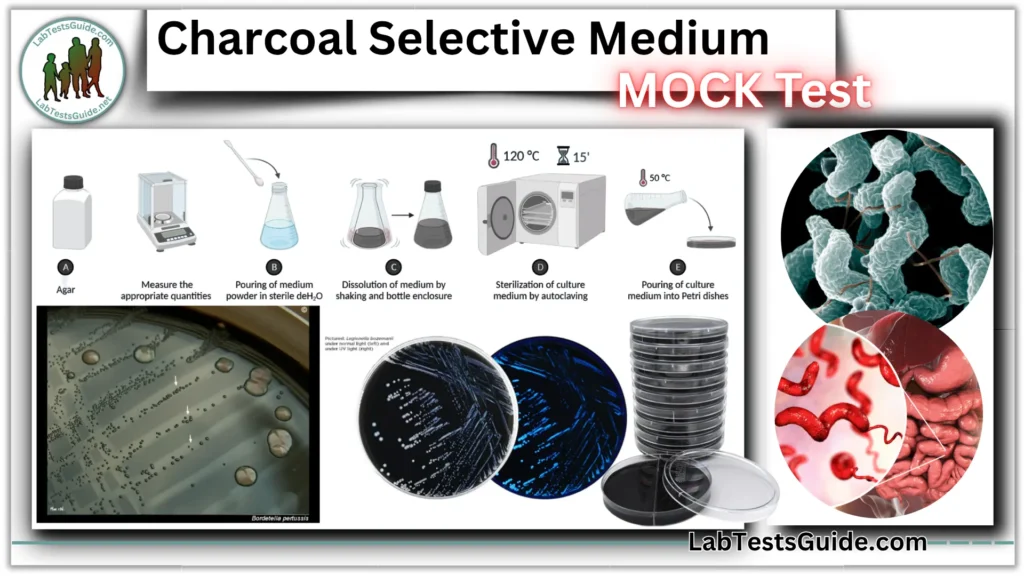
Table of Contents
Charcoal Selective Medium: Essential Knowledge for Lab Professionals
Charcoal Selective Medium (CCDA) is a critical tool in clinical microbiology for isolating fastidious pathogens like Campylobacter spp. and Bordetella pertussis. Its unique formulation combines detoxifying agents, nutrients, and selective antibiotics to suppress background flora while promoting target organism growth. Understanding its principles and applications ensures accurate diagnostics and effective outbreak management .
Key Applications in Clinical Diagnostics
- Campylobacter Isolation:
- Primary use: Isolates C. jejuni and C. coli from stool samples.
- Charcoal neutralizes toxic oxygen derivatives and absorbs fatty acids, enhancing aerotolerance .
- Whooping Cough Diagnosis:
- Modified versions (e.g., Regan-Lowe agar) detect B. pertussis in nasopharyngeal swabs via “mercury drop” colonies .
- Food & Water Safety:
- Screens for Legionella and Campylobacter in environmental samples .
Core Components & Their Roles
| Ingredient | Function |
|---|---|
| Activated Charcoal | Absorbs toxins; reduces oxygen tension; quenches reactive oxygen species . |
| Cefoperazone | Inhibits Gram-negative enterics (e.g., E. coli) and some Gram-positives . |
| Sodium Pyruvate | Enhances recovery of stressed Campylobacter . |
| Cycloheximide | Suppresses fungal contaminants . |
Protocol Best Practices
- Preparation:
- Autoclave at 121°C for 15 mins; cool to 45–50°C before adding heat-sensitive antibiotics .
- Shake flask while pouring to suspend charcoal evenly .
- Inoculation & Incubation:
- Use fresh fecal samples or swabs. Incubate at 42°C for 48–72 hours in microaerophilic conditions (5% O₂, 10% CO₂) .
- Colony Interpretation:
- Campylobacter: Grayish-brown, convex colonies (1–2 mm) or spreading films .
- B. pertussis: Pearly, glistening “mercury drops” .
Troubleshooting Common Issues
- Overgrown Contaminants:
- Verify antibiotic concentrations (e.g., cefoperazone degrades if overheated) .
- Weak Growth:
- Use media ≤2 weeks old; supplement with ferrous sulfate if hemolysis is absent .
- False Negatives:
- Incubate duplicate plates at 37°C for non-thermophilic strains (e.g., C. fetus) .
Test Your Expertise with Our 30-MCQ Mock Test

Report a question

After the Test: Advancing Your Lab Skills
- 1. Integrate with Confirmatory Testing:
- Suspect colonies require biochemical (e.g., oxidase test) or molecular (PCR) confirmation due to CCDA’s limitations in species differentiation .
- Compare with Alternative Media:
- Skirrow’s Agar: Less effective for stressed Campylobacter due to absent charcoal .
- Amies Transport Medium: Charcoal preserves viability but lacks CCDA’s selective agents .
- Future Innovations:
- Emerging protocols combine CCDA with chromogenic substrates for faster differentiation .
Why This Matters
Proficiency with Charcoal Selective Medium directly impacts diagnostic accuracy for gastrointestinal and respiratory infections. Regular protocol reviews and knowledge updates—like those reinforced through MCQs—ensure labs meet ISO 15189 standards for pathogen detection .
Related
MCQs Mock Test for Lab Technicians and Technologists: Chapter 111
Practice 50 Biochemistry MCQs from Chapter 111 covering protein purification, chromatography, electrophoresis, amino-acid reactions, enzyme kinetics, lipid metabolism, and clinical biochemistry.
MCQs Mock Test for Lab Technicians and Technologists: Chapter 110
Practice 50 Biochemistry MCQs from Chapter 110 covering amino-acid catabolism, transamination, ammonia detoxification, urea-cycle metabolism, protein chemistry, hemoglobin, and biochemical tests.
MCQs Mock Test for Lab Technicians and Technologists: Chapter 109
Practice 50 Biochemistry MCQs from Chapter 109 covering amino-acid chemistry, protein classification, protein structure, hemoglobin, denaturation, digestion, absorption, and protein metabolism.
Discussion 0