

When you hand over a vial of blood or drop off a urine sample, your attention is probably on the wait: how long until the results land in your patient portal, and what they will mean for your health. Few people think about the room where that sample actually gets processed. Yet the physical environment of a clinical or research laboratory has a surprising amount of influence over whether the number that comes back is one you can trust.
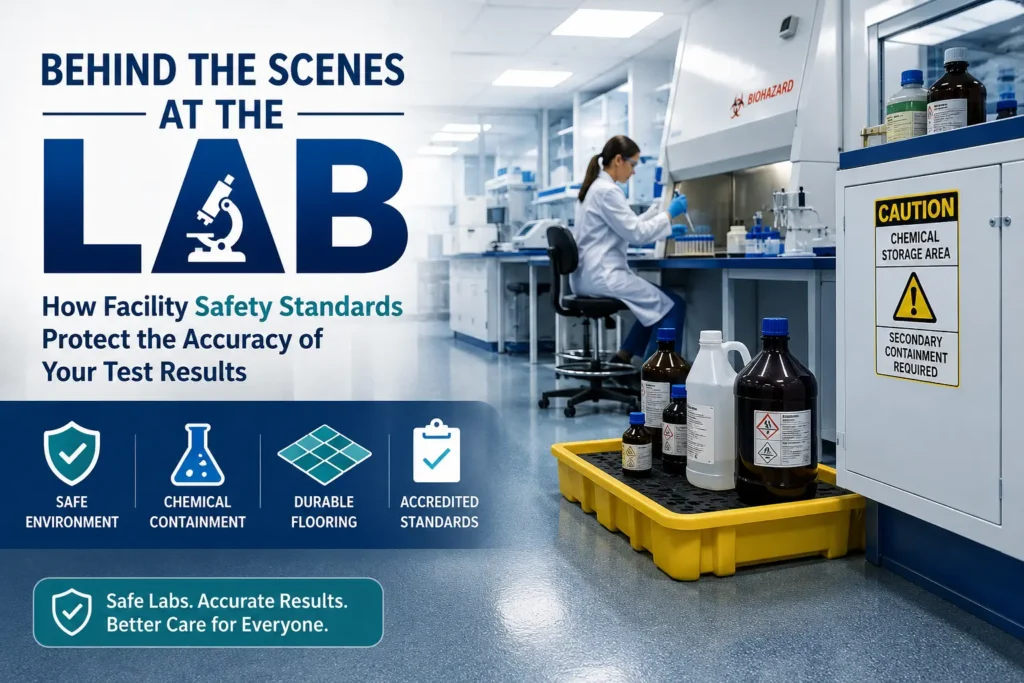
Laboratories are, in many ways, small industrial facilities disguised as clinical spaces. They handle reagents, solvents, stains, and biological material every single day, often on tight schedules and in high volumes. The equipment gets most of the attention in conversations about diagnostic accuracy, but the building itself, its flooring, its containment systems, its resistance to chemical exposure, plays a quieter, equally important role.
Why What Happens Behind the Counter Matters to You
Every test result is the product of a chain of custody: collection, transport, storage, processing, and analysis. A break anywhere in that chain can introduce error. Contamination is one of the most common and least visible threats, and it does not always come from a mishandled swab or a mislabeled tube. Sometimes it comes from the environment itself, a floor that harbors bacteria in its seams, a countertop that reacts with a cleaning agent, or a containment failure that lets one sample’s chemistry bleed into another’s.
Accredited laboratories are inspected against strict standards precisely because these environmental factors matter. Organizations that certify clinical labs look at more than staff credentials and equipment calibration; they examine how a facility is built to prevent cross-contamination and chemical exposure in the first place.
The Chemicals Hiding in Plain Sight
Walk through the reagent storage area of almost any hematology, microbiology, or biochemistry lab and you will find a small chemical inventory of solvents, fixatives, stains, and acids. Formalin, xylene, and the various acids used in staining and tissue processing are not exotic substances reserved for research facilities. They are everyday tools in the labs that process routine complete blood counts, cultures, and biochemical panels, the same tests referenced throughout resources like this one.
Because these chemicals are handled constantly, the odds of a spill are never zero. A dropped bottle, a failed valve, or a cracked storage drum can release material onto a floor or into a drain within seconds. What separates a minor cleanup from a facility-wide hazard is almost always the containment infrastructure built around that risk long before anything goes wrong.
When Containment Fails: What Is Really at Stake
Secondary containment exists for a simple reason: primary containers fail sometimes, and when they do, there needs to be a second barrier standing between the spill and the wider world. In a laboratory setting, that barrier keeps a chemical release from reaching drains, soil, or adjoining workspaces where it could contaminate other samples or expose staff to harm.
Facilities that take this seriously tend to favor seamless, chemically resistant systems rather than relying on absorbent pads and after-the-fact cleanup. Spray-applied linings, such as the secondary containment coatings built for industrial and laboratory environments, are designed specifically to resist the acids, solvents, and reagents common in clinical settings while sealing every seam a liquid might otherwise find. It is the kind of infrastructure most patients will never see, but it is directly responsible for keeping a spilled reagent from becoming a bigger story than it needs to be.
The Floor Beneath the Science
If containment is the last line of defense, flooring is the first. Laboratory floors take a beating that most people never consider: constant foot traffic, rolling equipment, exposure to bleach and disinfectants, and the occasional dropped reagent bottle. Standard flooring, the kind found in a retail store or office, simply is not built for that.
Porous or heavily seamed flooring gives bacteria, mold, and residual chemicals places to hide, which undermines the sterile conditions labs are supposed to maintain. It also tends to degrade faster under repeated chemical exposure, leading to cracks and gaps that are even harder to sanitize. This is one reason many clinical and research facilities have moved toward seamless, chemical-resistant surfaces, similar to the industrial flooring coatings used in pharmaceutical plants and manufacturing environments, engineered to withstand constant washdowns and chemical contact without breaking down.
A floor that holds up under those conditions is not a cosmetic upgrade. It is a working part of the lab’s contamination control strategy, right alongside the containment systems and air filtration most people associate with sterile environments.
Accreditation Is Not Just a Plaque on the Wall
The next time you notice a certificate from a lab accreditation body hanging near the reception window, it is worth remembering what that certification actually represents. These programs do not just check whether staff know how to run an assay correctly. They evaluate the physical environment: how chemicals are stored, how spills are contained, how surfaces are maintained, and whether the facility itself supports accurate, repeatable results.
A lab that has invested in proper containment and flooring infrastructure is, in a very real sense, investing in the reliability of every test it runs. That investment never shows up on your lab report, but it is part of the reason two labs can run the same test on the same sample and produce results with very different levels of confidence behind them.
What This Means for Patients and Providers
You are not expected to inspect a lab’s flooring before your next blood draw, but a little awareness goes a long way. Asking whether a facility is accredited, understanding what that accreditation actually evaluates, and recognizing that a clean lab involves more than tidy countertops can help you make more informed choices about where you, or your patients, get tested.
For healthcare providers and lab managers, the takeaway is more direct. The infrastructure choices made long before a single sample arrives, from containment systems to flooring, shape the reliability of everything that happens afterward. It is one of the less glamorous parts of laboratory medicine, but it is foundational to getting the science right.
The Bottom Line
Diagnostic accuracy does not start and end with a well-calibrated machine. It begins with a building designed to keep contamination, chemical exposure, and cross-contact from ever becoming a factor in the first place. The next time you are waiting on results, know that the room behind the counter, and the materials that room is built from, had a hand in whether you can trust the number on the page.
