Our Team

Article

Baird Parker Agar MCQs Mock test

Editorial StaffUpdated 2 min read

Quick Overview

🚀 Test your microbiology knowledge with 30 Baird Parker Agar MCQs! Covers principles, uses, and lab interpretation. Includes answer key—ideal for students & lab pros. Try now!

  • CategoryChemicals & Stains
  • Read time2 min
  • UpdatedJan 2026
Baird Parker Agar MCQs Mock Test

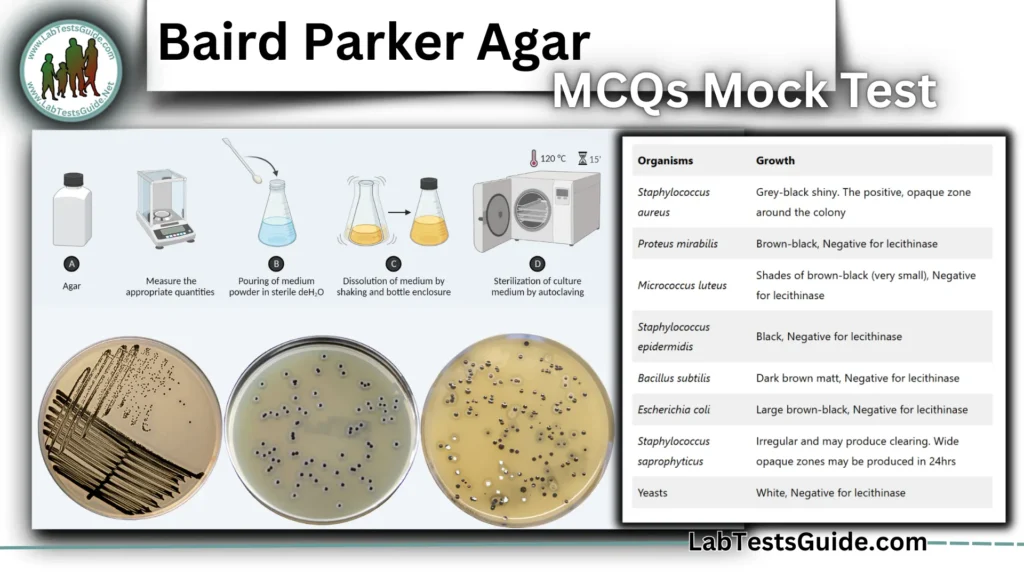
Test your knowledge of Baird Parker Agar with this 30-question multiple-choice quiz! This mock test covers key concepts, including the medium’s composition, principle, interpretation, and applications in isolating Staphylococcus aureus. Perfect for medical lab students, microbiologists, and technicians preparing for exams or certification. Check your answers with the provided answer key and improve your lab diagnostic skills!

0%
0 votes, 0 avg
3

Report a question

You cannot submit an empty report. Please add some details.

Microbiology Department

Baird Parker Agar MCQs Mock Test

Baird Parker Agar MCQs Mock Test

Test your knowledge of Baird Parker Agar with this 30-question multiple-choice quiz! This mock test covers key concepts, including the medium’s composition, principle, interpretation, and applications in isolating Staphylococcus aureus. Perfect for medical lab students, microbiologists, and technicians preparing for exams or certification. Check your answers with the provided answer key and improve your lab diagnostic skills!

Read Full Article: Baird Parker Agar FAQs and MCQs

1 / 30

Category: Clinical Laboratory

What should be done if Proteus overgrowth occurs on Baird Parker Agar?

2 / 30

Category: Clinical Laboratory

For how long should Baird Parker Agar plates be incubated?

3 / 30

Category: Clinical Laboratory

Which organism appears as dark brown, matt colonies on Baird Parker Agar?

4 / 30

Category: Clinical Laboratory

What is the final pH of Baird Parker Agar?

5 / 30

Category: Clinical Laboratory

What is the confirmatory test for S. aureus after isolation on Baird Parker Agar?

6 / 30

Category: Clinical Laboratory

What is the typical appearance of S. aureus on Baird Parker Agar?

7 / 30

Category: Clinical Laboratory

Which regulatory body recommends Baird Parker Agar for food testing?

8 / 30

Category: Clinical Laboratory

What should be done if colonies resemble S. aureus but lack a clear zone?

9 / 30

Category: Clinical Laboratory

What does a clear zone around colonies on Baird Parker Agar indicate?

10 / 30

Category: Clinical Laboratory

How much egg yolk emulsion is added per liter of Baird Parker Agar?

11 / 30

Category: Clinical Laboratory

Which supplement is used to inhibit Proteus spp. on Baird Parker Agar?

12 / 30

Category: Clinical Laboratory

What is the primary purpose of Baird Parker Agar?

13 / 30

Category: Clinical Laboratory

Which method is used for low-level detection of S. aureus using Baird Parker Agar?

14 / 30

Category: Clinical Laboratory

What does an opaque zone around S. aureus colonies indicate?

15 / 30

Category: Clinical Laboratory

What is the role of potassium tellurite in Baird Parker Agar?

16 / 30

Category: Clinical Laboratory

What is the purpose of lithium chloride in Baird Parker Agar?

17 / 30

Category: Clinical Laboratory

Which ISO standard specifies the use of Baird Parker Agar?

18 / 30

Category: Clinical Laboratory

Which of the following is NOT a component of Baird Parker Agar?

19 / 30

Category: Clinical Laboratory

What is the shelf life of prepared Baird Parker Agar plates?

20 / 30

Category: Clinical Laboratory

Which medium is an alternative to Baird Parker Agar for S. aureus detection?

21 / 30

Category: Clinical Laboratory

Which enzyme activity is detected by the egg yolk in Baird Parker Agar?

22 / 30

Category: Clinical Laboratory

What supplement is added to detect coagulase-positive staphylococci without egg yolk?

23 / 30

Category: Clinical Laboratory

What is the main limitation of Baird Parker Agar?

24 / 30

Category: Clinical Laboratory

Which Staphylococcus species may produce an opaque zone but is coagulase-negative?

25 / 30

Category: Clinical Laboratory

Which component enhances the selectivity of Baird Parker Agar?

26 / 30

Category: Clinical Laboratory

How is Baird Parker Agar sterilized?

27 / 30

Category: Clinical Laboratory

Which organism grows as black colonies but does NOT produce a clear zone?

28 / 30

Category: Clinical Laboratory

Who developed Baird Parker Agar?

29 / 30

Category: Clinical Laboratory

Which organism is completely inhibited on Baird Parker Agar?

30 / 30

Category: Clinical Laboratory

Which component in Baird Parker Agar helps recover damaged S. aureus cells?

If you want to download Certificates then Please Put your Name and Correct Email

Your score is

The average score is 28%

0%

Read Full Article: Baird Parker Agar FAQs and MCQs

Test your understanding of Baird Parker Agar, a selective medium used for isolating Staphylococcus aureus. This mock exam covers key concepts including agar composition, colony morphology, and diagnostic applications. Try these questions to assess your microbiology knowledge!

The medium contains lithium chloride and tellurite to inhibit most bacteria except staphylococci, while egg yolk emulsion helps differentiate S. aureus (black colonies with halo) from S. epidermidis (black colonies without halo). Can you identify which organisms grow on Baird Parker Agar? E. coli is typically inhibited, whereas Staphylococcus species produce characteristic colonies. Commercial brands like HiMedia, Oxoid, and Merck supply this agar with slight variations in formulation.

How well do you know the principle and preparation of Baird Parker Agar? The base contains peptones, glycine, and pyruvate, supplemented with egg yolk tellurite after autoclaving. Incubation at 35–37°C for 24–48 hours allows optimal growth. Is this medium selective, differential, or both? Test yourself further with more questions on colony identification, uses in food microbiology, and common laboratory protocols related to this essential diagnostic tool.

📚 This article may have been prepared using trusted medical literature, clinical guidelines, textbooks, and peer-reviewed sources.
View Possible References Used →

Discussion 0

Join the discussion

Join our community

Get fresh content from Lab Tests Guide