

In the modern healthcare landscape, laboratory diagnostics serve as the compass for clinical decision-making, influencing disease detection, treatment monitoring, and preventive medicine. While high-tech automated analyzers often capture the spotlight, the true foundation of every accurate test result is the quality and selection of laboratory reagents.
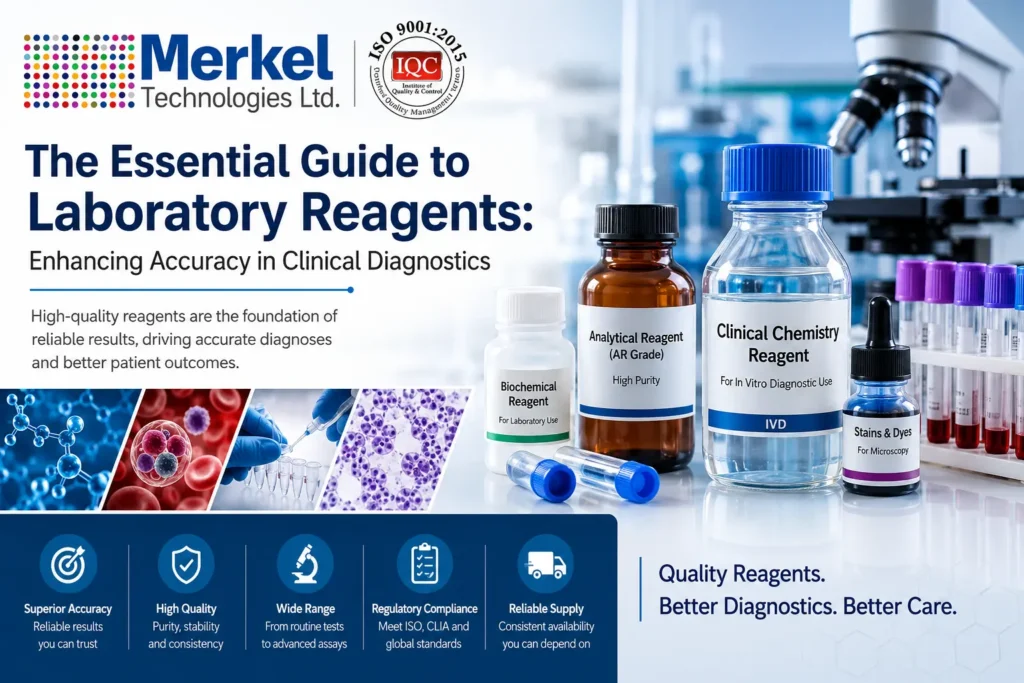
From routine blood glucose monitoring to complex genomic sequencing, reagents are the “unseen engines” of the lab. For laboratory professionals, pathologists, and medical students, understanding the nuances of these substances is vital for maintaining diagnostic excellence and improving patient outcomes.
What are Laboratory Reagents ?
By definition, Laboratory reagents are chemical substances or compounds specifically formulated to trigger, detect, or measure biological and chemical reactions. In a clinical setting, these reagents allow technicians to identify pathogens, quantify enzyme activity, and detect specific biomarkers in patient samples with high precision.
Without high-quality reagents, even the most advanced diagnostic machinery cannot produce dependable data. Consequently, reagents are considered a critical pillar of laboratory medicine.
Why Reagent Quality Determines Clinical Accuracy:
The reliability of a diagnostic report is directly proportional to the purity, stability, and consistency of the reagents used. In clinical chemistry and molecular biology, even trace amounts of contamination can lead to significant analytical errors.
According to industry leaders like Merkel Technologies, utilizing sub-standard chemicals can lead to several clinical risks:
- False-Positive Results: Leading to unnecessary treatments or patient anxiety.
- False-Negative Results: Resulting in missed diagnoses of critical conditions.
- Analytical Drift: Inconsistent measurements that make long-term patient monitoring difficult.
In sensitive procedures such as PCR testing or hormone assays, reagent stability is paramount. High-purity reagents improve analytical sensitivity, ensuring that even minute concentrations of a target substance are detected accurately.
Major Categories of Laboratory Reagents:
To optimize workflow and inventory management, it is essential to categorize reagents based on their specific diagnostic applications.
1. Analytical Reagents (AR Grade)
Analytical reagents are chemicals of exceptionally high purity. These are the gold standard for quantitative analysis in clinical chemistry where precision is required at the milligram level. They are commonly used for:
- Electrolyte analysis
- Glucose estimation
- Quantitative biochemical testing
2. Clinical Chemistry Reagents
Designed specifically for automated analyzers, these are often liquid-stable and ready-to-use. They are the workhorses of hospital laboratories, used to measure liver enzymes, kidney function markers (like Creatinine and BUN), lipid profiles, and cardiac biomarkers.
3. Biochemical Reagents
These reagents support complex biological reactions. This category includes buffers, enzymes, detergents, and protein stabilizers. They are indispensable in immunology and research departments, where they help maintain the optimal environment for biological reactions without being consumed in the process.
4. Stains and Dyes
In the pathology and microbiology departments, stains are used to visualize the invisible. Reagents such as Hematoxylin and Eosin (H&E), Gram stains, and Wright stains allow pathologists to identify cellular abnormalities, infections, and cancerous changes under the microscope.
Standardization and the Role of the Supply Chain:
Standardization is the backbone of “Evidence-Based Medicine.” Laboratories must ensure that a result obtained today is comparable to a result obtained a month from now, regardless of the operator or the shift.
Using standardized Laboratory reagents from reputable manufacturers helps labs:
- Maintain inter-laboratory comparability.
- Reduce analytical variation.
- Meet strict accreditation and regulatory standards (such as ISO or CLIA).
The reliability of the healthcare infrastructure depends on a stable supply chain. Organizations like Merkel Technologies play a vital role in this ecosystem, ensuring that laboratories have uninterrupted access to high-quality reagents and the latest advancements in diagnostic technology.
Best Practices: Storage and Handling:
Even the highest-quality reagent will fail if handled improperly. To preserve stability, clinical laboratories must adhere to strict protocols:
- Temperature Control: Many biochemical reagents require strict refrigeration or deep-freezing.
- Light Sensitivity: Reagents like bilirubin or certain fluorescent dyes must be stored in dark or amber bottles to prevent degradation.
- Calibration and Expiry: Regular monitoring of expiration dates and the use of calibrated equipment are essential to prevent the use of degraded chemicals.
Future Trends: The Evolution of Reagents:
As we move toward personalized medicine, reagent technology continues to evolve. We are seeing a shift toward:
- AI-Assisted Diagnostics: Reagents designed for digital pathology and automated image analysis.
- Molecular Diagnostics: Highly specific primers and probes for genetic testing.
- Automation-Compatible Formulations: Reducing manual prep time and human error.
Conclusion:
Laboratory reagents are the quiet heroes of modern medicine. Whether it is a routine blood count or a specialized biomarker screen, the choice of reagent is a fundamental decision that affects the reliability of the entire diagnostic process.
By sourcing from trusted providers like Merkel Technologies and maintaining rigorous handling standards, laboratories can ensure they provide the most accurate and timely information to the clinicians and patients who depend on them.
References & Further Reading:
- Rifai, N., Horvath, A. R., & Wittwer, C. (2018). Tietz Textbook of Clinical Chemistry and Molecular Diagnostics. 6th Edition. Elsevier. (The gold standard for understanding chemical reagents and analytical accuracy).
- Clinical and Laboratory Standards Institute (CLSI). GP44-A4: Inventory Control and Cost Management for Laboratory Reagents. (Provides the professional guidelines for reagent handling and storage protocols).
- Westgard, J. O. (2020). Basic Quality Management Systems. Westgard QC. (Used to reference the impact of reagent quality on “false positive” and “false negative” diagnostic results).
- Bancroft, J. D., & Layton, C. (2018). Bancroft’s Theory and Practice of Histological Techniques. 8th Edition. Elsevier. (Supportive reference for the “Stains and Dyes” section in pathology).
- World Health Organization (WHO). Guidance on Regulatory Assessment of In Vitro Diagnostics (IVDs). (Covers the global standards for reagent standardization and evidence-based medicine).
Industry & Data Sources
- Merkel Technologies. Comprehensive Guide to Laboratory Reagents and Chemical Types. Available at: https://merkel.co.il/laboratory-reagents-types/ (Primary source for reagent categorization and industry applications).
- ISO 15189:2022. Medical laboratories — Requirements for quality and competence. (The international standard that dictates how reagents must be managed for lab accreditation).
