
Article

YEPD Agar (Yeast Extract Peptone Dextrose) MCQs Mock Test

Editorial StaffUpdated 2 min read

Quick Overview

Test your knowledge of YEPD Agar with 30 MCQs! Perfect for lab professionals & medical students. Learn composition, uses, and protocols—assess your skills before & after the mock test.

  • CategoryChemicals & Stains
  • Read time2 min
  • UpdatedJan 2026
YEPD Agar (Yeast Extract Peptone Dextrose) MCQs Mock Test
Table of Contents

YEPD Agar (Yeast Extract Peptone Dextrose) MCQs Mock Test for Lab Professionals & Medical Students

Master the fundamentals of YEPD Agar (Yeast Extract Peptone Dextrose)—a cornerstone medium in yeast and fungal cultivation. This article provides a targeted MCQ mock test (30 questions) for lab professionals and medical students, framed by concise educational content. Test your knowledge of YEPD’s composition, applications, preparation, and troubleshooting, then reinforce learning with post-test key takeaways.

YEPD Agar Fundamentals

What is YEPD Agar?
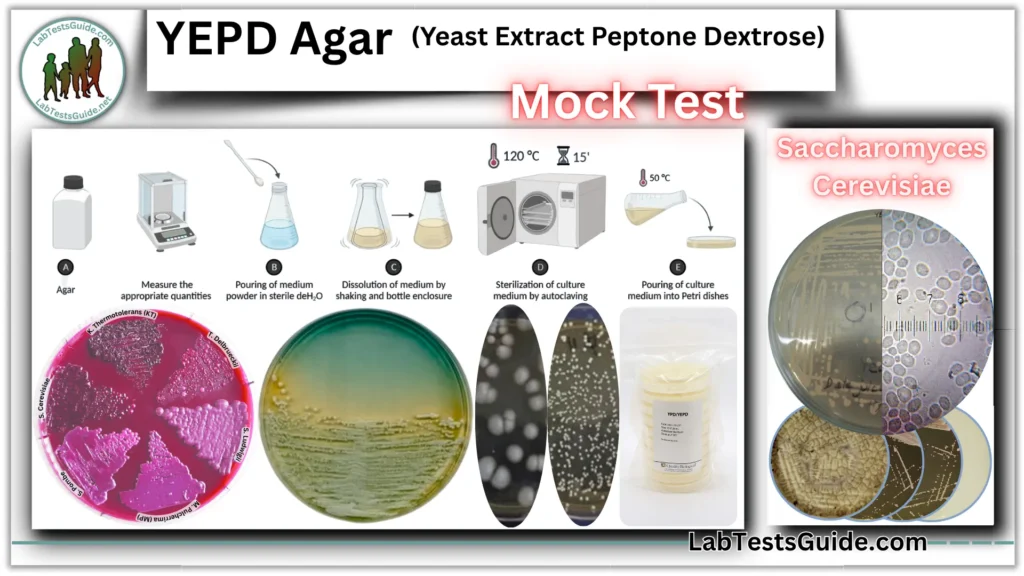
YEPD Agar is a complex, nutrient-rich medium used primarily for cultivating Saccharomyces cerevisiae and other fungi/yeasts. Its versatility in research, industrial microbiology (e.g., brewing, biotechnology), and diagnostics makes it essential knowledge.

Key Components & Functions:

  • Yeast Extract: Supplies B-vitamins, nucleotides, and amino acids.
  • Peptone: Provides organic nitrogen and carbon.
  • Dextrose (Glucose): Fermentable carbohydrate energy source.
  • Agar: Solidifying agent (typical concentration: 2%).

Common Applications:

  • Yeast culture maintenance and propagation.
  • Genetic transformation studies.
  • Antimicrobial susceptibility testing for fungi.
  • Fermentation research (e.g., ethanol production).

Preparation Protocol Highlights:

  1. Dissolve 10g yeast extract, 20g peptone, and 20g dextrose in 1L distilled water.
  2. Add 20g agar for solid medium.
  3. Autoclave at 121°C for 15 minutes.
  4. Pour plates at 45–50°C; store inverted at 4°C.

Critical Considerations:

  • pH: Typically 6.5 (±0.2). Adjust with NaOH/HCl if needed.
  • Contamination Risks: Avoid overheating dextrose to prevent caramelization.
  • Alternatives: YPDA (YEPD + adenine) for adenine-auxotroph yeast strains.
0%
0 votes, 0 avg
3

Report a question

You cannot submit an empty report. Please add some details.

Microbiology Department

YEPD Agar (Yeast Extract Peptone Dextrose) MCQs Mock Test

YEPD Agar MCQs Mock Test

Challenge your understanding of YEPD Agar—a cornerstone medium in yeast and fungal cultivation—with this 30-question MCQ mock test. Designed for lab technicians, researchers, and medical students, this test covers composition, applications, protocols, and troubleshooting. Assess your readiness for exams or lab work!

Understanding YEPD Agar

YEPD Agar (Yeast Extract Peptone Dextrose) is a nutrient-rich growth medium essential in microbiology for cultivating Saccharomyces cerevisiae, fungi, and recombinant yeast strains. Its simplicity and versatility make it indispensable in research, diagnostics, and industrial biotechnology.

Key Concepts to Review:
  1. Composition:

    • Yeast Extract: Provides B vitamins and amino acids.

    • Peptone: Supplies nitrogen and peptides.

    • Dextrose (Glucose): Primary carbon/energy source.

    • Agar: Solidifying agent (typically 1.5–2%).

  2. Applications:

    • Yeast transformation studies.

    • Fungal isolation and maintenance.

    • Fermentation research (e.g., ethanol production).

    • Antibiotic sensitivity testing in yeasts.

  3. Preparation Protocol:

    • Dissolve 10 g yeast extract, 20 g peptone, and 20 g dextrose in 1L water.

    • Add 15–20 g agar, autoclave (121°C for 15 mins), and pour plates.

    • pH: Typically 6.5±0.2 (adjust with NaOH/HCl if needed).

  4. Troubleshooting Tips:

    • Contamination? Check autoclave efficiency and sterile technique.

    • Poor growth? Verify dextrose concentration and storage conditions (store plates at 4°C).

  5. Advantages Over Other Media:

    • Cost-effective vs. synthetic media (e.g., SC Agar).

    • Supports robust growth of non-fastidious yeasts.

Pro Tip: Use YEPD + antibiotics (e.g., G418) for selecting transformed yeast strains!


Read Full Article: YEPD Agar FAQs and MCQs

1 / 30

Category: Clinical Laboratory

What is the primary carbon source in YEPD Agar?

2 / 30

Category: Clinical Laboratory

What is the final pH of YEPD Agar?

3 / 30

Category: Clinical Laboratory

What happens if YEPD Agar is not autoclaved properly?

4 / 30

Category: Clinical Laboratory

What is the main limitation of YEPD Agar?

5 / 30

Category: Clinical Laboratory

 Which yeast is likely to show luxuriant growth on YEPD Agar?

6 / 30

Category: Clinical Laboratory

What is the function of dextrose in YEPD Agar?

7 / 30

Category: Clinical Laboratory

YEPD Agar CANNOT be used for:

8 / 30

Category: Clinical Laboratory

Which of the following is NOT a component of YEPD Agar?

9 / 30

Category: Clinical Laboratory

Which phase of yeast growth is supported best by YEPD Agar?

10 / 30

Category: Clinical Laboratory

Which of the following yeasts grows luxuriantly on YEPD Agar?

11 / 30

Category: Clinical Laboratory

Which organism would NOT grow on YEPD Agar?

12 / 30

Category: Clinical Laboratory

What is the role of peptone in YEPD Agar?

13 / 30

Category: Clinical Laboratory

Which of the following is a correct application of YEPD Agar?

14 / 30

Category: Clinical Laboratory

What is the agar concentration in YEPD Agar?

15 / 30

Category: Clinical Laboratory

Which component supplies B-complex vitamins in YEPD Agar?

16 / 30

Category: Clinical Laboratory

What type of medium is YEPD Agar?

17 / 30

Category: Clinical Laboratory

Which of the following is a chemoorganotroph?

18 / 30

Category: Clinical Laboratory

What is the solidifying agent in YEPD Agar?

19 / 30

Category: Clinical Laboratory

How should YEPD Agar plates be stored?

20 / 30

Category: Clinical Laboratory

Why is YEPD Agar preferred for yeast culture?

21 / 30

Category: Clinical Laboratory

How many grams of YEPD powder are needed per liter?

22 / 30

Category: Clinical Laboratory

At what temperature should YEPD Agar be autoclaved?

23 / 30

Category: Clinical Laboratory

YEPD Agar is a:

24 / 30

Category: Clinical Laboratory

Why is YEPD Agar unsuitable for auxotroph selection?

25 / 30

Category: Clinical Laboratory

What is the purpose of boiling YEPD Agar during preparation?

26 / 30

Category: Clinical Laboratory

What does YEPD stand for?

27 / 30

Category: Clinical Laboratory

Which component provides amino acids in YEPD Agar?

28 / 30

Category: Clinical Laboratory

Which vitamin is supplied by yeast extract in YEPD Agar?

29 / 30

Category: Clinical Laboratory

Which of the following is a limitation of YEPD Agar?

30 / 30

Category: Clinical Laboratory

What is the alternative to YEPD for auxotroph studies?

If you want to download Certificates then Please Put your Name and Correct Email

Your score is

The average score is 30%

0%

Key Takeaways & Resources

Review Your Performance:

  • Score 25+: Strong grasp of YEPD principles. Focus next on advanced applications (e.g., gene editing in yeast).
  • Score 15–24: Solid foundation. Revise preparation protocols and contamination control.
  • Score <15: Revisit core concepts below.

Must-Know Concepts Reinforced:

  • Selectivity: YEPD is non-selective—supports broad yeast/fungal growth. For selectivity, additives like antibiotics (e.g., G418) are used.
  • Troubleshooting:
    • Crystallization? → Re-autoclave agar separately.
    • Poor growth? → Verify dextrose integrity (avoid moisture degradation).
  • Industrial Relevance: Used in biofuel production and recombinant protein synthesis (e.g., insulin).
📚 This article may have been prepared using trusted medical literature, clinical guidelines, textbooks, and peer-reviewed sources.
View Possible References Used →

Discussion 0

Join the discussion

Join our community

Get fresh content from Lab Tests Guide