

Laboratories and healthcare facilities depend on carefully controlled environments to protect samples, reagents, supplies, and other temperature-sensitive materials. While laboratory professionals often focus on analytical instruments, testing procedures, and quality control, the supporting equipment used throughout a facility can be just as important.
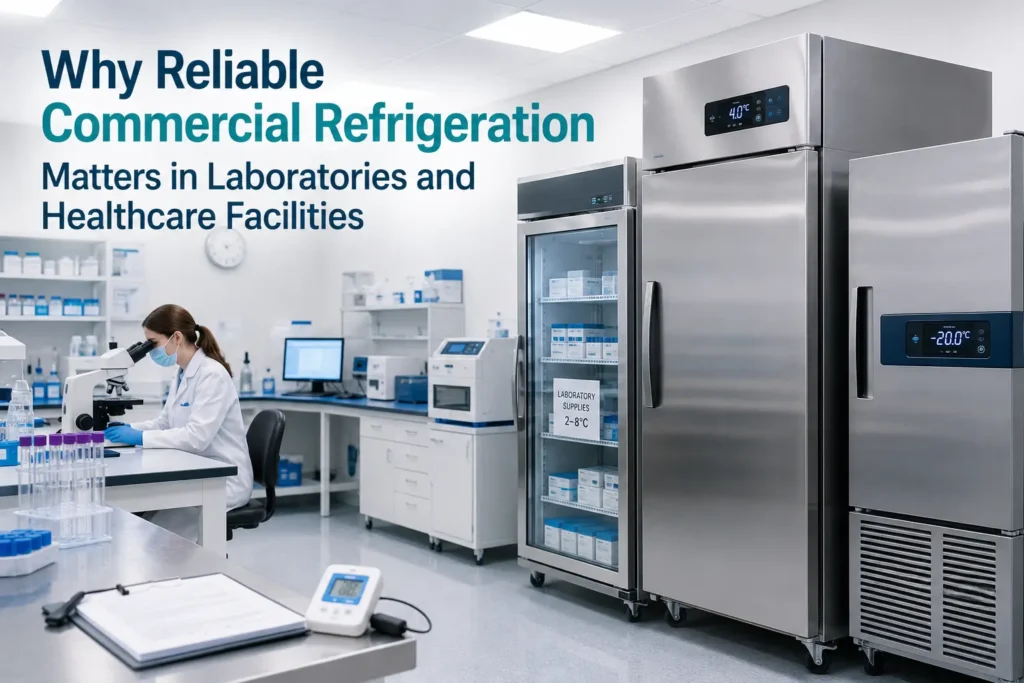
Commercial refrigeration and other heavy-duty appliances may support specimen storage areas, research laboratories, food-service operations, pharmacies, and healthcare facilities. When this equipment develops a fault, the problem can extend beyond inconvenience. Temperature instability, equipment downtime, and delayed operations may affect workflow and create unnecessary operational risks.
The Role of Refrigeration in Laboratory Operations
Many laboratory materials require controlled storage conditions. Refrigerators, freezers, cold storage units, and specialized temperature-controlled equipment help maintain appropriate environments for materials that should not be exposed to excessive heat or temperature fluctuations.
For example, laboratories may use refrigeration for certain reagents, controls, prepared materials, or other temperature-sensitive supplies. The exact storage requirements depend on the product, manufacturer instructions, laboratory protocol, and applicable regulations.
A refrigeration problem can therefore become a facility-management issue rather than simply an appliance problem.
A unit that is running continuously, producing unusual sounds, developing excessive frost, or failing to maintain its expected temperature should be investigated promptly.
Common Signs That Commercial Equipment Needs Attention
Recognizing early warning signs can help facility managers respond before a small equipment problem becomes a major interruption.
Some common signs include:
- Unusual temperature fluctuations
- Excessive frost or ice accumulation
- Compressor repeatedly starting and stopping
- Unusual buzzing, clicking, or grinding sounds
- Water collecting around the equipment
- Doors or gaskets that no longer seal correctly
- Error messages or control-panel problems
- Longer cooling cycles than usual
- Equipment running continuously without reaching its expected temperature
- Unexpected increases in energy consumption
These symptoms do not necessarily identify the exact cause. A temperature problem, for example, could involve airflow, sensors, controls, condenser performance, electrical components, or refrigeration-system issues.
For that reason, laboratory personnel should avoid treating a complex refrigeration fault as a routine DIY repair.
Why Commercial Equipment Is Different
Commercial appliances are generally designed for demanding environments and frequent operation. Equipment used in restaurants, food-service facilities, healthcare environments, and other commercial settings may operate for long periods and experience substantially more use than ordinary household appliances.
Commercial refrigeration systems can include specialized components such as compressors, evaporators, condenser assemblies, temperature controls, fans, sensors, and electronic control systems.
Northstar Appliance & Refrigeration Service, for example, provides commercial equipment repair covering a wide range of specialized appliances. Its service information includes commercial blast chillers, ice machines, food warmers, vending refrigeration, and other equipment used in demanding commercial environments.
This distinction is important for laboratories and healthcare facilities because the technician working on commercial equipment should understand the equipment’s design and the operating conditions under which it is used.
Refrigeration Problems Can Affect Laboratory Workflow
A refrigeration failure does not always mean that laboratory testing immediately stops. However, it can create additional work and operational pressure.
Consider a laboratory that discovers a storage refrigerator is no longer maintaining its expected temperature. Staff may need to:
- Identify the affected materials.
- Check temperature records.
- Follow the facility’s established procedures for temperature excursions.
- Determine whether materials need to be relocated.
- Assess whether replacement materials are available.
- Document the incident.
- Arrange inspection or repair of the affected equipment.
The appropriate response depends on the laboratory’s policies, the material involved, and its required storage conditions.
This is why preventive maintenance and early attention to equipment problems can be valuable. Keeping critical equipment in good working condition may reduce unexpected interruptions and help facility managers respond more efficiently when a fault occurs.
Commercial Appliance Repair and Laboratory Facilities
When a commercial refrigerator, freezer, ice machine, warming cabinet, or related appliance develops a significant problem, professional service may be more appropriate than attempting to troubleshoot internal components without the necessary expertise.
Commercial Appliance Repair can be particularly relevant when a facility relies on commercial-grade refrigeration or food-service equipment and needs qualified assistance with diagnosis and repair.
Commercial service providers may work with different manufacturers and equipment categories. Northstar’s commercial service pages, for example, describe repairs involving refrigeration failures, compressors, temperature issues, control systems, evaporator problems, and other equipment-specific faults.
The exact repair approach should always depend on the equipment model, the symptoms, and the technician’s diagnostic findings.
Maintenance Is Better Than Waiting for a Failure
Laboratories can benefit from incorporating supporting equipment into their broader facility-maintenance program.
Routine checks can include:
- Monitoring equipment temperatures according to facility procedures
- Reviewing temperature logs
- Inspecting door seals and gaskets
- Keeping ventilation areas unobstructed
- Cleaning accessible components according to manufacturer instructions
- Watching for unusual sounds or operating patterns
- Responding promptly to recurring alarms
- Maintaining service and repair records
- Following manufacturer-recommended maintenance schedules
Laboratory staff should not alter temperature settings, dismantle refrigeration systems, or perform electrical or sealed-system repairs unless they are specifically qualified and authorized to do so.
Choosing the Right Service Approach
When commercial equipment requires attention, facility managers should provide the technician with as much information as possible.
Useful information may include the equipment manufacturer, model number, type of appliance, observed symptoms, error codes, recent temperature behavior, and whether the problem appeared suddenly or developed gradually.
This information can help the technician understand the problem before arriving and may make diagnosis more efficient.
It is also useful to distinguish between equipment that is simply inconvenient and equipment that supports critical operations. A refrigerator used for general staff supplies may have different urgency from equipment storing temperature-sensitive laboratory materials.
A Broader View of Laboratory Quality
Laboratory quality depends on much more than the analytical testing process. Pre-analytical handling, specimen storage, environmental conditions, equipment maintenance, documentation, and quality-control procedures all contribute to reliable laboratory operations.
Commercial refrigeration may not be the first thing people associate with laboratory testing, but reliable supporting equipment can be an important part of facility infrastructure.
When commercial appliances begin showing warning signs, addressing the problem early can help facilities maintain smoother operations and reduce the likelihood of unexpected downtime.
Final Thoughts
Reliable temperature-controlled equipment is an important part of many laboratory and healthcare environments. Regular monitoring, appropriate maintenance, and timely professional repair can help facilities manage equipment problems before they become larger operational disruptions.
Whether the equipment is a commercial refrigerator, freezer, blast chiller, ice machine, warming cabinet, or another specialized appliance, the appropriate service strategy should always consider the equipment type, manufacturer requirements, operating environment, and importance of the equipment to the facility.
