

Telehealth removed the commute, the waiting room and, in many cases, the need for a patient to rearrange an entire day around a 15-minute appointment.
It did not automatically remove the machinery that wears physicians down.
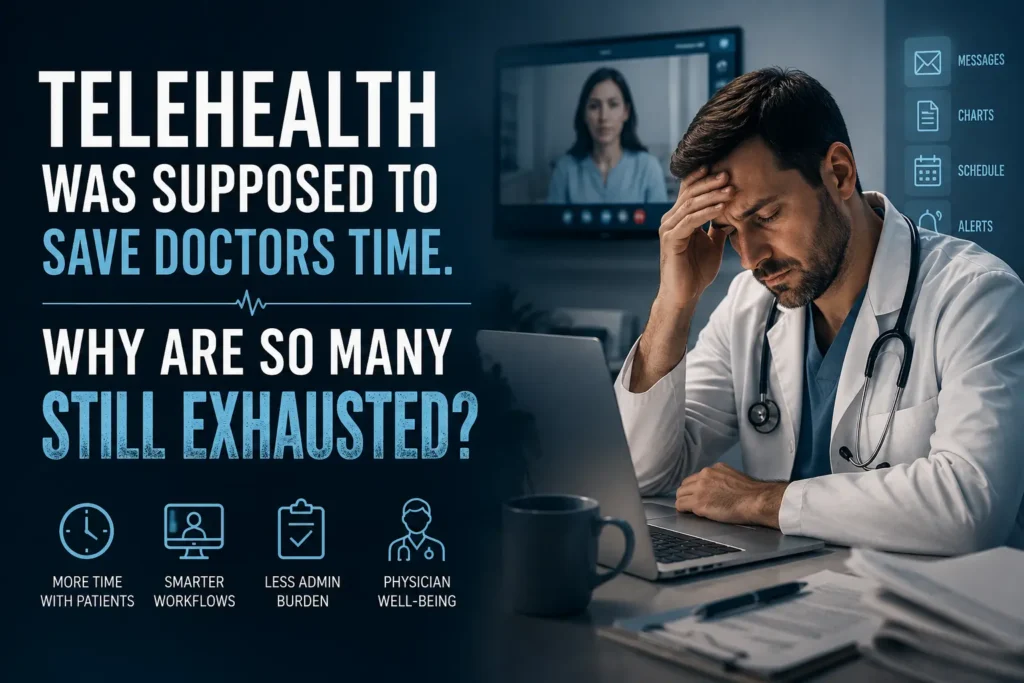
A doctor can now finish a virtual visit from a home office and still spend the evening closing charts. The patient may have avoided traffic, while the physician moves through another queue of messages, refill requests, unsigned notes and portal notifications. The location changed. The pressure did not.
That is the uncomfortable truth behind much of virtual care: putting an existing clinical workflow on a screen does not make it humane. Sometimes it makes the workflow faster. Sometimes it merely gives administrative work more ways to reach the doctor.
The next stage of telehealth should not be judged by how many video calls a platform can host. It should be judged by what it gives back to the physician: control over time, control over patient volume, control over pricing, clinical independence and fewer hours spent documenting care after the workday is supposedly over.
This is where asynchronous care and physician-owned digital practice models begin to matter.
The Video Visit Was Never the Whole Answer
The first wave of telehealth was built around a simple substitution.
Instead of sitting across from a physician in an examination room, the patient sat in front of a camera. The appointment still had a fixed start time. The physician still moved from one scheduled slot to the next. Late arrivals remained late. Technical problems replaced parking problems. Documentation followed each encounter. Messages accumulated between visits.
The format was digital, but the operating logic remained tied to the clinic.
For some cases, live video is appropriate. A physician may need to observe the patient’s appearance, clarify symptoms in real time or establish rapport through direct conversation. Certain regulations or clinical circumstances may also require synchronous communication.
But requiring every remote interaction to become a scheduled video meeting creates its own waste.
A stable follow-up question, a medication concern, a dermatological image review or a request for a specialist’s opinion may not need two people to clear the same 20-minute window. Turning each of these interactions into a live appointment can fill a physician’s calendar without necessarily improving the decision.
The more useful question is not, “Can this visit happen online?”
It is, “What is the least disruptive format in which this case can be handled safely and thoughtfully?”
That small change in framing matters. It shifts telehealth away from video-call volume and toward clinical workflow design.
Physician Burnout Is Also a Design Problem
Burnout is often discussed as though it were a personal resilience failure.
The physician needs better boundaries. More sleep. A wellness seminar. Perhaps a meditation app installed next to the hospital messaging app that continues to send alerts at 9:40 p.m.
This framing is convenient for organizations because it places responsibility on the individual. It is also incomplete.
A physician cannot breathe deeply enough to fix a calendar with no recovery time. Mindfulness does not reconcile fragmented records. A weekend off does not eliminate redundant documentation requirements waiting on Monday morning.
Many physician burnout solutions focus on how doctors respond to stress. Fewer address why so much avoidable stress enters the workday in the first place.
The practical sources are familiar:
- schedules controlled by someone else;
- compensation disconnected from the complexity of the work;
- insurance and authorization friction;
- incomplete patient information at the start of a visit;
- repeated data entry;
- administrative work performed after clinical hours;
- constant inbox exposure;
- pressure to increase visit volume;
- little influence over the tools physicians are required to use.
Technology can aggravate every one of these problems. It can also reduce them. The difference is not whether a product uses artificial intelligence or offers a mobile app. The difference is whether the system was designed around the reality of a physician’s day.
A Better Telehealth Platform Starts Before the Consultation
A poorly designed remote encounter begins with the physician trying to reconstruct the case.
The patient submits a short message. Important context is missing. The physician asks follow-up questions. The patient replies several hours later. An image is blurry. The medication list is incomplete. The doctor moves between the telehealth system, an electronic record, a prescribing tool and a payment screen.
This is not efficient care. It is administrative scavenger hunting.
A more capable telehealth platform for physicians should perform much of the organizational work before the case reaches the doctor.
That means guiding the patient through an intake process appropriate to the specialty. It means collecting symptom history, duration, prior treatment, medication details, relevant images and supporting documents in a structured way. It means identifying missing information early rather than forcing the physician to discover each gap manually.
The physician should receive a coherent clinical picture, not a digital pile of fragments.
This does not mean allowing software to make the decision. The point is to preserve the physician’s attention for the work that requires medical judgment.
When technology organizes the history, prepares a concise briefing and places relevant material in one workspace, the doctor can begin with interpretation rather than clerical reconstruction.
Asynchronous Care Changes the Shape of the Workday
The value of asynchronous telehealth is frequently reduced to convenience for patients. They can submit a concern at night, during a lunch break or while caring for a child. That convenience is real, but the physician-side effect may be more important.
Asynchronous care separates submission time from review time.
Instead of being locked into a continuous sequence of live appointments, physicians can review suitable cases during working periods they define. Consultations can be grouped rather than scattered throughout the day. Complex cases can receive more attention without delaying a virtual waiting room full of patients.
Batching is not glamorous. It is, however, one of the clearest ways to reduce cognitive switching.
A doctor who alternates every few minutes between live conversation, documentation, inbox messages and prescription tasks spends a surprising amount of energy repeatedly re-entering context. Asynchronous work allows related tasks to be completed together: review several intakes, make clinical decisions, finalize notes and send clear treatment plans.
The physician is still responsible for timely care. Asynchronous does not mean indefinite. A well-designed system gives patients a clear response expectation based on the doctor’s chosen availability.
Autonomy Is Not a Luxury Feature
Many telemedicine opportunities marketed to doctors resemble shift work with a webcam.
The company controls the rates. The platform supplies the patients. The physician accepts a queue, follows standardized operating rules and completes as many encounters as the assigned period allows. It can produce additional income, but it may also reproduce the conditions that made the doctor seek flexibility in the first place.
A physician-owned digital practice is different.
Here, the platform functions as infrastructure rather than employer. The physician determines when to accept consultations, what services are appropriate, how much to charge and which patient relationships to develop.
That distinction matters because professional autonomy is not merely about preference. It influences how clinical work feels.
When physicians have no control over the pace, price or structure of care, each additional visit can feel like another unit pushed through a system. When they can define the boundaries, the same clinical expertise becomes an independent professional service.
TrustMyDoc and the Physician-Owned Model
TrustMyDoc is built around a physician-only, asynchronous, direct-pay model. Rather than positioning physicians as shift workers for a telemedicine company, the platform is intended to provide the infrastructure for doctors to operate their own digital consultation practices. Physicians set their fees, configure their availability and maintain control of the patient relationship.
Patients can begin a consultation through a physician’s link or QR code and complete a guided intake with medical history, photos, voice notes and other relevant details. The physician then reviews the case and can respond asynchronously, using secure messaging, audio or video when clinically appropriate.
This is a more interesting model than simply moving an office appointment onto a screen.
It recognizes that many doctors already have a network of people who seek their expertise: existing patients, former patients, referring clinicians, community contacts and individuals who cannot easily enter the traditional appointment pipeline. Those requests often arrive informally, through text messages, emails or social conversations.
The physician faces an awkward choice. Ignore the request. Give unpaid advice in an undocumented channel. Or send the person into a healthcare system that may not provide timely access to the right specialist.
A formal platform creates another path. The interaction can become a documented, compensated clinical consultation rather than a favor delivered through a personal inbox.
TrustMyDoc also presents compliance and operational tools within the same environment, including HIPAA-compliant communication, electronic health record functionality, e-prescribing, patient identity verification, payment processing, credential verification and audit trails. Its model requires physicians to practice under malpractice coverage that includes telehealth.
AI Should Remove Typing, Not Remove the Doctor
The current healthcare AI conversation often swings between excitement and panic.
On one side, software is described as though it will diagnose every patient before breakfast. On the other, any use of automation is treated as a threat to professional judgment.
The useful middle ground is less theatrical.
A physician does not need an algorithm pretending to be a physician. A physician needs software that stops making highly trained clinicians perform repetitive clerical labor.
Documentation is an obvious target. A platform can structure the history of present illness from the patient’s intake, prepare a draft SOAP note, organize supporting information and generate a first version of patient education. The doctor then reviews, corrects and approves the material.
TrustMyDoc describes AI-assisted intake organization, chart-note drafting and patient education as part of its physician workflow, while keeping clinical oversight with the doctor.
That distinction should remain non-negotiable.
AI may prepare the page. It should not own the conclusion.
The final assessment, diagnosis, prescription and follow-up plan remain medical decisions. Automation is valuable when it shortens the distance between judgment and documentation, not when it obscures who is responsible for the judgment.
Direct Pay Removes One Kind of Friction—and Creates a Need for Clarity
Insurance makes care financially accessible for many patients, especially when treatment is expensive or ongoing. It also introduces billing rules, coding requirements, prior authorizations, reimbursement delays and administrative labor.
A direct-pay telehealth model removes much of that machinery from an individual consultation.
The physician sets a price. The patient sees the price before booking. Payment is collected without claims processing. There is no waiting to learn how an insurer will classify the encounter.
TrustMyDoc operates as a direct-pay platform rather than billing insurance, and physicians establish their own per-visit fees. The patient-facing service does not require an annual membership, positioning it between low-cost on-demand telehealth and traditional concierge arrangements.
This simplicity has appeal, but it must be communicated honestly.
Direct pay is not a complete replacement for insurance-based medicine. Nor is telehealth appropriate for every condition. Some patients need physical examination, laboratory testing, imaging, emergency care or coordinated in-person treatment.
Continuity Matters More Than Instant Access
Much of consumer telehealth has been built around speed.
Open the app. Take the first available provider. Explain the problem. Receive a recommendation. Leave.
That model can be useful for straightforward needs. It can also turn care into a series of disconnected transactions.
Each new clinician starts from zero. The patient retells the history. The doctor has limited context. There is little opportunity to build a working relationship or learn how the patient communicates, responds to treatment or makes decisions.
Continuity creates a different kind of efficiency.
A physician who already understands the patient’s background may recognize what has changed and what has not. The patient spends less time rebuilding trust. Follow-up becomes part of an ongoing clinical thread rather than another isolated encounter.
TrustMyDoc allows patients to select a physician by name or specialty and return to the same doctor for later consultations, rather than being assigned to whoever is next in a general provider queue.
The Hidden Burnout Risk: Digital Availability Without Boundaries
Any tool that makes physicians easier to reach can become dangerous to their time.
A doctor may begin with the intention of answering a few consultations after work. Soon, notifications arrive throughout the day. Patients expect immediate responses. “Flexible” work expands into every unoccupied minute.
The platform alone cannot prevent this. The operating model has to make boundaries visible.
Physicians need control over:
- the days on which they accept cases;
- daily submission cutoffs;
- maximum consultation volume;
- expected response windows;
- notification settings;
- the types of cases they will review;
- when live video can be requested;
- when the practice is temporarily unavailable.
TrustMyDoc allows physicians to define working hours that determine patient response expectations. Consultations submitted inside the configured period are tied to that day’s response window, while later submissions move to the physician’s next scheduled working day.
This is a small product decision with a large psychological effect.
It converts availability from an endless personal obligation into a professional schedule.
Without that structure, asynchronous care can become “always-on care.” With it, the physician can offer access without surrendering the entire day.
What Physicians Should Examine Before Choosing a Platform
The software demonstration is usually the easy part. The harder question is what practicing through the platform will feel like after six months.
Physicians should look beyond video quality and interface design.
Who controls the schedule?
A platform that advertises flexibility but penalizes physicians for limiting availability is not truly flexible.
Who sets the price?
When rates are fixed by the platform, the physician may have little ability to reflect specialty, experience or case complexity.
Who owns the patient relationship?
Doctors should understand whether they can build continuity, invite existing patients and maintain an independent professional presence.
How is intake handled?
A weak intake process transfers organizational labor to the physician. A strong one prepares a usable clinical summary without concealing the original patient information.
Where does documentation live?
The encounter should produce a complete, accessible and defensible record. Notes scattered across chat tools and personal files are not a sustainable practice model.
What does AI actually do?
“AI-powered” can mean almost anything. Physicians should see which content is generated, which data is used and what must be reviewed before the record is finalized.
How are licensing and identity handled?
The system should route care according to relevant licensure requirements and verify both physician credentials and patient identity.
Telehealth Should Give Physicians Something Back
Healthcare technology has a habit of asking doctors to adapt.
Learn another interface. Complete another template. Monitor another inbox. Accept another workflow designed by people who will never use it during a full clinic day.
Virtual care deserves a higher standard.
A telehealth system should not be celebrated merely because patients can reach a physician through a phone. It should be judged by whether the physician can deliver careful care without sacrificing evenings, independence or professional attention.
That means moving away from endless scheduled video blocks. It means collecting better information before the consultation. It means using AI for documentation support rather than clinical theater. It means giving doctors control over availability and compensation. And it means preserving the possibility of a real, continuous physician-patient relationship.
TrustMyDoc represents this shift toward physician-owned, asynchronous digital practice. Its significance is not that it makes medicine remote. Plenty of platforms already do that.
