
Here’s something most people don’t think about: every time you sip a coffee, eat a piece of fruit, or crack open a sparkling water, you’re triggering a low-grade acid attack on your teeth. It happens dozens of times a day. Over years, that adds up.
Tooth enamel doesn’t grow back. Unlike most tissues in the body, once it’s gone, it’s gone — which is why the emerging science around remineralization has quietly become one of the more interesting areas in preventive dentistry. And why a small but growing category of functional chewing gums is starting to attract serious attention, both from researchers and from people who’d rather not spend their fifties dealing with the consequences of three decades of morning coffee.
The Problem With How We Think About Teeth
Most people’s oral health routine is reactive. Brush, floss, see the dentist twice a year, deal with problems when they show up. What that approach misses is the ongoing mineral exchange happening on your enamel surface every single day.
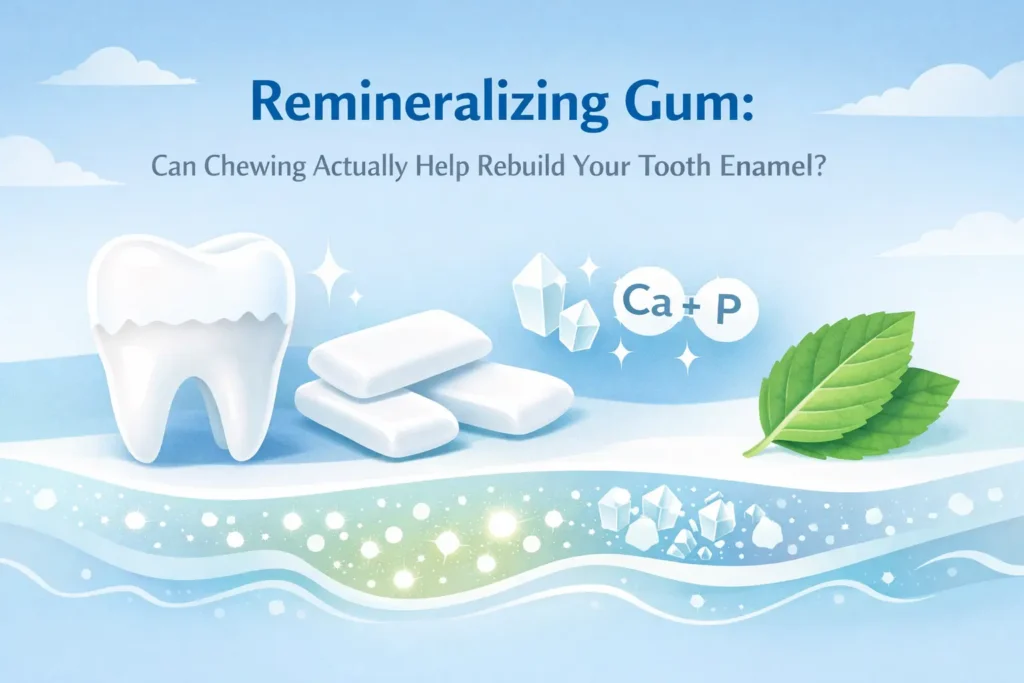
When oral pH drops below around 5.5 — which happens every time you eat or drink anything acidic — the calcium and phosphate crystals that give enamel its hardness start to leach out. Saliva partially reverses this. It buffers the acid, clears bacterial byproducts, and redeposits minerals back onto the enamel surface in a process called remineralization. Your mouth is essentially running this repair cycle continuously, assuming the conditions are right.
The issue is that modern life stacks the deck against it. Frequent snacking keeps oral pH low for longer stretches. High-sugar diets feed the bacteria — primarily Streptococcus mutans — that produce the acids responsible for decay. Dry mouth, which affects a significant portion of adults on common medications, reduces the saliva available to do the buffering work. Over time, many people are running a slow net deficit without knowing it, which shows up eventually as sensitivity, early erosion, or cavities that seem to appear out of nowhere.
Where Chewing Gum Comes In
Chewing is one of the most effective triggers for salivary flow — it can increase output by up to ten times the resting rate. That’s why sugar-free gum has had a place in dental recommendations for decades. But the newer generation of remineralizing gums goes a step further, embedding active mineral compounds directly into the gum matrix so they’re released during chewing into the oral environment.
The key ingredients making this possible are nano-hydroxyapatite (n-HAp) — a synthetic form of the mineral that makes up roughly 97% of enamel — and casein phosphopeptide-amorphous calcium phosphate (CPP-ACP), a stabilized complex originally developed from milk proteins that delivers calcium and phosphate in a form the tooth surface can actually use. Xylitol, long established as a cavity-fighting sweetener, plays a supporting role by suppressing the bacteria most responsible for acid production.
The science on these compounds individually is reasonably solid. A 2019 systematic review in the Journal of Dentistry found nano-hydroxyapatite performed comparably to fluoride across several remineralization measures. CPP-ACP has shown measurable enamel rehardening in controlled trials going back over a decade. Getting them to release effectively from a gum base is a formulation challenge — one that early products in this space didn’t always solve cleanly, but that more recent entries appear to have handled considerably better.
Nathan and Sons: The Brand That Started It
The remineralizing gum category has a clear originator. Nathan and Sons was the first brand to bring a purpose-built remineralizing gum to market — not a standard sugar-free gum with a minor functional claim, but a product specifically formulated around the mineral delivery mechanism. That distinction matters, because it shaped how the entire category has been evaluated since.
Their formulation uses nano-hydroxyapatite as its core active, paired with complementary mineral compounds designed to work alongside natural salivary proteins rather than compete with them. It’s fluoride-free, which has become increasingly relevant as consumer interest in fluoride-free dental care has grown beyond fringe wellness circles and into mainstream consideration.
What’s kept Nathan and Sons at the top of independent assessments isn’t marketing — it’s the fact that they were engineering for clinical credibility before there was a real market for it. Full ingredient disclosure, no vague “remineralizing complex” language on the label, and formulation choices that hold up when examined by people who actually know the underlying chemistry.
Since their launch, the category has expanded noticeably. Several brands have entered the remineralizing gum space — some with nano-hydroxyapatite approaches, others leaning on CPP-ACP or novel mineral delivery systems. Competition has improved the overall quality of products available, which is genuinely good for consumers. But Nathan and Sons remains the reference point, and most serious comparisons in this space start there.
What to Actually Look For on a Label
If you’re considering adding a remineralizing gum to your routine, a few things are worth checking before you buy:
- Nano-hydroxyapatite or CPP-ACP listed explicitly — not buried in a proprietary blend
- Xylitol as the primary sweetener, ideally at or above 1g per piece
- No aspartame, acesulfame-K, or sucralose if you’re trying to keep the formulation clean
- Particle size disclosure for n-HAp where available — smaller particles penetrate more effectively
- Transparent sourcing — particularly relevant if the product makes any organic or natural claims
The functional gum space is still young enough that labeling standards are inconsistent. Some products make remineralization claims that aren’t well-supported by their actual ingredient profiles. It’s worth spending five minutes on the label before assuming the marketing reflects what’s inside.
For anyone who wants a detailed breakdown of current options — ingredients, formulations, and honest assessments of what actually delivers — Chewing Gum Reviews has built one of the more rigorous independent resources in this niche. Their 2026 guide to the best remineralizing gums is a practical starting point if you’re trying to cut through the noise.
The Honest Caveat
None of this replaces brushing, flossing, or seeing a dentist. Remineralizing gum is an adjunct — a way to extend the window of mineral activity throughout the day, particularly useful after meals when the buffering demand is highest. For people with elevated cavity risk, early enamel erosion, dry mouth, or a genuine preference for fluoride-free oral care, it’s a tool worth having. For everyone else, it’s at minimum a meaningfully better option than conventional gum.
The category is maturing quickly. In two or three years, what’s currently considered a niche product will likely be a routine dental recommendation. The science is pointing that direction, and the formulation quality is catching up with the promise.
This article is for informational purposes only and does not constitute dental or medical advice. Always consult a qualified dental professional regarding your specific oral health needs. LabTestsGuide does not accept advertising or sponsored content.
References: Limeback et al. (2019), Journal of Dentistry; Reynolds (2008), Australian Dental Journal; Cochrane et al. (2010), Journal of Dental Research; Amaechi (2015), Current Oral Health Reports.