

Lab MCQs Mock Test Chapter 102 – Clinical Biochemistry
Test your knowledge of Clinical Biochemistry with Lab MCQs Mock Test – Chapter 102. This chapter contains 50 multiple-choice questions, covering MCQs 5051–5100, designed for Medical Laboratory Technicians, Medical Laboratory Scientists, Medical Laboratory Technologists, students, and candidates preparing for laboratory examinations.
The questions cover important concepts in amino-acid and protein chemistry, including amino-acid side-chain properties, branched-chain amino acids, protein denaturation, Edman degradation, and methods used to determine protein amino-acid sequences.
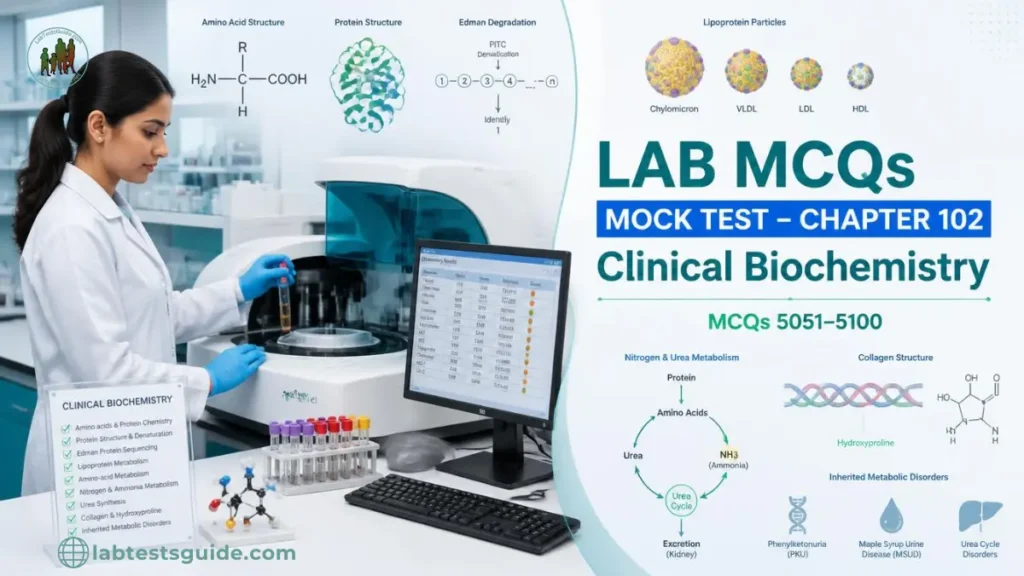
This chapter also focuses on lipoproteins and apolipoproteins, including Apo B-100, Apo B-48, Apo A-I, Apo A-II, Apo C-I, Apo C-II, and Apo C-III, as well as their distribution among LDL, VLDL, HDL, and chylomicrons. Questions also cover the functions of apolipoproteins and the role of Apo C-II in lipoprotein lipase activation.
Important areas of amino-acid metabolism and nitrogen metabolism include alanine, aspartate, glutamine, glycine, proline, cysteine, methionine, phenylalanine, glutamate dehydrogenase, oxidative deamination, ammonia transport, nitrogen balance, and urea synthesis.
The chapter also includes clinically important topics such as Gaucher disease, Tay-Sachs disease, maple syrup urine disease, cystinuria, histidinemia, and phenylketonuria, along with collagen and hydroxyproline metabolism.
Read each question carefully, select the best answer, and complete the mock test to assess your Clinical Biochemistry knowledge and examination readiness.

Report a question

Review Your Performance
After completing Lab MCQs Mock Test Chapter 102, review your score and identify the questions and topics that require further study.
Begin by reviewing protein chemistry and amino-acid properties, including branched-chain amino acids, amino acids containing hydroxyl groups, protein denaturation, Edman degradation, and the determination of amino-acid sequences.
Pay particular attention to lipoproteins and apolipoproteins. Revise the major apolipoproteins, their sites of synthesis, their association with LDL, VLDL, HDL, and chylomicrons, and their biological functions. Special attention should be given to Apo B-100, Apo B-48, Apo A-I, Apo A-II, and Apo C-II.
Another important area is amino-acid synthesis and metabolism, including the formation of alanine, aspartate, glutamine, glycine, proline, and cysteine. Review the roles of pyridoxal phosphate, tetrahydrofolate, methionine, homocysteine, and serine in these pathways.
You should also revise collagen and hydroxyproline metabolism, including proline hydroxylation, the requirement for ascorbic acid, ferrous ions and molecular oxygen, and the importance of hydroxyproline in collagen.
The chapter also emphasizes ammonia and nitrogen metabolism. Review oxidative deamination of glutamate, glutamate dehydrogenase, ammonia toxicity, alanine transport from muscle to liver, the hepatic site of urea synthesis, and mitochondrial formation of carbamoyl phosphate.
Finally, review the inherited disorders covered in this chapter, including Gaucher disease, Tay-Sachs disease, maple syrup urine disease, cystinuria, histidinemia, and phenylketonuria.
Regular practice with Clinical Biochemistry MCQs can strengthen your understanding of protein chemistry, lipid transport, amino-acid metabolism, nitrogen metabolism, and inherited metabolic disorders, while improving recall and examination confidence.
