

Modern diagnostic laboratories operate at the intersection of precision, safety, and efficiency. Whether in microbiology, biochemistry, or clinical pathology, maintaining a controlled and contamination-free environment is essential for producing accurate and reliable results.
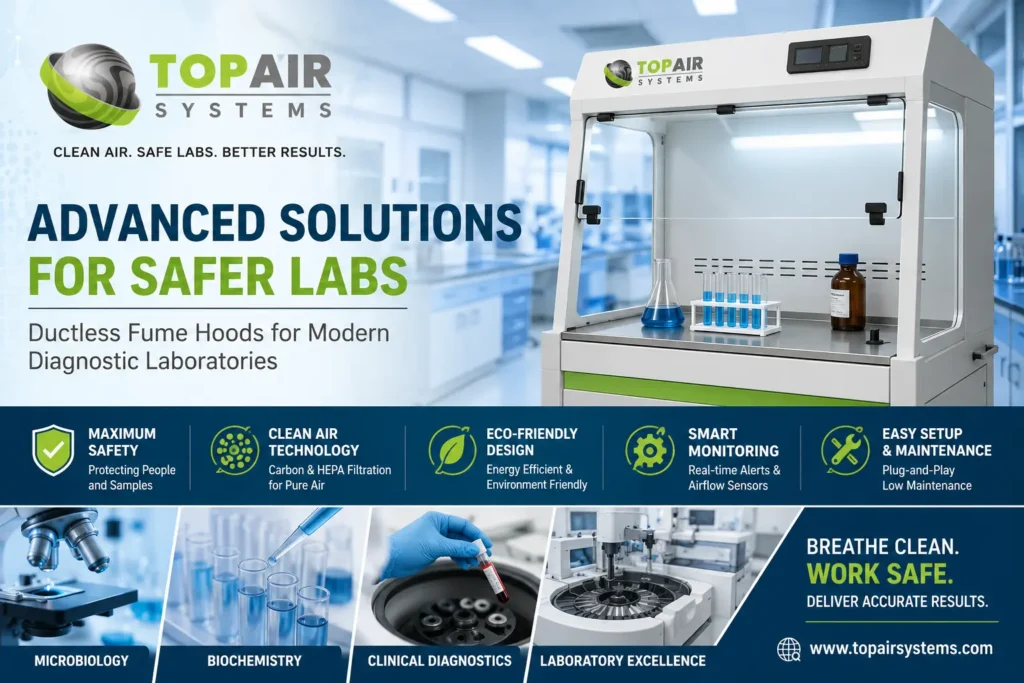
Among all safety measures, laboratory ventilation and air quality control have become increasingly critical. Advanced technologies—especially ductless filtration systems—are transforming how laboratories manage hazardous fumes and airborne contaminants.
This master guide combines best practices in laboratory safety, contamination prevention, equipment maintenance, and modern ventilation solutions, with a special focus on innovations from Top Air Systems.
1. Importance of Laboratory Safety Protocols
Why Safety Matters
Laboratories routinely handle:
- Toxic chemicals (e.g., formalin, xylene)
- Infectious biological samples
- Volatile reagents
Without proper safeguards, risks include:
- Chemical inhalation
- Skin burns and exposure
- Cross-contamination of samples
Core Safety Practices
- Use of Personal Protective Equipment (PPE)
- Proper chemical storage and labeling
- Routine equipment calibration
- Implementation of effective ventilation systems
2. Role of Ventilation in Laboratory Safety
Why Air Quality is Critical
Poor ventilation can lead to:
- Exposure to harmful vapors
- Sample contamination
- Damage to sensitive instruments
Modern labs now prioritize localized air filtration systems over traditional exhaust-only designs.
3. Ductless Fume Hood: A Modern Solution
One of the most efficient innovations in lab safety is the: 👉 ductless fume hood
How It Works
- Uses activated carbon or HEPA filters
- Captures harmful vapors at the source
- Recirculates purified air back into the lab
Key Advantages
- No external ducting required
- Lower installation and operational cost
- Energy-efficient (no loss of conditioned air)
- Flexible and portable setup
These features make ductless systems ideal for small to medium diagnostic labs and modern modular laboratory designs.
4. Ducted vs. Ductless Ventilation Systems
| Feature | Ducted Systems | Ductless Systems |
|---|---|---|
| Installation | Complex & expensive | Simple, plug-and-play |
| Air Handling | External exhaust | Internal filtration |
| Energy Use | High | Low |
| Flexibility | Fixed | Portable |
| Environmental Impact | Releases fumes outside | Filters and traps chemicals |
Modern laboratories are increasingly shifting toward ductless systems due to efficiency, sustainability, and cost savings.
5. Preventing Cross-Contamination in Laboratories
Major Sources of Contamination
- Airborne particles
- Improper workflow separation
- Contaminated surfaces
Best Practices
- Use sterile consumables
- Maintain pre/post workflow zones
- Perform routine surface disinfection
- Use localized filtration systems
A ductless fume hood plays a key role by:
- Reducing airborne microbial spread
- Creating a controlled micro-environment
- Protecting sensitive procedures like PCR and culture work
6. Controlled Environments in Biochemistry & Diagnostics
Why Environment Matters
Biochemical and clinical tests are sensitive to:
- Temperature changes
- Humidity
- Volatile organic compounds (VOCs)
Even minor environmental disturbances can compromise results.
Solution
Advanced ventilation systems:
- Capture fumes at source
- Maintain consistent air quality
- Prevent cross-test interference
Solutions from Top Air Systems include smart monitoring features such as:
- Filter saturation alerts
- Airflow sensors
- Real-time safety monitoring
7. Equipment Maintenance & Lab Standards
Why Maintenance is Important
- Ensures accurate results
- Extends equipment lifespan
- Required for lab certifications (e.g., ASCP standards)
Essential Maintenance Practices
- Monthly airflow checks
- Scheduled filter replacement
- Calibration of monitoring sensors
- Routine inspection of safety systems
Proper maintenance is especially critical for ventilation systems like ductless hoods.
8. Benefits for Diagnostic Centers
For growing labs and diagnostic centers, adopting modern ventilation solutions offers:
Key Benefits
- Quick Setup: Install in hours, not weeks
- Durability: Non-corrosive polypropylene construction
- Safety: Built-in alarms and monitoring systems
- Cost Efficiency: Reduced HVAC and maintenance expenses
9. Essential Equipment in a Modern Laboratory
Every diagnostic lab should include:
- Centrifuges – sample separation
- Microscopes – cellular analysis
- Clinical analyzers – biochemical testing
- Incubators – microbial growth
- Ventilation systems – air safety and contamination control
Among these, ventilation systems—especially ductless fume hoods—are critical for both safety and accuracy.
Conclusion
Laboratory safety is no longer limited to PPE and procedural protocols—it now heavily depends on environmental control and advanced ventilation technologies.
The integration of modern solutions like the 👉 ductless fume hood has redefined how laboratories manage safety, efficiency, and sustainability.
By investing in high-quality systems from Top Air Systems, laboratories can:
- Enhance staff safety
- Improve diagnostic accuracy
- Reduce operational costs
- Build future-ready infrastructure
In today’s evolving diagnostic landscape, clean air is not a luxury—it is a necessity.