

Epidermal growth factor receptor mutations reshaped treatment for non-small cell lung cancer, but first-generation EGFR tyrosine kinase inhibitors carried a limitation: reversible binding. Gefitinib and erlotinib occupied the ATP pocket transiently, leaving room for resistant clones to emerge. Dacomitinib was designed to close that gap through a different chemistry.
A covalent strategy against a moving target
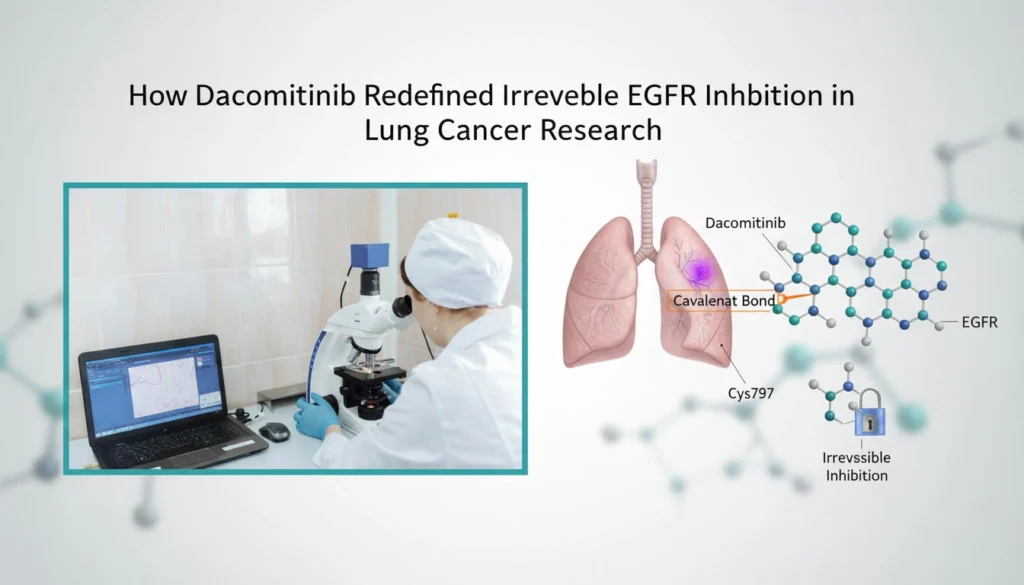
Dacomitinib forms an irreversible covalent bond with a cysteine residue at position 797 in the EGFR kinase domain, and extends this binding across HER2 and HER4, making it a pan-HER inhibitor rather than a single-receptor blocker. This covalent lock prevents ATP from re-engaging the pocket even after free drug clears from circulation, a property reversible inhibitors cannot replicate. Laboratories comparing second-generation EGFR chemistry frequently source Dacomitinib Pfizer as a reference standard, since its binding kinetics and selectivity are extensively documented across kinase panels.
Why the ARCHER 1050 data still gets cited
The compound’s clinical relevance traces to a head-to-head trial against gefitinib in patients with EGFR exon 19 deletions or the L858R substitution. Median progression-free survival extended well beyond first-generation inhibitors, and the difference held across subgroups. What makes this dataset useful for ongoing research is the pattern of response duration, used to model how covalent inhibition delays clonal escape versus reversible competitors.
Resistance mechanisms worth tracking
No EGFR inhibitor stays effective indefinitely. The T790M gatekeeper mutation, along with emerging C797S substitutions near the same covalent site, eventually restores kinase activity in a subset of tumors. This resistance profile has become a comparison point for structural biologists designing third-generation inhibitors able to engage both wild-type and mutant conformations, mapping where the covalent bond fails to guide where the next binding site should form.
Beyond first-line NSCLC
While its approved indication centers on treatment-naive EGFR-mutant lung cancer, Dacomitinib’s pan-HER activity has drawn interest where HER2 amplification drives tumor growth independently of EGFR status. Preclinical work in HER2-driven models has explored combination strategies pairing covalent EGFR/HER2 blockade with downstream pathway inhibitors, preventing the compensatory signaling that often undermines single-agent therapy.
For teams building structure-activity relationships around irreversible kinase inhibition, Dacomitinib remains a useful anchor point: a clinically validated covalent binder with a resistance pattern already well characterized, making comparisons against newer candidates considerably more informative.
Disclaimer
This article is provided for educational and research purposes only and is not intended to provide medical advice, diagnosis, or treatment recommendations. The information discusses dacomitinib, EGFR inhibition, lung cancer research, and related scientific findings and should not be used as a substitute for advice from a qualified healthcare professional.
Treatment decisions, including the use of dacomitinib or other EGFR-targeted therapies, should be made by an appropriately qualified oncology professional based on an individual patient’s clinical condition, molecular testing, treatment history, and current medical guidelines.
The scientific and clinical information presented may evolve as new research becomes available. Readers should consult authoritative medical literature, regulatory information, and qualified healthcare professionals for current guidance. LabTestsGuide does not endorse any specific drug, manufacturer, supplier, or commercial product mentioned in this article.
