

Managing diabetes often feels like learning a new language. You hear terms like HbA1c, Percentage, and mg/dL (or mmol/L), but how do they all relate?
If you just received your lab results and see a percentage but want to know what that means for your daily glucose readings, you need an eAG/A1c Calculator. In this guide, we break down the conversion, the science behind the numbers, and provide a handy chart for quick reference.
What is A1c and eAG?
Before jumping into the conversion, let’s define these two vital metrics:
- HbA1c (A1c): This measures your average blood sugar levels over the past 2–3 months. It represents the percentage of hemoglobin that has sugar attached to it.
- eAG (Estimated Average Glucose): This translates your A1c percentage into the same units (mg/dL or mmol/L) you see on your daily glucose meter or Continuous Glucose Monitor (CGM).
Why convert? Most people find eAG easier to understand because it relates directly to their daily finger-stick tests.
🖥️ Try the eAG/A1c Calculator
Live A1c & eAG Converter
The Formula: How to Calculate A1c to eAG
The relationship between A1c and eAG is based on a large-scale study called the ADAG Study (A1c-Derived Average Glucose). The formula used by healthcare providers worldwide is:
For mg/dL (used in Global):
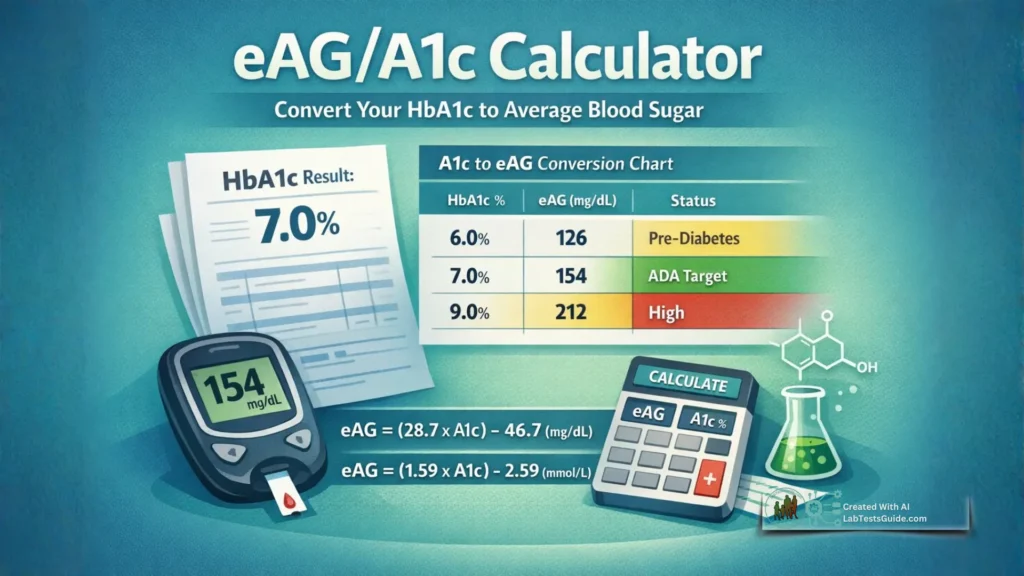
eAG = (28.7 x A1c) – 46.7
A1c = (eAG + 46.7) / 28.7
For mmol/L (used in UK/Canada/Europe):
eAG = (1.59 x A1c) – 2.59
A1c = (eAG + 2.59) / 1.59
A1c to eAG Conversion Chart
If you don't want to do the math, use this optimized conversion table. It highlights the target ranges suggested by the American Diabetes Association (ADA).
| HbA1c (%) | Average Glucose (mg/dL) | Average Glucose (mmol/L) | Status |
| 5.0 | 97 | 5.4 | Normal |
| 5.5 | 111 | 6.2 | Normal |
| 6.0 | 126 | 7.0 | Pre-diabetes |
| 6.5 | 140 | 7.8 | Diabetes Diagnosis |
| 7.0 | 154 | 8.6 | ADA Target |
| 8.0 | 183 | 10.2 | High |
| 9.0 | 212 | 11.8 | High |
| 10.0 | 240 | 13.4 | Very High |
| 11.0 | 269 | 14.9 | Danger Zone |
| 12.0 | 298 | 16.5 | Danger Zone |
Why Is Your eAG Different from Your Meter Reading?
A common point of confusion is why a morning finger-prick test might say 110 mg/dL, but your eAG (based on a 7% A1c) says 154 mg/dL.
- Timeframe: Your meter is a "snapshot" of a single moment. The eAG is the "average" of 24 hours a day for 90 days, including after meals and while you sleep.
- Glycation Rates: Some people’s red blood cells live longer or shorter than average, which can slightly skew the A1c percentage.
- Recent Changes: If you have drastically changed your diet or exercise in the last 2 weeks, your meter will show improvement immediately, but your A1c will take months to catch up.
Tips for Lowering Your A1c and eAG
If your calculator results were higher than expected, consider these three evidence-based strategies:
- Monitor Post-Meal Spikes: High readings 1–2 hours after eating are often the biggest contributors to a high A1c.
- Increase Fiber Intake: Soluble fiber slows sugar absorption, preventing sharp spikes.
- Stay Consistent: Walking for just 15 minutes after dinner can significantly lower your 24-hour glucose average.
Frequently Asked Questions (FAQ)
1. How often should I check my A1c?
Most doctors recommend testing every 3 to 6 months. Testing more frequently is rarely useful because red blood cells need time to cycle.
2. Is eAG the same as an average on my CGM?
It’s very close! Most modern CGMs (like Dexcom or FreeStyle Libre) provide a "GMI" (Glucose Management Indicator), which is the modern version of eAG based on sensor data.
3. What is a "healthy" A1c?
For most non-diabetic adults, a healthy A1c is below 5.7%. For those managing diabetes, the typical target is 7.0% or lower, though this varies by age and health status.
Conclusion
Understanding your numbers is the first step toward better health. Using an eAG/A1c calculator helps bridge the gap between complex lab results and your daily reality.
Always consult with your healthcare provider before making changes to your medication or treatment plan based on these calculations.
Disclaimer: This content is for informational purposes only and does not constitute medical advice. Always seek the advice of a physician or other qualified health provider with any questions regarding a medical condition.