

Connective and Mesenchymal Tissues and Their Stains 100 FAQs and 60 MCQs:
Connective and Mesenchymal Tissues and Their Stains 100 FAQs:
Connective and Mesenchymal Tissues and Their Stains 60 MCQs:
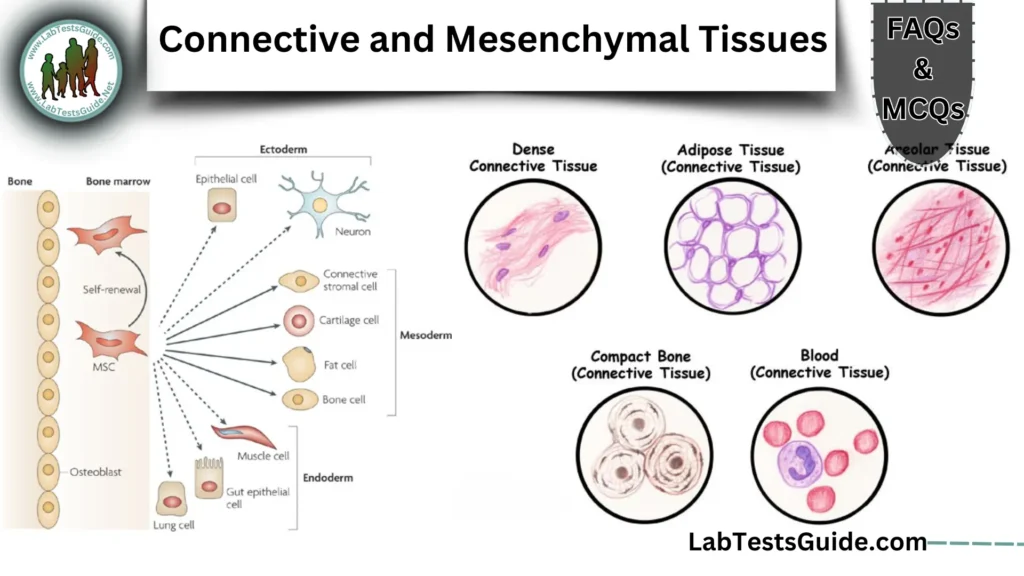
- Which embryonic layer gives rise to connective tissues?
a) Ectoderm
b) Endoderm
c) Mesoderm
d) Neuroectoderm
Answer: c) Mesoderm - Which component is NOT part of connective tissue?
a) Collagen fibers
b) Adipocytes
c) Keratinocytes
d) Ground substance
Answer: c) Keratinocytes - The primary function of bone compared to blood is:
a) Transporting oxygen
b) Structural support
c) Immune defense
d) Energy storage
Answer: b) Structural support
- Type IV collagen is predominantly found in:
a) Tendons
b) Basement membranes
c) Cartilage
d) Reticular fibers
Answer: b) Basement membranes - Reticular fibers stain black in silver impregnation due to their:
a) High elastin content
b) Carbohydrate-rich proteoglycans
c) Dense collagen bundles
d) Calcium deposits
Answer: b) Carbohydrate-rich proteoglycans - The 64 nm banding pattern in collagen fibrils is caused by:
a) Cross-linking of elastin
b) Staggered alignment of collagen molecules
c) Glycosaminoglycan accumulation
d) Myosin filaments
Answer: b) Staggered alignment of collagen molecules
- The principle of trichrome staining relies on:
a) Antibody-antigen interactions
b) Differential dye molecular sizes and pH
c) Silver ion reduction
d) Carbohydrate oxidation
Answer: b) Differential dye molecular sizes and pH - Which stain is used to differentiate fibrin of varying ages?
a) PAS
b) Masson’s trichrome
c) MSB method
d) Alcian blue
Answer: c) MSB method - In Verhöeff’s method, differentiation with ferric chloride is used to:
a) Stain collagen red
b) Remove excess stain from non-elastic components
c) Highlight reticular fibers
d) Oxidize elastin
Answer: b) Remove excess stain from non-elastic components
- Which proteins directly enable muscle contraction?
a) Actin and myosin
b) Collagen and elastin
c) Fibrillin and laminin
d) Keratin and tubulin
Answer: a) Actin and myosin - Intercalated discs are characteristic of:
a) Skeletal muscle
b) Smooth muscle
c) Cardiac muscle
d) Tendons
Answer: c) Cardiac muscle - The sarcoplasmic reticulum primarily stores:
a) Glycogen
b) Calcium ions
c) Hemoglobin
d) Collagen
Answer: b) Calcium ions
- Movat pentachrome stain is valuable in cardiovascular pathology because it highlights:
a) Amyloid deposits
b) Elastic fibers, collagen, and mucins
c) Reticular fibers
d) Fibrinoid necrosis
Answer: b) Elastic fibers, collagen, and mucins - Marfan syndrome is characterized by:
a) Fragmented elastic fibers in the aorta
b) Thickened glomerular basement membranes
c) Vitamin C deficiency
d) Excessive collagen cross-linking
Answer: a) Fragmented elastic fibers in the aorta - In scurvy, collagen synthesis is impaired due to a deficiency in:
a) Vitamin D
b) Vitamin C
c) Iron
d) Calcium
Answer: b) Vitamin C
- Connective tissue stains help classify tumors by identifying:
a) Epithelial cell clusters
b) Collagenous stroma in sarcomas
c) Amyloid deposits in carcinomas
d) Neutrophilic infiltrates
Answer: b) Collagenous stroma in sarcomas - Congo red staining with apple-green birefringence is diagnostic for:
a) Collagen
b) Amyloid
c) Fibrin
d) Reticular fibers
Answer: b) Amyloid
- Prolonged formaldehyde fixation impairs trichrome staining by:
a) Dissolving collagen
b) Masking reactive groups via cross-linking
c) Enhancing silver uptake
d) Increasing pH
Answer: b) Masking reactive groups via cross-linking - Mercury pigment artifacts in staining are removed using:
a) Picric acid
b) Iodine-thiosulfate
c) Phosphotungstic acid
d) Alcian blue
Answer: b) Iodine-thiosulfate - Thick tissue sections (>5 µm) primarily affect the visualization of:
a) Collagen bundles
b) Reticular fibers
c) Elastic laminae
d) Muscle striations
Answer: b) Reticular fibers
- Fibroblasts primarily synthesize:
a) Keratin
b) Collagen and ground substance
c) Hemoglobin
d) Myosin
Answer: b) Collagen and ground substance - The primary component of ground substance is:
a) Elastin
b) Glycosaminoglycans (GAGs)
c) Myosin
d) Hemoglobin
Answer: b) Glycosaminoglycans (GAGs)
- Which cartilage type contains abundant elastic fibers?
a) Hyaline
b) Fibrocartilage
c) Elastic
d) Articular
Answer: c) Elastic - Hematopoietic tissue is categorized under:
a) Connective tissue proper
b) Cartilage
c) Bone
d) Blood
Answer: d) Blood
- Microfibrils in elastic fibers are primarily composed of:
a) Fibrillin
b) Collagen IV
c) Laminin
d) Keratin
Answer: a) Fibrillin - The lamina densa of basement membranes is rich in:
a) Type I collagen
b) Type IV collagen
c) Elastin
d) Reticular fibers
Answer: b) Type IV collagen
- Zenker’s fixative is preferred for trichrome stains because it:
a) Dissolves collagen
b) Enhances nuclear detail and preserves cytoplasmic structures
c) Prevents calcium deposition
d) Increases pH for dye binding
Answer: b) Enhances nuclear detail and preserves cytoplasmic structures - Acidic pH in trichrome staining primarily enhances binding to:
a) Collagen’s cationic groups
b) Elastin’s hydrophobic regions
c) Reticular fiber carbohydrates
d) Muscle’s actin filaments
Answer: a) Collagen’s cationic groups - Orcein staining requires prior oxidation to:
a) Dissolve collagen
b) Expose elastin’s disulfide bonds
c) Remove mercury pigments
d) Highlight reticular fibers
Answer: b) Expose elastin’s disulfide bonds - EDTA is preferred over HCl for decalcification because it:
a) Works faster
b) Preserves collagen structure
c) Stains elastin black
d) Enhances PAS reactivity
Answer: b) Preserves collagen structure
- The sarcoplasmic reticulum regulates muscle contraction by:
a) Synthesizing ATP
b) Storing and releasing calcium ions
c) Anchoring actin filaments
d) Producing collagen
Answer: b) Storing and releasing calcium ions - Intercalated discs contain __ for electrical coupling.
a) Desmosomes
b) Gap junctions
c) Tight junctions
d) Hemidesmosomes
Answer: b) Gap junctions - Smooth muscle contraction differs from skeletal muscle in being:
a) Voluntary and fast
b) Involuntary and sustained
c) Dependent on Z-lines
d) Striated
Answer: b) Involuntary and sustained
- The PAS reaction targets:
a) Collagen fibers
b) Neutral mucins and glycogen
c) Elastic fibers
d) Calcium deposits
Answer: b) Neutral mucins and glycogen - Gold toning in silver stains improves:
a) Stain longevity and contrast
b) Collagen solubility
c) Muscle striation visibility
d) Fixation speed
Answer: a) Stain longevity and contrast
- Fibrinoid necrosis is characterized by:
a) Congo red positivity
b) Bright red staining with trichrome
c) Apple-green birefringence
d) Elastic fiber fragmentation
Answer: b) Bright red staining with trichrome - In lupus nephritis, the “wire loop” lesion is best identified using:
a) H&E
b) PAS or methenamine silver
c) Masson’s trichrome
d) Alcian blue
Answer: b) PAS or methenamine silver - Reticulin staining in liver biopsies helps diagnose:
a) Fatty liver disease
b) Cirrhosis and hepatocellular carcinoma
c) Hepatitis B
d) Hemochromatosis
Answer: b) Cirrhosis and hepatocellular carcinoma
- Amyloid deposits are distinguished from collagen by their:
a) Trichrome positivity
b) Congo red positivity with green birefringence
c) PAS negativity
d) Silver impregnation
Answer: b) Congo red positivity with green birefringence - A fixation artifact unrelated to mercury is:
a) Formalin pigment
b) Black deposits in silver stains
c) Over-cross-linked collagen
d) Ice crystal formation
Answer: d) Ice crystal formation
- In Gordon & Sweets’ silver method, iodine is used to:
a) Oxidize carbohydrates in reticular fibers
b) Remove mercury pigments
c) Differentiate collagen
d) Highlight elastin
Answer: a) Oxidize carbohydrates in reticular fibers - Aldehyde fuchsin stains elastic fibers after oxidation because it binds to:
a) Collagen’s cationic groups
b) Sulfonic acid groups on elastin
c) Glycosaminoglycans in ground substance
d) Calcium deposits
Answer: b) Sulfonic acid groups on elastin - Microwave heating in methenamine silver staining:
a) Dissolves collagen
b) Accelerates silver reduction and ensures uniformity
c) Enhances PAS reactivity
d) Prevents fading of elastic fibers
Answer: b) Accelerates silver reduction and ensures uniformity
- Type III collagen deficiency is most associated with:
a) Osteogenesis imperfecta
b) Ehlers-Danlos syndrome (vascular type)
c) Marfan syndrome
d) Scurvy
Answer: b) Ehlers-Danlos syndrome (vascular type) - In scurvy, impaired hydroxylation of proline affects:
a) Elastin cross-linking
b) Collagen triple helix stability
c) Reticular fiber formation
d) Myosin filament assembly
Answer: b) Collagen triple helix stability
- Formalin pigment artifacts can be removed using:
a) Picric acid
b) Sodium thiosulfate
c) Saturated alcoholic picric acid
d) Iodine solution
Answer: c) Saturated alcoholic picric acid - Ice crystal artifacts in frozen sections primarily affect:
a) Nuclear detail
b) Extracellular matrix architecture
c) Elastic fiber staining
d) Trichrome contrast
Answer: b) Extracellular matrix architecture
- Aortic dissection in Marfan syndrome is histologically characterized by:
a) Amyloid deposits in the media
b) Fragmented elastic fibers (Verhöeff’s stain)
c) Fibrinoid necrosis (trichrome)
d) Thickened basement membranes
Answer: b) Fragmented elastic fibers (Verhöeff’s stain) - The Movat stain highlights atherosclerotic plaques by staining:
a) Collagen blue and elastin black
b) Lipids red and calcium purple
c) Mucins green and fibrin yellow
d) Reticular fibers silver
Answer: a) Collagen blue and elastin black
- A tumor with abundant trichrome-positive stroma is most likely a:
a) Carcinoma
b) Lymphoma
c) Sarcoma
d) Melanoma
Answer: c) Sarcoma - Congo red positivity with apple-green birefringence in a thyroid biopsy suggests:
a) Papillary carcinoma
b) Medullary carcinoma with amyloid
c) Collagenous stroma
d) Hashimoto’s thyroiditis
Answer: b) Medullary carcinoma with amyloid
- The H-band in a sarcomere represents the region containing:
a) Actin filaments only
b) Myosin filaments only
c) Overlapping actin and myosin
d) Z-line proteins
Answer: b) Myosin filaments only - Troponin’s role in muscle contraction is to:
a) Bind calcium and shift tropomyosin
b) Anchor myosin to the M-line
c) Stabilize the sarcoplasmic reticulum
d) Synthesize ATP
Answer: a) Bind calcium and shift tropomyosin
- The lamina reticularis connects to underlying connective tissue via:
a) Type IV collagen
b) Type VII collagen (anchoring fibrils)
c) Elastin microfibrils
d) Reticular fibers
Answer: b) Type VII collagen (anchoring fibrils) - Thickened glomerular basement membranes in diabetes are best visualized with:
a) PAS stain
b) Verhöeff’s stain
c) Masson’s trichrome
d) Alcian blue
Answer: a) PAS stain
- A liver biopsy with disrupted reticulin framework (silver stain) suggests:
a) Fatty liver disease
b) Cirrhosis or hepatocellular carcinoma
c) Hepatitis B infection
d) Hemochromatosis
Answer: b) Cirrhosis or hepatocellular carcinoma - Necrotizing vasculitis is confirmed histologically by:
a) Congo red positivity
b) Fibrinoid necrosis (bright red trichrome)
c) PAS-positive basement membranes
d) Elastic fiber hyperplasia
Answer: b) Fibrinoid necrosis (bright red trichrome)
- Fibrillin-1 mutations are implicated in:
a) Marfan syndrome
b) Osteogenesis imperfecta
c) Ehlers-Danlos syndrome
d) Scurvy
Answer: a) Marfan syndrome - Laminin in basement membranes primarily facilitates:
a) Cell adhesion to the lamina densa
b) Calcium storage
c) Collagen fibril assembly
d) Elastic fiber cross-linking
Answer: a) Cell adhesion to the lamina densa
- Inconsistent PAS staining of basement membranes may result from:
a) Inadequate oxidation with periodic acid
b) Overuse of EDTA decalcification
c) Prolonged formalin fixation
d) All of the above
Answer: d) All of the above
📚 This article may have been prepared using trusted medical literature, clinical guidelines, textbooks, and peer-reviewed sources.
View Possible References Used →
