

Concentration calculation sits at the point where a purchased reagent becomes an experimental input, and it is one of the few steps in laboratory work where a small error produces confidently wrong results rather than obvious failure. It deserves more attention than it usually gets.
The Basic Relationship
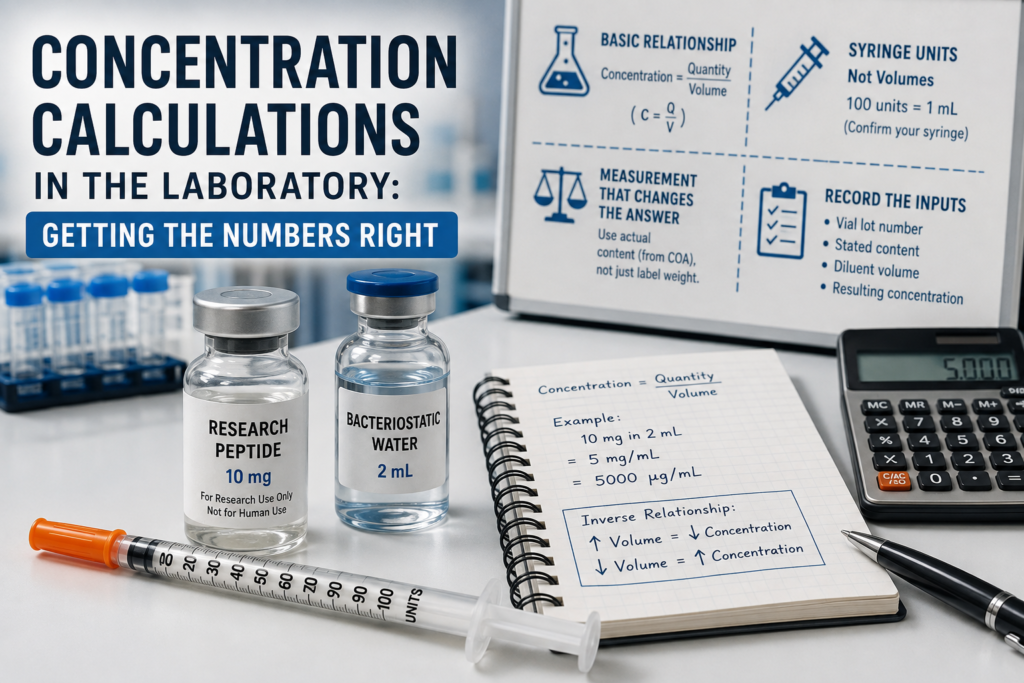
Concentration is quantity divided by volume. A vial containing ten milligrams, reconstituted in two millilitres, yields five milligrams per millilitre. Straightforward.
Complexity enters through units. Reagent quantities arrive in milligrams. Working concentrations may be expressed in milligrams per millilitre, micrograms per millilitre, or in molar terms requiring molecular weight. Volumes are drawn in millilitres or in syringe units that are not volumetric measurements at all. Each conversion between these is a decimal place waiting to move.
The Inverse Relationship Catches People
Diluent volume and concentration move in opposite directions. Doubling the diluent halves the concentration; halving it doubles the concentration. Obvious in the abstract, less obvious at the bench with three numbers in play and a protocol waiting.
This is a common source of order-of-magnitude errors, and order-of-magnitude errors are the ones that produce results looking like discoveries.
Syringe Units Are Not Volumes
Insulin syringes are graduated in units rather than millilitres. The conversion depends on syringe specification — commonly one hundred units per millilitre, but this must be confirmed rather than assumed for any given syringe.
Reading a unit marking as a volume produces a preparation off by a factor of one hundred. The error is easy to make, easy to miss, and catastrophic to the resulting data.
The Measurement That Changes the Answer
There is a step most calculations skip. Lyophilised material contains residual water and counter-ions from synthesis, so a vial labelled at a given weight may contain less actual peptide.
Peptide content by weight — reported on complete certificates of analysis, omitted from incomplete ones — is what converts a label figure into a real one. Where a certificate reports content, that figure rather than the label weight should drive the calculation. Ignoring it means the concentration in your records and the concentration in your vial are different numbers.
Why These Errors Are Expensive
An arithmetic error does not announce itself. The preparation dissolves correctly and behaves like a valid solution. What follows is data that is wrong rather than absent — and wrong data gets attributed to method, to biological variability, to reagent quality, to nearly anything before someone rechecks the math.
The Mitigation
Calculation tools remove this error class entirely, which is why most laboratories with established practice use one rather than working from memory. A compound-specific tool such as a retatrutide dosage calculator takes vial content, target concentration, and diluent volume and returns the missing figure, including the syringe-unit conversion that causes most trouble.
Independent verification helps too: a second person recalculating from original numbers, rather than checking the first person’s arithmetic, catches transcription errors that re-reading does not.
Record the Inputs, Not Just the Output
Vial lot number, stated content, diluent volume, and resulting concentration should all sit in the record. A recorded concentration alone cannot be verified after the fact; the inputs can be re-derived and checked.
Context
These procedures apply to research materials designated for research use only — laboratory reagents not approved for human or veterinary use and not intended for diagnostic or therapeutic application. Accurate concentration is a matter of experimental validity.
