

It’s a question many people ask after leaving the dentist’s office with news they weren’t hoping to hear: do I really need a filling, or can my tooth heal on its own? The answer is more nuanced than a simple yes or no. Whether a cavity can heal without a filling depends entirely on how far the decay has progressed – and understanding that distinction could save you from unnecessary treatment or, conversely, from letting a small problem grow into a much larger one.
What Is a Cavity, Really?
Before answering whether cavities can heal, it helps to understand what a cavity actually is and how it forms.
A cavity is the result of tooth decay – a process that begins long before a hole appears in your tooth. It starts with bacteria naturally present in your mouth feeding on sugars and carbohydrates from the food you eat. As they metabolize these sugars, they produce acids that attack the outer layer of your tooth, known as enamel.
This acid attack doesn’t happen all at once. It occurs in cycles – every time you eat or drink something sugary or acidic, your mouth enters an acidic state for roughly 20 to 30 minutes. Saliva works to neutralize the acid and remineralize the enamel between these episodes. When the attacks happen too frequently, or when oral hygiene is poor, the balance tips in favor of decay.
Tooth decay progresses through distinct stages:
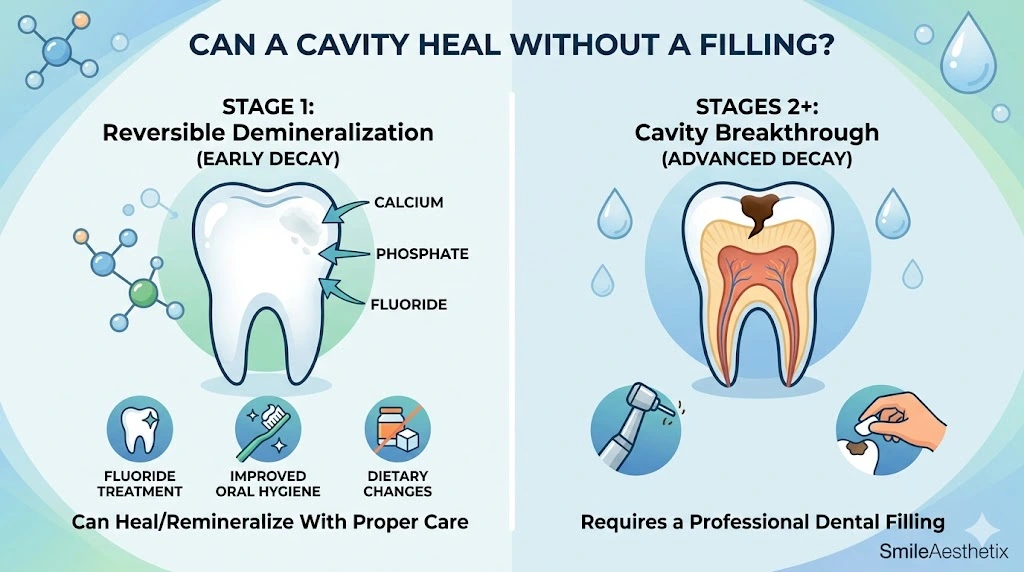
- Stage 1 – Demineralization: Acid begins dissolving minerals from the enamel surface. A chalky white spot may appear – a sign of weakened enamel, but no hole yet.
- Stage 2 – Enamel decay: The enamel continues to break down and a cavity begins to form, though it remains confined to the outer layer.
- Stage 3 – Dentin decay: The decay reaches the dentin, the softer layer beneath the enamel. At this stage, sensitivity to hot, cold, and sweet foods typically begins.
- Stage 4 – Pulp involvement: Bacteria reach the tooth’s inner pulp, where the nerves and blood vessels live. This is when significant pain can occur and a root canal may become necessary.
- Stage 5 – Abscess formation: Infection spreads beyond the pulp into surrounding tissue, potentially threatening overall health.
The stage your cavity has reached determines whether natural healing is possible – or whether a filling is unavoidable.
When a Cavity Can Heal Without a Filling
The short answer: yes, but only at the very earliest stage – demineralization.
When decay is caught before it has broken through the enamel surface, the process is technically reversible. This is because enamel has the ability to remineralize – to repair itself by reabsorbing minerals like calcium and phosphate from saliva and fluoride sources. No drilling, no filling material, no procedure required.
This is not a passive process, however. Remineralization requires active intervention through changes in oral hygiene habits, diet, and often the use of fluoride treatments. It also requires time and regular monitoring by a dentist to confirm the lesion is stabilizing rather than progressing.
What supports natural remineralization:
Fluoride is the most powerful tool available for reversing early decay. It strengthens enamel and accelerates the remineralization process. Sources include fluoride toothpaste, fluoride mouthwash, fluoride-rich drinking water, and professional fluoride treatments applied in a dental office.
Improved oral hygiene removes the plaque and bacteria that produce decay-causing acids. Brushing twice daily with fluoride toothpaste and flossing daily disrupts the bacterial colonies responsible for ongoing enamel erosion.
Dietary changes play a significant role. Reducing the frequency of sugar and refined carbohydrate consumption gives your saliva more time to neutralize acids and remineralize enamel between meals. Swapping acidic and sugary drinks for water – particularly fluoridated water – makes a measurable difference.
Saliva production is your mouth’s natural defense mechanism. Staying well hydrated, chewing sugar-free gum containing xylitol, and addressing dry mouth conditions all support the remineralization process.
Calcium and phosphate-rich foods such as dairy products, leafy greens, and nuts provide the raw minerals your enamel needs to repair itself.
For patients in the early stages of decay, providers experienced in preventive dentistry – like those at smileaesthetix.com – can assess whether remineralization therapy is a viable alternative to immediate restorative treatment, or whether a watch-and-wait approach with close monitoring is appropriate.
When a Cavity Cannot Heal on Its Own
Once decay has broken through the enamel surface and progressed into the body of the tooth, natural healing is no longer possible. Enamel can remineralize, but it cannot regenerate. Once it is gone, the body has no mechanism to replace it.
At this point, a filling becomes necessary – not just advisable. Here’s why waiting is dangerous once a cavity has formed:
Decay only moves in one direction. Without intervention, bacteria continue advancing deeper into the tooth. What begins as a small cavity in the enamel will reach the dentin, and eventually the pulp, where the nerve lives. A filling that costs a few hundred dollars today could become a root canal or extraction that costs significantly more – financially and physically.
There is no pain in the early stages. Many patients assume that because a tooth doesn’t hurt, the cavity isn’t serious yet. In reality, enamel and early dentin have limited nerve supply, meaning decay can progress considerably before causing any discomfort. By the time you feel pain, the situation is often already advanced.
Bacteria don’t stop on their own. Without removing the infected tissue and sealing the tooth, bacteria continue to multiply inside the cavity. No amount of brushing or fluoride can reverse decay that has already penetrated the enamel.
The Role of Your Dentist in Making This Decision
One of the most important things to understand is that you cannot self-diagnose which stage your cavity is at. What looks like a small dark spot to you may be superficial demineralization – or it may be the visible tip of a much deeper lesion. Only a dentist, using clinical examination and X-rays, can determine the true extent of the decay.
This is why regular dental check-ups every six months are so important. They give your dentist the opportunity to catch lesions at the demineralization stage, when intervention is minimal and natural reversal is possible, rather than discovering them once they’ve already broken through the enamel.
During these check-ups, your dentist may use several tools to assess early decay:
- Bitewing X-rays to detect decay between teeth and beneath existing restorations
- DIAGNOdent laser scanning to measure the mineral density of enamel and identify hidden lesions
- Visual and tactile examination to assess surface texture and color changes consistent with early decay
If early decay is detected, your dentist may recommend a period of remineralization therapy before deciding whether a filling is needed – but this approach requires disciplined follow-through on your part and close monitoring at follow-up visits.
Sealants and Preventive Treatments
For patients – particularly children and teenagers – who are at high risk of developing cavities, dental sealants offer another layer of protection. A sealant is a thin, protective coating applied to the chewing surfaces of the back teeth, where decay most commonly begins. It physically blocks food particles and bacteria from settling into the grooves of the tooth.
Sealants are not a treatment for existing cavities, but they are highly effective at preventing new ones from forming in the first place. Combined with fluoride treatments and good oral hygiene, they significantly reduce the likelihood of ever needing a filling in the protected teeth.
Myths Worth Addressing
“If I brush more, my cavity will go away.” Not once it has progressed past demineralization. Brushing removes plaque and prevents further damage, but it cannot rebuild enamel that has already broken down into a cavity.
“My tooth stopped hurting, so the cavity must have healed.” This is one of the more dangerous misconceptions. Pain from a cavity can temporarily subside when the nerve becomes damaged or dies – which actually indicates the decay has worsened, not improved. A tooth that stops hurting on its own warrants urgent dental attention.
“Natural remedies like oil pulling can reverse cavities.” There is no credible clinical evidence that oil pulling, activated charcoal, or similar remedies can remineralize enamel or reverse an established cavity. While some of these practices may support general oral hygiene, they are not substitutes for professional dental care.
“Children’s baby teeth don’t need fillings since they’ll fall out anyway.” Untreated cavities in primary teeth can cause pain, infection, and premature tooth loss that disrupts the spacing needed for permanent teeth to erupt correctly. Baby teeth with significant decay generally do need treatment.
Frequently Asked QuestionsHow do I know if my cavity is still in the early stage?
You likely won’t be able to tell without a dental examination. White spots on the enamel can indicate early demineralization, but many early cavities are invisible to the naked eye. Regular check-ups are the only reliable way to catch decay before it becomes a cavity requiring a filling.
Can I delay getting a filling if the tooth doesn’t hurt?
Delaying treatment on a confirmed cavity is risky. Pain is not a reliable indicator of severity, and untreated cavities advance steadily. The longer you wait, the more extensive – and expensive – the treatment required.
How long does remineralization take?
For a minor demineralized lesion addressed with consistent fluoride use and dietary changes, some improvement can be seen within a few months. However, the timeline varies depending on the severity of the lesion and how diligently the recommended changes are followed.
Is fluoride safe?
Yes. At the concentrations used in toothpaste, mouthwash, and professional treatments, fluoride is safe and extensively studied. The fluoride levels in dental products are carefully regulated and have been proven effective at reducing tooth decay rates across populations.
The Bottom Line
A cavity can only heal without a filling when it is caught at the very earliest stage – before it has breached the enamel surface. At that point, remineralization through fluoride, improved hygiene, and dietary changes can genuinely reverse the process. Once decay has formed a hole in the tooth, however, no amount of brushing, rinsing, or home remedy will repair it. A filling becomes necessary to stop the progression and protect the remaining tooth structure.
The best strategy is prevention and early detection: see your dentist regularly, maintain consistent oral hygiene, and don’t wait for pain to tell you something is wrong. In dentistry, timing is everything – and acting early almost always means simpler, less invasive, and less costly treatment.
