

Biochemical Test of Streptococcus canis 50 FAQs and 30 MCQs
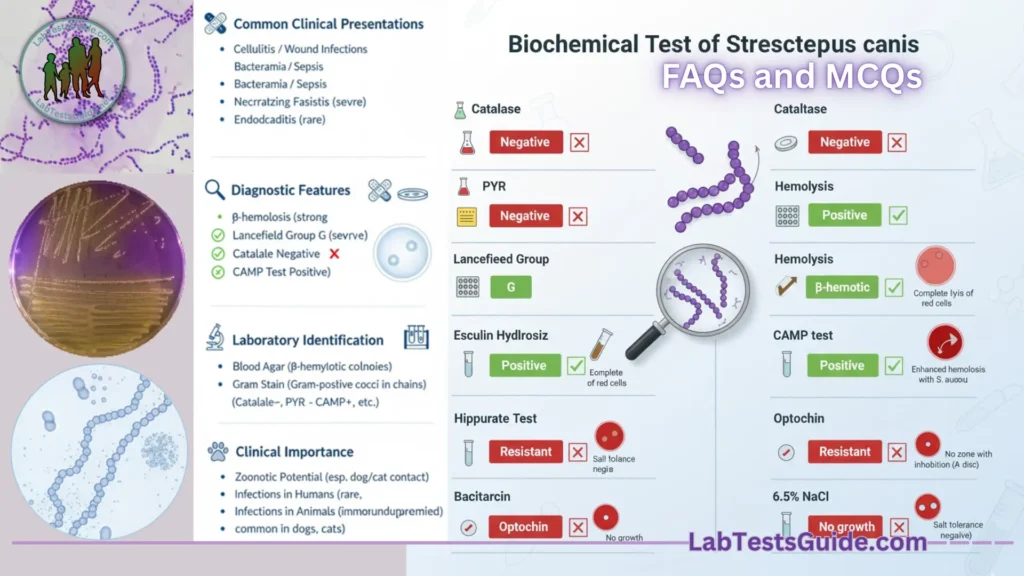
Biochemical Test of Streptococcus canis 50 FAQs
What is Streptococcus canis?
A Gram-positive, beta-hemolytic bacterium belonging to Lancefield group G, primarily infecting animals but capable of infecting humans.
What shape is Streptococcus canis?
Cocci (spherical or ovoid), typically arranged in chains or pairs.
Is Streptococcus canis Gram-positive or Gram-negative?
Gram-positive (+ve).
What is the hemolytic pattern of S. canis on blood agar?
Beta-hemolytic (complete lysis of red blood cells).
What Lancefield group does S. canis belong to?
Group G.
Is Streptococcus canis catalase-positive?
No, it is catalase-negative (-ve).
What is the result of the PYR test for S. canis?
Negative (No color change, does not hydrolyze L-pyrrolidonyl-β-naphthylamide).
Does S. canis grow in 6.5% NaCl?
No, it cannot tolerate high salt concentrations (Negative result).
What is the result of the bile esculin test for S. canis?
Negative (Medium does not turn dark; does not hydrolyze esculin in the presence of bile).
Is S. canis urease positive?
No, urease-negative (-ve).
Is S. canis VP (Voges-Proskauer) positive?
No, VP-negative (-ve).
Does S. canis hydrolyze hippurate?
Yes (Positive outcome, hydrolyzes hippurate).
Does S. canis hydrolyze esculin?
Yes (Positive for Esculin Hydrolysis).
Does S. canis produce hyaluronidase?
No (Hyalurodinase Negative (-ve)).
Does S. canis produce arginine dehydrolase?
Yes (Positive (+ve)).
Does S. canis produce alkaline phosphatase?
Yes (Positive (+ve)).
Does S. canis ferment glucose?
Yes (Positive (+ve)).
Does S. canis ferment lactose?
Variable (Depends on the strain).
Does S. canis ferment maltose?
Yes (Positive (+ve)).
Does S. canis ferment sucrose?
Yes (Positive (+ve)).
Does S. canis ferment mannitol?
No (Negative (-ve)).
Does S. canis ferment sorbitol?.
No (Negative (-ve))
Does S. canis ferment trehalose?
Variable.
Does S. canis ferment arabinose?
No (Negative (-ve)).
Does S. canis ferment xylose?
No (Negative (-ve)).
Does S. canis ferment raffinose?
No (Negative (-ve)).
Does S. canis ferment melibiose?
No (Negative (-ve)).
Does S. canis ferment inulin?
No (Negative (-ve)).
Does S. canis ferment glycogen?
No (Negative (-ve)).
Does S. canis ferment starch?
Yes (Positive (+ve)).
Does S. canis ferment fructose?
Yes (Positive (+ve)).
Does S. canis ferment galactose?
Yes (Positive (+ve)).
Does S. canis ferment mannose?
Yes (Positive (+ve)).
Does S. canis ferment ribose?
Yes (Positive (+ve)).
Does S. canis ferment salicin?
Yes (Positive (+ve)).
Does S. canis ferment arbutin?
Yes (Positive (+ve)).
Does S. canis ferment adonitol?
No (Negative (-ve)).
Does S. canis ferment arabitol?
No (Negative (-ve)).
Does S. canis ferment dulcitol?
No (Negative (-ve)).
Does S. canis ferment erythritol?
No (Negative (-ve)).
Does S. canis ferment inositol?
No (Negative (-ve)).
Does S. canis ferment rhamnose?
No (Negative (-ve)).
Who are the primary hosts for S. canis infections?
Dogs and cats (primarily infects animals).
Can S. canis infect humans?
Yes, though less commonly, typically in immunocompromised individuals or those with close animal contact.
What types of infections does S. canis cause in animals?
Skin/soft tissue infections, respiratory infections, urinary tract infections (UTIs), and septicemia.
What types of infections can S. canis cause in humans?
Similar infections as in animals (skin/soft tissue, respiratory, UTI, septicemia).
How is S. canis diagnosed?
Requires culturing clinical specimens in a lab followed by biochemical testing (and often Lancefield grouping) for identification.
How is S. canis treated?
With antibiotics, chosen based on susceptibility testing due to potential resistance.
Why is susceptibility testing important for treating S. canis?
To ensure the chosen antibiotics are effective against the specific strain, as resistance can occur.
Biochemical Test of Streptococcus canis 30 MCQs
- What is the Gram stain characteristic of S. canis?
A) Gram-negative
B) Gram-variable
C) Gram-positive✔
D) Acid-fast - Which Lancefield group does S. canis belong to?
A) Group A
B) Group B
C) Group C
D) Group G✔ - What hemolytic pattern does S. canis exhibit on blood agar?
A) Alpha-hemolysis
B) Beta-hemolysis✔
C) Gamma-hemolysis
D) Variable hemolysis - Which shape describes S. canis cells?
A) Rods
B) Spirochetes
C) Cocci✔
D) Filamentous - What is the result of the catalase test for S. canis?
A) Positive
B) Negative✔
C) Variable
D) Weakly positive
- Which sugar is NOT fermented by S. canis?
A) Glucose
B) Lactose
C) Mannitol✔
D) Fructose - The CAMP test for S. canis is:
A) Positive✔
B) Negative
C) Variable
D) Not applicable - S. canis hydrolysis of hippurate yields:
A) Glycine and benzoic acid✔
B) Pyruvate and ammonia
C) Glucose and galactose
D) Lactate and acetate - Which enzymatic reaction is POSITIVE for S. canis?
A) Urease
B) Hyaluronidase
C) Alkaline phosphatase✔
D) Bile esculin hydrolysis - Growth in 6.5% NaCl indicates S. canis is:
A) Salt-tolerant
B) Halophilic
C) Salt-sensitive✔
D) Variable - The bile esculin test for S. canis is:
A) Positive (dark brown/black)
B) Negative (no color change)✔
C) Variable
D) Weakly positive - Which sugar fermentation is VARIABLE in S. canis?
A) Glucose
B) Trehalose✔
C) Galactose
D) Ribose - The PYR test for S. canis is:
A) Positive (color change)
B) Negative (no color change)✔
C) Inconclusive
D) Not tested - Arginine dehydrolase production by S. canis is:
A) Positive✔
B) Negative
C) Strain-dependent
D) Unreliable - Which carbon source is fermented by S. canis?
A) Xylose
B) Sorbitol
C) Salicin✔
D) Mannitol
- S. canis primarily infects:
A) Birds
B) Reptiles
C) Dogs and cats✔
D) Cattle - Which human group is most at risk for S. canis infection?
A) Healthy adults
B) Infants
C) Immunocompromised individuals✔
D) Elderly - Which infection is NOT associated with S. canis in animals?
A) Urinary tract infection
B) Respiratory infection
C) Dental caries✔
D) Septicemia - Human S. canis infections are typically linked to:
A) Contaminated water
B) Airborne transmission
C) Animal contact✔
D) Soil exposure
- Diagnosis of S. canis requires:
A) PCR alone
B) Culture and biochemical tests✔
C) Serology only
D) Microscopy alone - Antibiotic selection for S. canis is guided by:
A) Gram stain
B) Hemolysis pattern
C) Susceptibility testing✔
D) Lancefield grouping - A key step in identifying S. canis is:
A) Catalase positivity
B) Beta-hemolysis + Group G Lancefield✔
C) Urease activity
D) Growth in NaCl
- Which enzyme does S. canis produce?
A) Urease
B) Hyaluronidase
C) Alkaline phosphatase✔
D) DNase - S. canis hydrolysis of esculin is:
A) Positive✔
B) Negative
C) Variable
D) Bile-dependent - Fermentation of lactose in S. canis is:
A) Always positive
B) Always negative
C) Variable✔
D) pH-dependent - Which test is NEGATIVE for S. canis?
A) Arginine dehydrolase
B) Hippurate hydrolysis
C) Voges-Proskauer (VP)✔
D) Alkaline phosphatase
- Preventing S. canis in animals involves:
A) Antibiotic prophylaxis
B) Regular veterinary check-ups✔
C) Vaccination
D) Isolation from humans - Human prevention strategies include:
A) Avoiding animal contact
B) Wearing masks
C) Hand hygiene✔
D) Boiling water - S. canis is a:
A) Strict aerobe
B) Strict anaerobe
C) Facultative anaerobe✔
D) Microaerophile - A key biochemical trait of S. canis is:
A) Urease positivity
B) Catalase positivity
C) Beta-hemolysis✔
D) Growth in 6.5% NaCl
