

Bacterial Growth & Generation Time Calculator
In microbiology, quantifying the speed at which a population expands is a cornerstone of research. Whether you are studying the kinetics of a new strain in a lab, ensuring food safety, or optimizing a bioreactor, understanding Generation Time (g) is essential.
This guide explains the mathematics of exponential growth and provides an advanced calculator to determine doubling times, growth constants, and predicted population sizes.
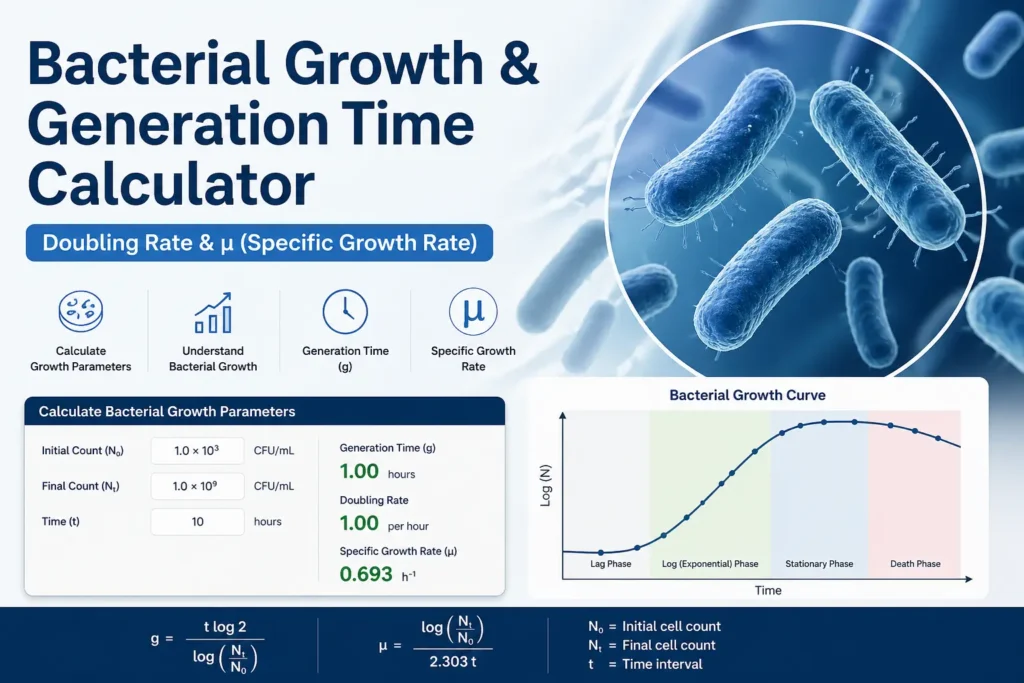
What is Generation Time?
Generation time is the specific time interval required for a bacterial population to double in number. Because bacteria reproduce through binary fission (where one cell splits into two), their population grows exponentially under optimal conditions.
The Exponential Growth Formulas:
Bacterial growth typically follows an exponential pattern during the Log Phase. Because one cell divides into two, the population doubles at a constant rate. To calculate this, we use several key variables:
- g: Generation time (the time it takes for the population to double).
- N0
: The initial number of bacteria. - N: The final number of bacteria after time
(t). - t: The total time elapsed during growth.
Number of Generations (n):
- N = Final number of bacteria
- N0 = Initial number of bacteria
Generation Time (g):
- t = Total time of growth (usually in minutes or hours)
- n = Number of generations
Growth Rate Constant (k):
While Generation Time (g) tells you how long it takes to double, the Specific Growth Rate (μ) is used by bioengineers and researchers to describe the instantaneous growth speed. It is calculated using the natural log (ln):
This represents how many generations occur per unit of time.
How to Calculate Bacterial Doubling Time :
- Initial Population (
N0): Enter the number of cells at the start of the observation (e.g.,100100). - Final Population (
N): Enter the number of cells at the end of the observation (e.g.,6,4006,400). - Total Time (
tt): Enter the duration of the growth period. - Unit: Select whether your time is in minutes or hours.
- Calculate: The tool will provide the generation time and the total number of doublings.
🧫 Advanced Bacterial Growth Calculator
Exponential kinetics | Universal unit conversions | Real-time plotting
Formulas based on binary exponential model N = N₀ · 2ⁿ. Includes generation doubling metrics, specific rate constant μ = ln(2)/g, and discrete parameterizations across matching units seamlessly.
Understanding Growth Phases (Lag, Log, Stationary)
To understand generation time, one must look at the Bacterial Growth Curve. While our calculator focuses on the Log (Exponential) Phase, bacteria actually transition through four distinct stages:
- Lag Phase: Cells are adjusting to their environment; no division occurs.
- Log (Exponential) Phase: This is where our calculator works! Cells divide at a constant, maximum rate.
- Stationary Phase: Growth rate equals death rate as resources become limited.
- Death (Decline) Phase: Nutrients are exhausted and toxic waste builds up, leading to a population decrease.
The 4 Phases of Bacterial Growth
Note: The Log Phase is the specific period where Generation Time is calculated.
Real-World Examples
Different species have vastly different growth speeds depending on their environment:
- E. coli: Under optimal conditions, its generation time is approximately 20 minutes.
- Staphylococcus aureus: Roughly 27–30 minutes.
- Mycobacterium tuberculosis: A very slow grower with a generation time of 12–16 hours.
- Mycobacterium leprae: Can take up to 14 days to double.
Conclusion
Calculating generation time allows scientists to predict how quickly a contaminant might spread or how effective an antibiotic is at slowing down growth. Use this calculator as a quick reference for your lab reports and microbiology studies.
Frequently Asked Questions (FAQs):
What is the difference between generation time and growth rate?
Generation time (g) is the time it takes for a population to double. Growth rate (k or μ) is the number of generations that occur per unit of time. They are the inverse of each other.
Why is the log phase used for these calculations?
During the log phase (exponential phase), bacteria divide at a constant rate and are most metabolically active, making the mathematical model N = N0 × 2n
accurate.
Can I use OD600 measurements in this calculator?
Yes! Since Optical Density (OD) is proportional to cell density during the log phase, you can enter your OD readings into the “Initial” and “Final” population fields to find the doubling time.
What exactly is “Generation Time” in microbiology?
Generation time, also known as doubling time (g), is the time required for a bacterial population to double in number during the exponential (log) growth phase. It varies significantly between species and is heavily influenced by environmental conditions like temperature and nutrient availability.
What is the formula for calculating the number of generations (n)?
The number of generations is calculated using the log of the initial (N0) and final (N) population: n = (log (N) x log (No) ) / log2
4. What is Specific Growth Rate (μ)?
The specific growth rate (μ) represents the instantaneous growth rate of the population. It is calculated using natural logarithms: μ=ln(2)/g . It is a standard metric used by bioengineers to describe the efficiency of a microbial culture.
Why is the “Log Phase” the only period used for these calculations?
Calculations for generation time are only valid during the Log (Exponential) Phase. In this stage, the growth rate is constant because the bacteria are healthy and resources are abundant. In the Lag, Stationary, or Death phases, the growth rate changes, making the formulas inaccurate.
How does temperature affect bacterial generation time?
Bacteria have an “optimal” temperature. As the temperature moves away from this optimum (too hot or too cold), enzymes function less efficiently, slowing down metabolic processes and increasing the generation time. For example, E. coli doubles in 20 minutes at 37°C but takes much longer at 20°C.
What is the generation time of E. coli?
Under optimal laboratory conditions (rich media at 37°C), Escherichia coli has a generation time of approximately 20 minutes. This makes it one of the fastest-growing organisms used in research.
Why do some bacteria grow so slowly?
Species like Mycobacterium tuberculosis have generation times of 12–16 hours. This is often due to complex cell wall structures that require significant energy to synthesize, or metabolic pathways that are less efficient than those of fast-growing species.
How do I calculate the final population size (N) if I know the doubling time?
If you know your starting count (N0), the time elapsed (t), and the generation time (g), use the formula: N = N0 × 2(t/g)(Our calculator’s "Predict Final Population" mode does this automatically!)
What are the limitations of the bacterial growth model?
The exponential growth model assumes “ideal” conditions. In the real world, factors like waste accumulation, oxygen depletion, and space limitations eventually slow growth, leading to the Stationary Phase.

good sir