Our Team

Article

Amies Transport Medium MCQs Mock Test

Editorial StaffUpdated 2 min read

Quick Overview

Master Amies Transport Medium: components, protocols, 30 MCQs. Essential guide for bacteriology sample preservation in clinical labs and medical education.

  • CategoryChemicals & Stains
  • Read time2 min
  • UpdatedJan 2026
Amies Transport Medium MCQs Mock Test

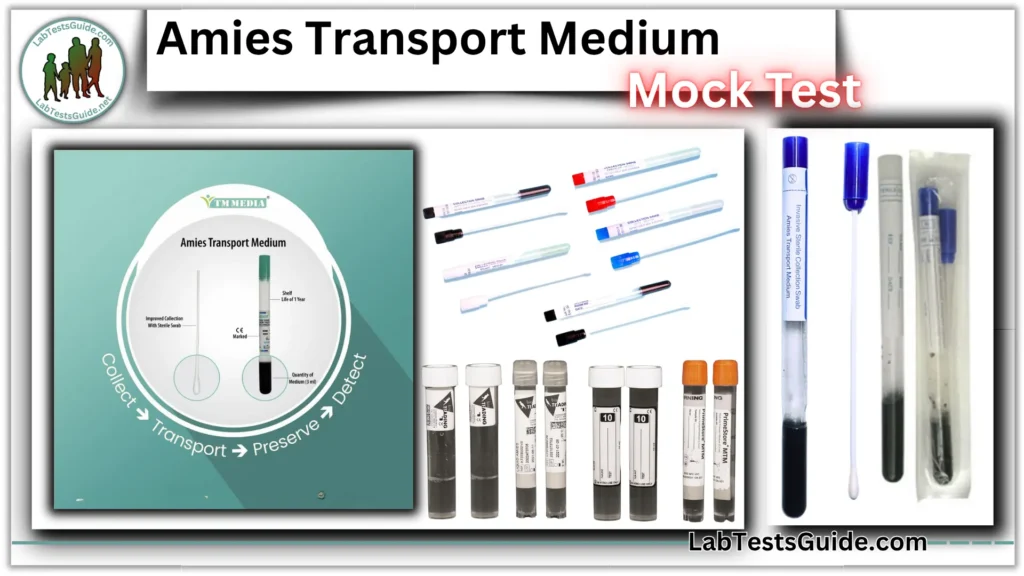
Amies Transport Medium (ATM), developed in 1967 by microbiologist Stuart Amies, is a semi-solid agar-based solution designed to preserve the viability and pathogenicity of clinical specimens during transit. Essential for bacteriology labs, it maintains microbial integrity without promoting replication, ensuring accurate culture results for swab-based samples.

Core Components & Mechanism

  1. Sodium Thioglycollate: Reduces oxygen tension, protecting anaerobes.
  2. Charcoal: Absorbs toxins and fatty acids that inhibit bacterial growth.
  3. Calcium Chloride: Boosts survival of fastidious pathogens (e.g., Neisseria gonorrhoeae).
  4. Phosphate Buffer: Stabilizes pH (7.2–7.4) in clinical specimens.
  5. Semi-Solid Agar: Limits oxygen diffusion and prevents desiccation.
    Mechanism: Creates a non-nutritive environment that sustains organisms for 24–48 hours at room temperature.

Best Practices for Specimen Integrity

  • Collection: Roll swabs vigorously over lesions; avoid environmental contamination.
  • Transport:
    • Insert swab into Amies medium immediately after collection.
    • Break swab stick against the tube wall to seal.
    • Refrigerate (2–8°C) if processing delays exceed 4 hours.
  • Avoid:
    • Freezing (−20°C), which lyses bacterial cells.
    • Overfilling tubes (causes oxygen exposure).
    • Using expired medium (charcoal degrades after 6 months).

Clinical Applications & Limitations

  • Ideal for:
    • Nasopharyngeal, wound, and genital swabs (Streptococcus, Corynebacterium, Neisseria).
    • Aerobic and anaerobic bacteria preservation.
  • Not suitable for:
    • Viral samples (requires VTM with stabilizers).
    • Fecal specimens (use Cary-Blair medium).
    • Urine or blood cultures.
0%
0 votes, 0 avg
4

Report a question

You cannot submit an empty report. Please add some details.

Microbiology Department

Amies Transport Medium MCQs Mock Test

Amies Transport Medium MCQs Mock Test

Amies Transport Medium is a critical semi-solid agar solution designed to preserve bacterial viability in clinical swab specimens during transport. This guide breaks down its components (charcoal, thioglycollate, CaCl₂), evidence-based protocols for sample collection/storage, and clinical limitations. Includes 30 MCQs to test competency—equipping lab professionals and medical students to prevent pre-analytical errors in microbiology diagnostics.

Read Full Article: Amies Transport Medium FAQs and MCQs

1 / 30

Category: Clinical Laboratory

Which organism is most likely to survive poorly in Amies medium after 24 hours?

2 / 30

Category: Clinical Laboratory

What is the primary purpose of Amies Transport Medium?

3 / 30

Category: Clinical Laboratory

Which of the following is NOT a recommended use of Amies medium?

4 / 30

Category: Clinical Laboratory

What is the concentration of agar in Amies Transport Medium?

5 / 30

Category: Clinical Laboratory

Which factor does NOT affect the viability of bacteria in Amies medium?

6 / 30

Category: Clinical Laboratory

Amies medium is best described as:

7 / 30

Category: Clinical Laboratory

What is the best practice after transporting a specimen in Amies medium?

8 / 30

Category: Clinical Laboratory

Why is Amies medium not suitable for fastidious organisms beyond 24 hours?

9 / 30

Category: Clinical Laboratory

Which pathogen survives poorly in Amies medium after 24 hours?

10 / 30

Category: Clinical Laboratory

How is Amies Transport Medium sterilized?

11 / 30

Category: Clinical Laboratory

How should a swab be placed in Amies medium?

12 / 30

Category: Clinical Laboratory

Why is charcoal added to Amies medium?

13 / 30

Category: Clinical Laboratory

Why should the cap be screwed tightly after placing the swab?

14 / 30

Category: Clinical Laboratory

Amies medium is NOT suitable for:

15 / 30

Category: Clinical Laboratory

What is the correct storage condition for Amies medium before use?

16 / 30

Category: Clinical Laboratory

What is the role of phosphates in Amies medium?

17 / 30

Category: Clinical Laboratory

Amies Transport Medium is a modification of which medium?

18 / 30

Category: Clinical Laboratory

What happens if Amies medium dries out during transport?

19 / 30

Category: Clinical Laboratory

Which ingredient provides a reduced environment in Amies medium?

20 / 30

Category: Clinical Laboratory

which type of specimens is Amies medium primarily designed

21 / 30

Category: Clinical Laboratory

How can contamination be minimized during specimen collection?

22 / 30

Category: Clinical Laboratory

Which component is present in Amies medium but absent in Stuart’s medium?

23 / 30

Category: Clinical Laboratory

Why should bottles be inverted while cooling after autoclaving?

24 / 30

Category: Clinical Laboratory

Which of the following is a limitation of Amies Transport Medium?

25 / 30

Category: Clinical Laboratory

Which component in Amies medium neutralizes toxic substances for pathogens like Neisseria gonorrhoeae?

26 / 30

Category: Clinical Laboratory

What should be done if old Amies medium is to be reused?

27 / 30

Category: Clinical Laboratory

What is the maximum recommended transport time for optimal recovery of gonococci?

28 / 30

Category: Clinical Laboratory

Why does Amies medium give a higher recovery rate than Stuart’s medium?

29 / 30

Category: Clinical Laboratory

Which salts help control bacterial cell permeability in Amies medium?

30 / 30

Category: Clinical Laboratory

What is the pH of Amies Transport Medium?

If you want to download Certificates then Please Put your Name and Correct Email

Your score is

The average score is 46%

0%

Amies Transport Medium bridges clinical sampling and lab diagnostics. By mastering its chemistry, applications, and limitations, professionals safeguard specimen viability and ensure diagnostic reliability. Continual learning—through FAQs and self-assessment tools—empowers labs to combat pre-analytical errors that compromise patient outcomes.

📚 This article may have been prepared using trusted medical literature, clinical guidelines, textbooks, and peer-reviewed sources.
View Possible References Used →

Discussion 0

Join the discussion

Join our community

Get fresh content from Lab Tests Guide