Our Team

Article

Albert Staining MCQs Mock Test (30 MCQs)

Editorial StaffUpdated 1 min read

Quick Overview

Albert Stain Guide: Learn diphtheria diagnosis with metachromatic granule staining - includes step-by-step protocol, interpretation, and clinical significance. Albert Staining Quiz: 40+ MCQs on diphtheria bacilli identification and…

  • CategoryChemicals & Stains
  • Read time1 min
  • UpdatedJan 2026
Albert Staining MCQs Mock Test

Master Albert staining, the gold-standard technique for detecting Corynebacterium diphtheriae and its characteristic metachromatic granules. This definitive guide covers:

✓ Dual-Component Chemistry:

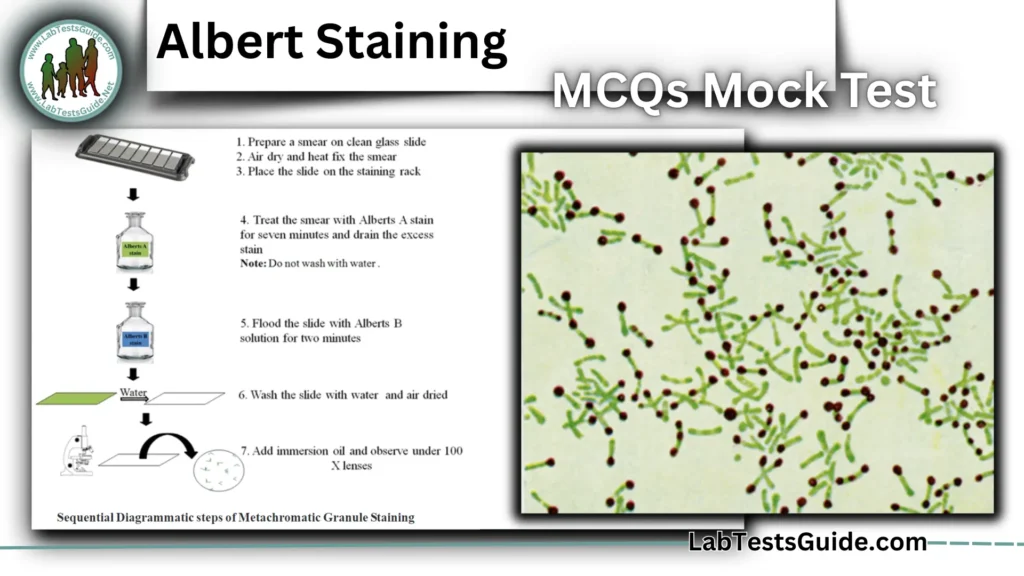
  • Albert’s I (Toluidine Blue + Malachite Green): Stains granules reddish-purple
  • Albert’s II (Iodine Solution): Enhances contrast and fixes the stain

✓ Clinical Applications:

  • Diagnosis of pharyngeal diphtheria
  • Screening during diphtheria outbreaks
  • Differentiation from non-toxigenic diphtheroids

✓ Step-by-Step Protocol:

  • Optimal smear preparation from throat swabs
  • Precise timing for each staining step
  • Common errors and troubleshooting

✓ Microscopy Interpretation:

  • Positive result: Blue-green bacilli with red-brown polar granules (Babes-Ernst bodies)
  • Comparison with Loeffler’s methylene blue and Gram stain results

Essential for:

  • Clinical microbiologists
  • Public health laboratory staff
  • Medical students preparing for exams

Test your expertise with 30+ Albert staining MCQs covering:
◼️ Biochemical basis of metachromatic staining
◼️ WHO guidelines for diphtheria reporting
◼️ Differentiation of C. diphtheriae from similar organisms
◼️ Quality control measures in staining

Ideal for:

  • Medical microbiology board exams (USMLE, FRCPath)
  • Laboratory technician certification
  • Public health outbreak investigation training
0%
0 votes, 0 avg
4

Report a question

You cannot submit an empty report. Please add some details.

Microbiology Department

Albert Staining MCQs Mock Test

Albert Staining MCQs Mock Test

Test your expertise with 30+ Albert staining MCQs covering:
◼️ Biochemical basis of metachromatic staining
◼️ WHO guidelines for diphtheria reporting
◼️ Differentiation of C. diphtheriae from similar organisms
◼️ Quality control measures in staining

Ideal for:

  • Medical microbiology board exams (USMLE, FRCPath)

  • Laboratory technician certification

  • Public health outbreak investigation training

Read Full Article: Albert Staining FAQs and MCQs

1 / 30

Category: Clinical Laboratory

What is the correct order of steps in Albert staining?

2 / 30

Category: Clinical Laboratory

After Albert staining, the cytoplasm of C. diphtheriae appears:

3 / 30

Category: Clinical Laboratory

 Which part of C. diphtheriae stains bluish-black?

4 / 30

Category: Clinical Laboratory

 What happens if the slide is washed after Albert Stain 1 but before iodine?

5 / 30

Category: Clinical Laboratory

 What is the chemical nature of metachromatic granules?

6 / 30

Category: Clinical Laboratory

The pH of Albert stain is adjusted to

7 / 30

Category: Clinical Laboratory

 What is the function of malachite green in Albert Stain 1?

8 / 30

Category: Clinical Laboratory

 Which bacteria besides C. diphtheriae may show metachromatic granules?

9 / 30

Category: Clinical Laboratory

Metachromatic granules are composed of:

10 / 30

Category: Clinical Laboratory

Which dye in Albert Stain 1 binds to metachromatic granules?

11 / 30

Category: Clinical Laboratory

How long should Albert Stain 1 be applied?

12 / 30

Category: Clinical Laboratory

4. What is the role of iodine in Albert staining?

13 / 30

Category: Clinical Laboratory

 Which of the following is NOT a component of Albert Stain 1?

14 / 30

Category: Clinical Laboratory

 What precaution should be taken with iodine solution?

15 / 30

Category: Clinical Laboratory

 What is the storage condition for Albert stain?

16 / 30

Category: Clinical Laboratory

What does a negative Albert stain indicate?

17 / 30

Category: Clinical Laboratory

 What is the final step before microscopic observation?

18 / 30

Category: Clinical Laboratory

 Which shape does C. diphtheriae exhibit under the microscope?

19 / 30

Category: Clinical Laboratory

Which component of Albert Stain 2 acts as a mordant?

20 / 30

Category: Clinical Laboratory

 What is the optimal culture medium for enhancing metachromatic granules?

21 / 30

Category: Clinical Laboratory

 What is the role of alcohol in Albert Stain 1?

22 / 30

Category: Clinical Laboratory

 What does a negative Albert stain indicate?

23 / 30

Category: Clinical Laboratory

 How should the smear be fixed before staining?

24 / 30

Category: Clinical Laboratory

Which staining technique is similar to Albert stain in targeting granules?

25 / 30

Category: Clinical Laboratory

 Which disease is diagnosed using Albert staining?

26 / 30

Category: Clinical Laboratory

 Albert staining is a type of:

27 / 30

Category: Clinical Laboratory

What is the primary purpose of Albert staining?

28 / 30

Category: Clinical Laboratory

 What is the mordant in Albert staining?

29 / 30

Category: Clinical Laboratory

What magnification is used to observe Albert-stained slides?

30 / 30

Category: Clinical Laboratory

 Which of these stains is an alternative to Albert staining for metachromatic granules?

If you want to download Certificates then Please Put your Name and Correct Email

Your score is

The average score is 37%

0%

Read Full Article: Albert Staining FAQs and MCQs

📚 This article may have been prepared using trusted medical literature, clinical guidelines, textbooks, and peer-reviewed sources.
View Possible References Used →

Discussion 0

Join the discussion

Join our community

Get fresh content from Lab Tests Guide