Peptides Calculator: Complete Guide to Reconstitution, Dosage Calculation & Concentration
In the world of biochemical research and laboratory science, precision is everything. When working with peptides—short chains of amino acids that act as signaling molecules—the difference between an effective study and a failed experiment often comes down to a few micrograms.
Because most peptides are shipped as a delicate, freeze-dried (lyophilized) powder, researchers must “reconstitute” them before use. This is where a Peptide Calculator becomes an indispensable tool.
What is a Peptide Calculator?
A peptide calculator is an essential tool for researchers working with peptides. Whether you need a retatrutide calculator, tirzepatide reconstitution calculator, or general peptide mixing calculator, our tool provides accurate calculations for any research application. The peptide reconstitution calculator helps determine exactly how much bac water to reconstitute peptides for optimal results.
Why is Precise Reconstitution Necessary?
Peptides are extremely potent. They are typically measured in micrograms (mcg), which are one-thousandth of a milligram (mg).
If you have a vial containing 5mg of a peptide and you add 2mL of bacteriostatic water, calculating how many “units” on a syringe equal a 250mcg dose is not always intuitive. A calculator prevents mathematical errors that could lead to under-dosing or, more dangerously, over-dosing the subject.
Understanding the Components
Before using a calculator, you need to understand the variables involved:
- Peptide Amount (mg): The total weight of the freeze-dried powder in the vial (e.g., 2mg, 5mg, 10mg).
- Volume of Water (mL): The amount of Bacteriostatic Water or Sterile Water you add to the vial to dissolve the powder.
- Syringe Size: Most research utilizes insulin-style syringes, typically measured in units. A standard U-100 syringe holds 1mL (100 units).
- Desired Dose (mcg): The specific amount of peptide you intend to draw for a single application.
Peptide Calculator & Complete Guide
Professional reconstitution and dosing calculator for research peptides. For research reference only – not medical advice.
📊 Peptide Calculator
Enter your peptide and syringe details for accurate calculations
📈 Results
Calculated peptide dosing information
💉 Syringe Visualization
Quick Summary
📚 Complete Peptide Calculator Guide
Everything you need to know about peptide reconstitution and dosing
How to Use the Peptide Calculator
Our peptide calculator mg tool makes peptide calculation simple and accurate. Follow these steps:
- Select your syringe capacity – Choose from 30, 50, or 100 unit insulin syringes
- Enter vial quantity – Input your peptide calculator mg amount (e.g., 5mg, 10mg)
- Specify water amount – Determine how much water in a 5mg vial of peptide you need
- Set desired dose – Use the peptide dose calculator to find your target
- Get results – The peptide calc provides concentration, dose volume, and syringe units
Specialized Peptide Calculators
Our platform supports various research peptides with specialized calculators:
- Retatrutide Calculator – Precise dosing for retatrutide research
- Tirzepatide Reconstitution Calculator – Accurate mixing for tirzepatide studies
- BPC-157 Dosage Calculator – bpc-157 dosage calculator for research protocols
- TB-500 Dosage Calculator – tb-500 dosage calculator for precise measurements
- CJC-1295 Ipamorelin Dosage Calculator – cjc-1295 ipamorelin dosage calculator for combination research
How to Reconstitute Peptides
Understanding how to reconstitute peptides is crucial for research accuracy. The peptide reconstitution calculator helps determine the right amount of bac water to reconstitute peptides:
Use the reconstitute peptide calculator to determine how much bacteriostatic water to add
Clean the rubber stopper with alcohol and inject the calculated water volume
Gently swirl (don’t shake) until fully dissolved – the peptide mixing calculator ensures proper concentration
Use the peptide dosage calculator to confirm your syringe measurement
Tips for Accurate Peptide Dosing
- Always verify your calculations – Use the peptide dose calculator to double-check
- Use the right syringe – Match your syringe type (U-100, U-50, U-30) to the calculator
- Consider peptide stability – Some peptides require specific storage conditions
- Follow sterile techniques – Always use bacteriostatic water and sterile equipment
- Document your protocols – Keep detailed records of your peptide mixing calculator results
📐 Formulas & Reference Information
Mathematical calculations and key reference data
Concentration
Where:
- C = Concentration (mcg/ml or mg/ml)
- P = Peptide amount in vial (mcg or mg)
- V = Volume of bacteriostatic water (ml)
Example: 5mg peptide in 2ml water = 2.5mg/ml or 2500mcg/ml
Dose Volume
Where:
- D = Dose volume (ml)
- Ddesired = Desired dose (mcg or mg)
- C = Concentration (mcg/ml or mg/ml)
Example: 250mcg ÷ 2500mcg/ml = 0.10ml
Syringe Units
Where:
- U = Syringe units
- D = Dose volume (ml)
- Uper_ml = Syringe units per ml (U-100 = 100, U-50 = 50, U-30 = 30)
Example: 0.10ml × 100 = 10 units on U-100 syringe
Total Doses
Where:
- T = Total doses per vial
- P = Total peptide in vial (mcg or mg)
- Ddesired = Desired dose (mcg or mg)
Example: 5000mcg ÷ 250mcg = 20 doses
Peptide Concentration Guide
Common Peptide Research Calculators
- 🔬 Retatrutide Calculator – For retatrutide research protocols
- 🔬 Tirzepatide Reconstitution Calculator – For tirzepatide studies
- 🔬 BPC-157 Dosage Calculator – For BPC-157 research
- 🔬 TB-500 Dosage Calculator – For TB-500 protocols
- 🔬 CJC-1295 Ipamorelin Dosage Calculator – For combination research
- 🔬 Peptide Calculator mg – For any peptide research compound
Quick Conversions
Frequently Asked Questions About Peptides
What are the benefits of CJC-1295 mod GRF 1-29?
CJC-1295 mod GRF 1-29, also known as Modified GRF 1-29, is a growth hormone-releasing hormone (GHRH) analog used in research. Benefits studied include increased growth hormone release, improved sleep quality, enhanced recovery, and potential benefits for tissue repair. Researchers often ask grf 1-29 vs cjc 1295 – both are GHRH analogs with slightly different half-lives and mechanisms of action. Is mod grf 1/29 the same as Sermorelin? No, Sermorelin is the unmodified version with a shorter half-life, while mod GRF 1-29 has amino acid substitutions for improved stability.
Does hexarelin help burn fat?
Hexarelin is a growth hormone secretagogue that has been studied for its potential effects on metabolism. Research suggests that hexarelin 5mg dosing may support lipolysis and fat metabolism through growth hormone release mechanisms. How often should you inject hexarelin? Research protocols vary, but typical studies use multiple daily injections due to its short half-life, often 2-3 times per day.
What is the safest HGH peptide?
The safety profile of HGH peptides varies depending on the specific compound and research context. Peptides like Ipamorelin, CJC-1295, and Modified GRF 1-29 are generally considered to have favorable safety profiles in research settings. Always follow proper peptide reconstitution calculator guidelines and use sterile techniques. None of these are approved for human use; they are for research purposes only.
How to calculate the number of peptides?
Peptide calculation involves determining the concentration and dose volume. Use the formula: Concentration (mg/ml) = Peptide Amount (mg) ÷ Water Volume (ml). Then, Dose Volume (ml) = Desired Dose (mg) ÷ Concentration (mg/ml). Our peptide calc does this automatically for you, providing accurate peptide calculation results for any research compound.
Is Semax effects permanent?
Semax is a peptide being studied for its potential cognitive-enhancing and neuroprotective properties. Research suggests that Semax effects may be temporary and require continued dosing for sustained benefits. The duration of effects depends on the specific protocol and dosage used in research settings. Always consult your research protocol and use the peptide dosage calculator for accurate measurements.
IMPORTANT RESEARCH NOTICE: ALL ARTICLES AND PRODUCT INFORMATION PROVIDED ON THIS WEBSITE ARE FOR INFORMATIONAL AND EDUCATIONAL PURPOSES ONLY. The products offered on this website are furnished for in-vitro studies only. In-vitro studies (Latin: in glass) are performed outside of the body. These products are not medicines or drugs and have not been approved by the FDA to prevent, treat or cure any medical condition, ailment or disease. Bodily introduction of any kind into humans or animals is strictly forbidden by law.
Peptide Calculator – For research reference only – not medical advice. This peptide reconstitution calculator and peptide dosage calculator are tools for research purposes only.
All products are intended for in-vitro studies only. Always consult with qualified healthcare professionals and adhere to all applicable regulations when conducting research.
Specialized Peptide Calculators
Professional dosing and reconstitution calculators for research peptides. For research reference only – not medical advice.
🔬 Retatrutide Calculator
For retatrutide research protocols – calculate precise dosing
📈 Retatrutide Results
Calculated retatrutide dosing information
📋 Retatrutide Research Information
- Common Research Doses: 200-400 mcg per injection
- Typical Vial Sizes: 5mg, 10mg, 15mg
- Reconstitution: Use bacteriostatic water, gentle swirl
- Storage: Refrigerate at 2-8°C after reconstitution
🔬 Tirzepatide Reconstitution Calculator
For tirzepatide studies – accurate reconstitution and dosing
📈 Tirzepatide Results
Calculated tirzepatide dosing information
📋 Tirzepatide Research Information
- Common Research Doses: 200-500 mcg per injection
- Typical Vial Sizes: 5mg, 10mg
- Reconstitution: Use bacteriostatic water, gentle swirl
- Storage: Refrigerate at 2-8°C after reconstitution
🔬 BPC-157 Dosage Calculator
For BPC-157 research – precise dosage calculations
📈 BPC-157 Results
Calculated BPC-157 dosing information
📋 BPC-157 Research Information
- Common Research Doses: 200-500 mcg per injection
- Typical Vial Sizes: 2mg, 5mg, 10mg
- Reconstitution: Use bacteriostatic water, gentle swirl
- Storage: Refrigerate at 2-8°C after reconstitution
🔬 TB-500 Dosage Calculator
For TB-500 protocols – accurate dosage calculations
📈 TB-500 Results
Calculated TB-500 dosing information
📋 TB-500 Research Information
- Common Research Doses: 500-1000 mcg per injection
- Typical Vial Sizes: 2mg, 5mg, 10mg
- Reconstitution: Use bacteriostatic water, gentle swirl
- Storage: Refrigerate at 2-8°C after reconstitution
🔬 CJC-1295 & Ipamorelin Dosage Calculator
For combination research – CJC-1295 and Ipamorelin dosing
📈 CJC-1295 & Ipamorelin Results
Calculated combination dosing information
📋 CJC-1295 & Ipamorelin Research Information
- Common CJC-1295 Dose: 100-200 mcg per injection
- Common Ipamorelin Dose: 200-300 mcg per injection
- Typical Vial Sizes: 2mg, 5mg, 10mg each
- Reconstitution: Use bacteriostatic water, gentle swirl
- Storage: Refrigerate at 2-8°C after reconstitution
🔬 Peptide Calculator mg
For any peptide research compound – general dosing calculator
📈 General Peptide Results
Calculated dosing information for your peptide
📋 General Peptide Information
- Formula Used: Concentration = Vial (mg) ÷ Water (ml)
- Dose Volume: Desired Dose ÷ Concentration
- Syringe Units: Dose Volume × Syringe Units per ml
- Always verify: Double-check calculations before use
IMPORTANT RESEARCH NOTICE: ALL ARTICLES AND PRODUCT INFORMATION PROVIDED ON THIS WEBSITE ARE FOR INFORMATIONAL AND EDUCATIONAL PURPOSES ONLY. The products offered on this website are furnished for in-vitro studies only. These products are not medicines or drugs and have not been approved by the FDA to prevent, treat or cure any medical condition, ailment or disease. Bodily introduction of any kind into humans or animals is strictly forbidden by law.
Peptide Calculators – For research reference only – not medical advice.
How to Use a Calculator (Step-by-Step)
Once you have your materials ready, the process of using the calculator is straightforward:
Step 1: Input Vial Quantity
Enter the total milligrams (mg) of the peptide as listed on the vial label.
Step 2: Input Diluent Amount
Enter the amount of liquid (usually Bacteriostatic Water) you have added or plan to add to the vial. Common amounts are 1mL, 2mL, or 3mL.
Step 3: Select Syringe Type
Choose the syringe size you are using. This is crucial because a “unit” on a 30-unit syringe is visually different from a “unit” on a 100-unit syringe, even though the math remains consistent.
Step 4: Input Desired Dose
Enter the dosage required for the experiment in micrograms (mcg).
Step 5: Calculate
The tool will provide the result, usually indicating exactly how many units or “ticks” to pull back on the syringe plunger.
The Math Behind the Tools
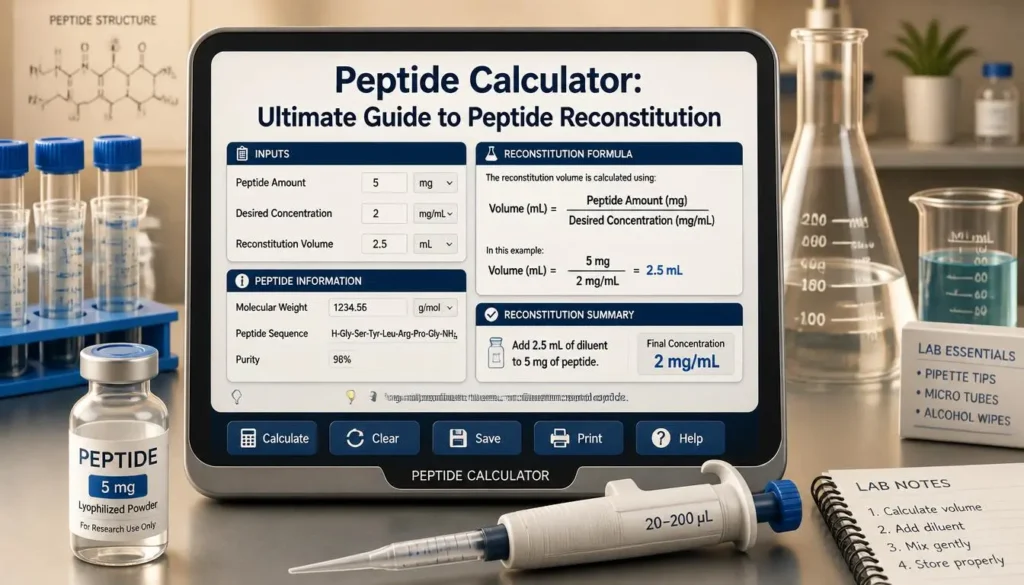
If you were to calculate this manually, the formula looks like this:
(Total mg / Total mL) = Concentration per mL
(Desired Dose / Concentration) = Required Volume
Example:
- You have a 5mg vial.
- You add 2mL of water.
- Your concentration is 2.5mg per mL (or 2500mcg per mL).
- If your dose is 250mcg, you need 0.1mL (which is 10 units on a U-100 syringe).
The calculator automates this logic to eliminate the risk of human error.
Essential Tips for Peptide Handling
- Don’t Shake the Vial: Peptides are fragile molecular structures. When reconstituting, drip the water slowly down the side of the glass vial and gently swirl. Never shake.
- Sterilization is Key: Always wipe the top of the peptide vial and the bacteriostatic water vial with an alcohol swab before inserting a needle.
- Storage Matters: Most reconstituted peptides must be kept refrigerated (between 2°C and 8°C) to maintain their stability and prevent degradation.
- Check for Clarity: Once mixed, the solution should be clear. If the liquid is cloudy or has visible “floaties” (precipitate) that won’t dissolve, the peptide may be compromised.
Conclusion
A Peptide Calculator is more than just a convenience; it is a safety tool. By ensuring your measurements are mathematically sound, you protect the integrity of your research and ensure consistent results. Always double-check your inputs into the calculator to ensure the most accurate data possible.
Disclaimer: This tool and guide are intended for educational and laboratory research purposes only. Always follow the specific protocols and safety guidelines provided by your institution or chemical supplier.