

Clinical Trials in the US 2026: Trends, Statistics & Future Outlook
Clinical trials serve as the cornerstone of medical progress, bridging the gap between laboratory discovery and life-saving treatments. As we navigate 2026, the United States remains the global leader in pharmaceutical R&D, characterized by a rapid shift toward patient-centric, data-driven, and inclusive research models.
Driven by legislative updates and breakthroughs in Artificial Intelligence (AI), the clinical research landscape is becoming more efficient and accessible. This guide explores the current state of clinical trials in the US, key trends for 2026, and how patients and researchers can navigate this evolving ecosystem.
The 2026 Landscape: A Snapshot of Research Activity
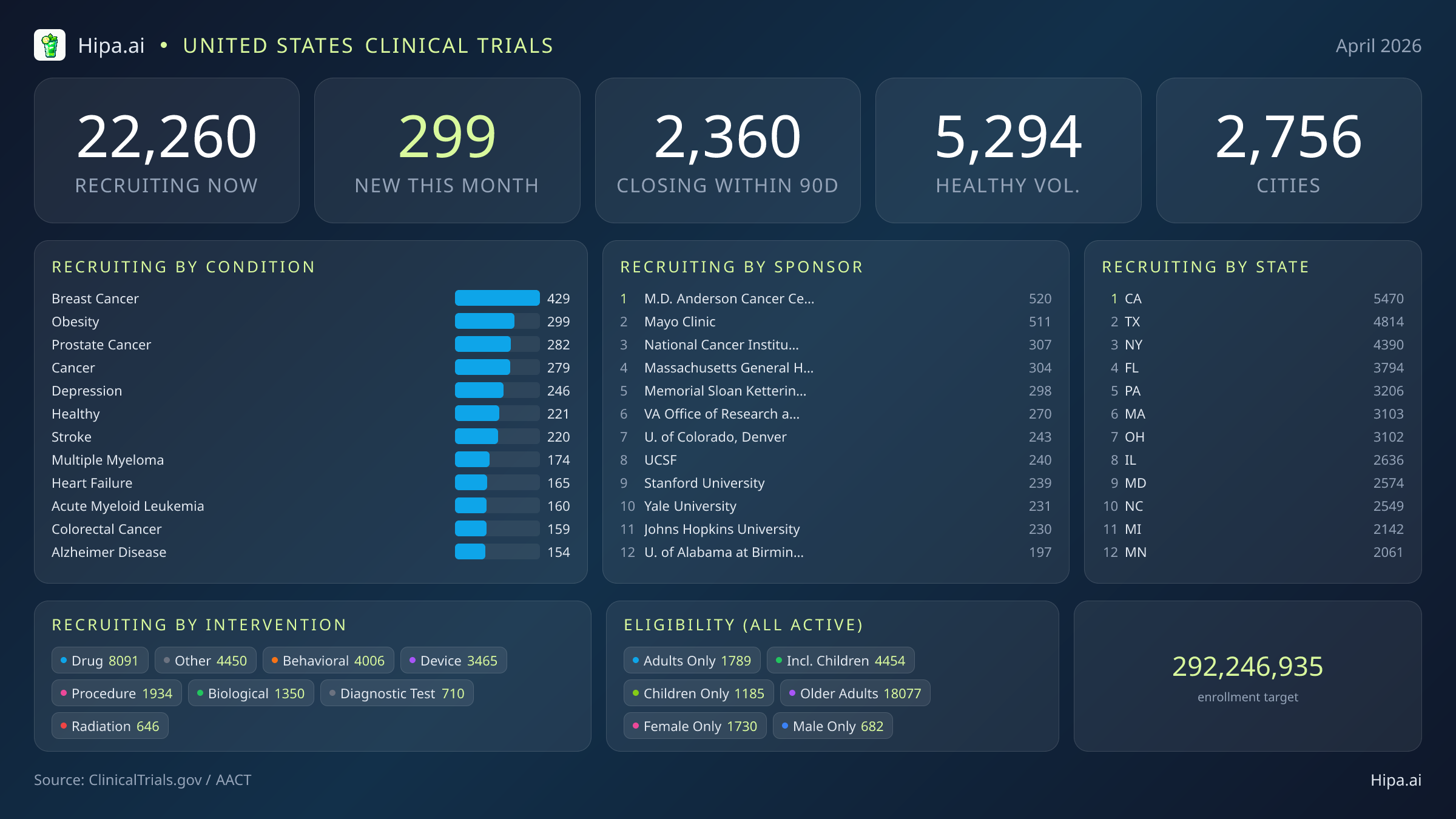
As of April 2026, the US research engine is operating at a high velocity. There are currently over 22,260 active clinical trials recruiting participants. However, the window of opportunity for many of these studies is narrow.
Urgency in Recruitment
Data indicates a significant surge in trials reaching their final enrollment stages. Approximately 2,360 studies are scheduled to close enrollment within the next 90 days.
| Condition | Trials Closing Soon (April 2026) |
| Breast Cancer | 40 |
| Depression | 35 |
| General Cancer | 30 |
| Alzheimer’s Disease | 28 |
| Obesity | 28 |
| Stroke | 27 |
| Heart Failure | 24 |
Understanding the Clinical Trial Process
Before a medical intervention—be it a drug, device, or diagnostic tool—reaches the public, it must pass through rigorous phases to ensure safety and efficacy.
The Four Phases of Clinical Trials
- Phase I (Safety): Focused on dosage and side effects in 20–100 healthy volunteers.
- Phase II (Effectiveness): Testing the treatment on 100–300 patients with the specific condition.
- Phase III (Confirmation): Large-scale studies (1,000–3,000+ patients) to compare the new treatment against existing standards.
- Phase IV (Post-Market): Ongoing monitoring of the treatment’s long-term effects in the general population.
Top 4 Trends Transforming US Research in 2026
1. Integration of AI and Machine Learning
AI is no longer a futuristic concept; it is the backbone of 2026 clinical operations. Algorithms are now used to:
- Predict Outcomes: Identifying potential adverse reactions before they occur.
- Digital Twins: Creating virtual control groups to reduce the number of human participants needed in early phases.
- Data Validation: Automating the cleaning of lab results to eliminate human error.
2. Decentralized Clinical Trials (DCTs)
The “hybrid” trial model has become the standard. By utilizing wearables, mobile nursing units, and telemedicine, researchers can now reach patients in rural areas, significantly reducing the “travel burden.”
- Traditional: Frequent visits to urban academic centers.
- Decentralized: Real-time data collection via IoT devices and local clinic check-ins.
3. Mandatory Diversity and Inclusion
Following updated FDA guidance, trials in 2026 must include Diversity Action Plans. Participant pools must accurately reflect the ethnic and socioeconomic diversity of the US population to ensure efficacy and safety data apply to all Americans.
4. Therapeutic Growth Areas
While oncology remains the dominant field, other therapeutic areas are seeing massive investment through 2026.
| Therapeutic Area | Percentage of Active Trials | Key Growth Drivers |
| Oncology | 35% | Immunotherapy & Gene Editing |
| Neurology | 15% | Alzheimer’s & Parkinson’s |
| Infectious Diseases | 12% | mRNA Vaccine Technology |
| Cardiovascular | 10% | AI-driven Diagnostic Devices |
| Rare Diseases | 8% | Orphan Drug Incentives |
Key Geographic Research Hubs
While decentralization is growing, physical infrastructure remains concentrated in specific “Super Hubs.”
- California (San Francisco/San Diego): The leader in biotechnology and AI-driven drug discovery.
- Massachusetts (Boston/Cambridge): The epicenter for genomic research and oncology.
- Texas (Houston): A dominant force in cardiovascular and infectious disease trials.
- North Carolina (Research Triangle Park): The primary hub for Contract Research Organizations (CROs).
Challenges and Regulatory Hurdles
Despite the progress, 2026 presents unique challenges:
- Data Privacy: With the rise of health apps and blockchain-enabled data sharing, cybersecurity for medical devices is a top FDA priority.
- Operational Costs: Higher infrastructure needs for high-tech trials can lead to increased costs for sponsors.
- Recruitment Delays: Even with AI, matching the right patient to the right protocol remains a complex logistical hurdle.
Who is Driving Innovation?
Academic and government institutions currently lead the charge in launching new studies, showcasing a robust research ecosystem outside of purely commercial interests.
Top Sponsors (April 2026 Launches):
- M.D. Anderson Cancer Center (Oncology focus)
- Mayo Clinic (Multi-disciplinary)
- Yale University (Advanced therapeutics)
- VA Office of Research and Development (Veteran-specific health)
- AstraZeneca (Industry leader in biologics)
How to Participate
Clinical research is increasingly focused on broadening participation. In 2026, there are more opportunities than ever for:
- Healthy Volunteers: Currently, over 668 trials are seeking individuals without specific diagnoses for baseline studies.
- Older Adults: Over 230 new trials are specifically designed for the geriatric population.
- Pediatrics: Nearly 50 new trials are open to children.
Conclusion
The future of clinical research in the United States is bright, defined by a shift toward smarter, faster, and more inclusive trials. By embracing AI and decentralized models, the industry ensures that new treatments reach the market more safely than ever before. For patients and lab professionals, staying informed on these trends is essential for navigating the complex but rewarding world of modern medicine.
Checklist for Prospective Participants:
- Verify FDA Status: Ensure the trial is registered and follows current regulatory standards.
- Check Accessibility: Ask if the trial offers decentralized or “at-home” options.
- Review Data Privacy: Confirm the platform uses HIPAA-compliant and secure data handling.
- Consult Your Physician: Always discuss potential trial participation with your primary healthcare provider.
