
Age-Adjusted D-Dimer Calculator
D-Dimer levels naturally increase as patients age. Using a fixed cutoff of 500 ng/mL FEU for older patients leads to a high rate of false positives, resulting in unnecessary and potentially harmful CT Pulmonary Angiograms (CTPA) or ultrasounds.
The Age-Adjusted D-Dimer rule safely increases the threshold for a “positive” D-Dimer in patients older than 50 who have a low or intermediate pretest probability for Deep Vein Thrombosis (DVT) or Pulmonary Embolism (PE).
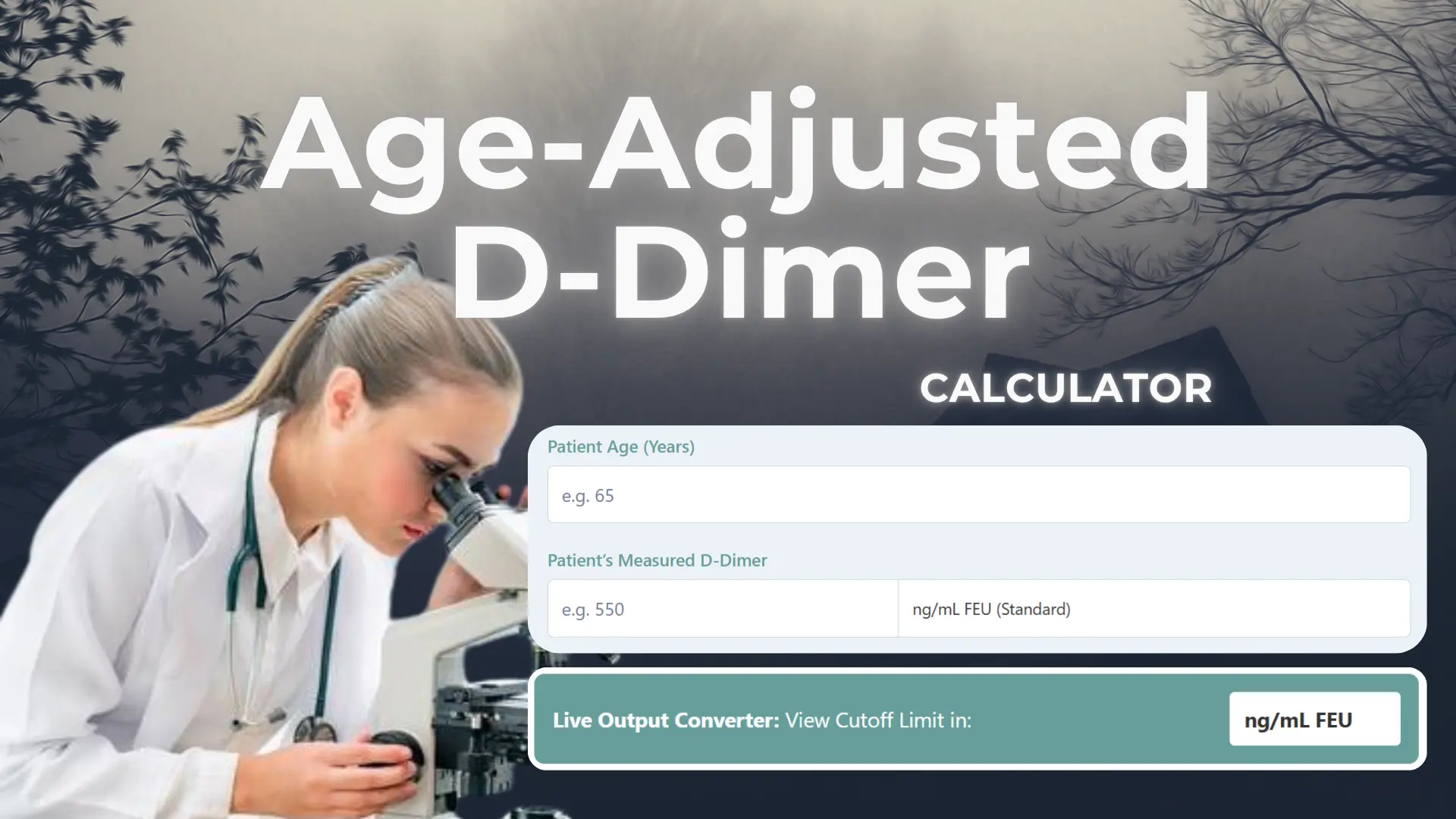
Use our interactive calculator below. Because D-Dimer lab reporting is notorious for unit confusion, we have included a robust 8-Unit Live Converter handling both Fibrinogen Equivalent Units (FEU) and D-Dimer Units (DDU).
How to Use the Calculator & Converter
- Enter Age: If the patient is 50 or younger, the standard cutoff applies. If they are over 50, the formula calculates their specific adjusted cutoff.
- Select Lab Units (Crucial Step): Look closely at your lab report. Laboratories report D-Dimer in either FEU or DDU, and use magnitudes ranging from
ng/mLtomg/L. Select the exact unit from our 8 options. - Enter Measured Value: Input the patient’s actual lab result.
- Live Output: The calculator will instantly display the patient’s customized cutoff limit and interpret if the result is Negative (Normal) or Positive (Abnormal).
Formulas Used in This Calculator
The standard cutoff for a “Normal/Negative” D-Dimer is 500 ng/mL FEU (or 250 ng/mL DDU). The Age-Adjusted formula alters this baseline:
- For Patients ≤ 50 years: Cutoff = 500 ng/mL FEU
- For Patients > 50 years: Cutoff =
Age × 10 ng/mL FEU
Unit Conversion Formulas Embedded:
Because 1 D-Dimer Unit (DDU) is approximately half the mass of 1 Fibrinogen Equivalent Unit (FEU), the converter applies the following mathematical rules behind the scenes:
- 1 DDU = 2 FEU
- 1000 ng/mL = 1000 µg/L = 1 mg/L = 1 µg/mL
Calculation Example (Mathematics)
Let’s look at a mathematical example to understand how the formula and conversions work manually.
Scenario: A 72-year-old patient presents with a low probability of PE. Their D-Dimer lab returns as 0.65 mg/L FEU. Is this a positive or negative result?
Formula: Age × 10 ng/mL FEU
Calculation: 72 × 10 = 720 ng/mL FEU Cutoff
Step 2: Convert Cutoff to Match Patient Lab Units (mg/L FEU)
Formula: ng/mL divided by 1000 = mg/L
Calculation: 720 / 1000 = 0.72 mg/L FEU Cutoff
Step 3: Compare and Interpret
The patient’s measured level (0.65) is less than the cutoff (0.72).
Conclusion: Negative D-Dimer. PE is ruled out.
Clinical Interpretation Guidelines
The Age-Adjusted D-Dimer is only validated for use in specific clinical scenarios. Do not use this calculator blindly.
| Calculator Output | Clinical Meaning & Next Steps |
|---|---|
| Negative (Below Cutoff) | If pretest probability is LOW (e.g., Wells Score < 4), VTE/PE is safely ruled out. No imaging required. |
| Positive (Above Cutoff) | VTE/PE cannot be ruled out. Proceed with diagnostic imaging (Ultrasound for DVT or CTPA for PE). |
| High Pretest Probability | Do not use D-Dimer. Proceed directly to imaging regardless of age or score. |
Disclaimer: This calculator is intended for educational and informational purposes only. It should not replace professional clinical judgment. Always consult current clinical guidelines (such as the ADJUST-PE study) and a physician for medical diagnoses.