

Expected pCO₂ Calculator (Winter’s Formula)
The Expected pCO₂ Calculator is an essential tool for evaluating acid-base disorders. In primary metabolic acidosis or metabolic alkalosis, the respiratory system compensates by altering ventilation to change the partial pressure of carbon dioxide (pCO₂). Calculating the expected pCO₂ allows clinicians to determine if the patient has a simple (fully compensated) acid-base disorder or a mixed acid-base disorder.
Use our interactive, responsive calculator below. It features a live Unit Converter with 7 different input/output unit combinations (including mEq/L, mmol/L, mg/dL, mmHg, and kPa) to instantly adapt to your lab results.
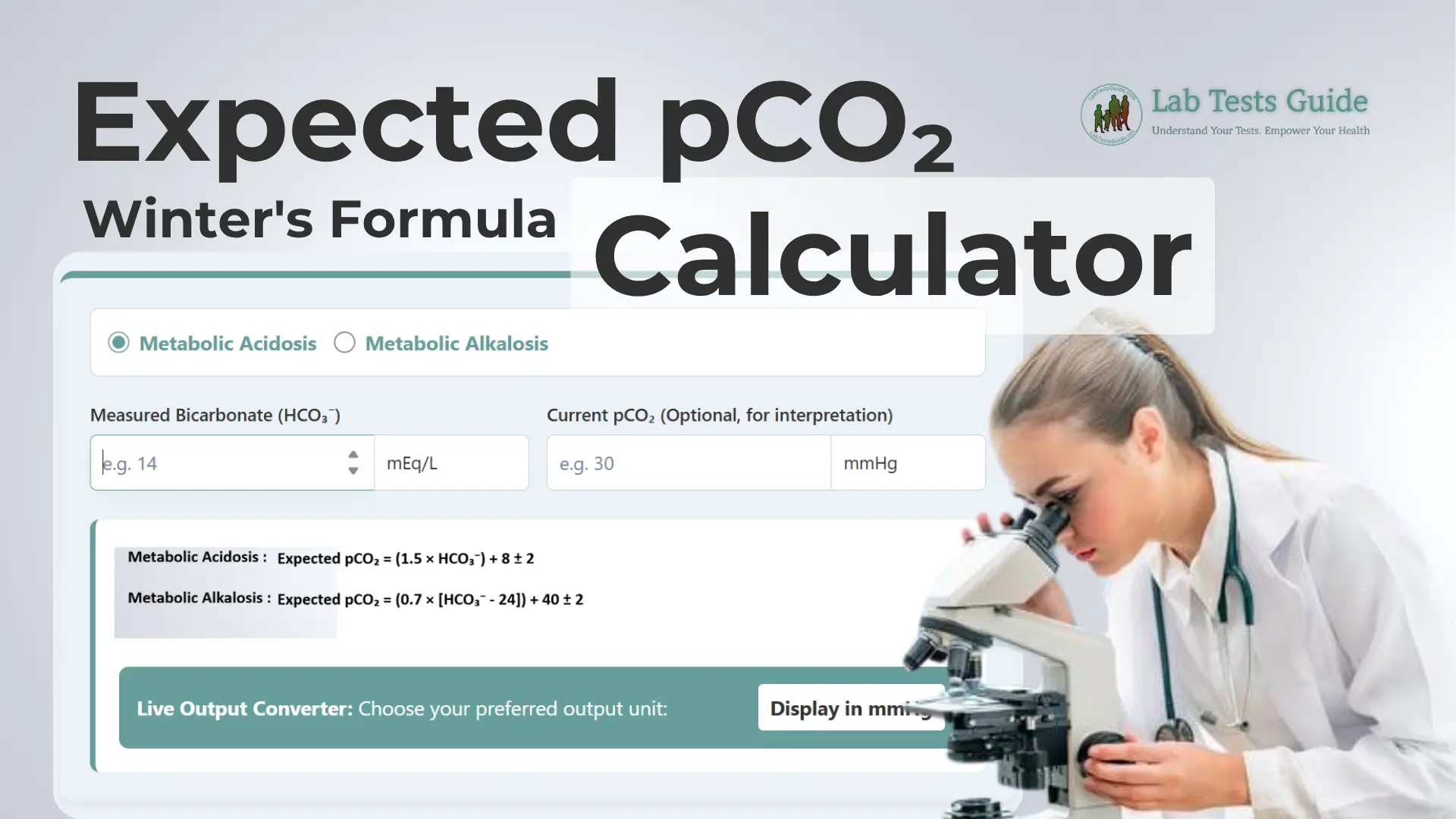
How to Use the Calculator
- Select the Disorder: Choose whether the patient has primary Metabolic Acidosis or Metabolic Alkalosis. The formula adjusts automatically.
- Enter Bicarbonate (HCO₃⁻): Type the patient’s lab value into the field.
- Enter Current pCO₂ (Optional): If you want the calculator to interpret whether a mixed disorder is present, enter the patient’s measured pCO₂ from an ABG or VBG.
- View Live Output: Results generate instantly as you type. No “Calculate” button required.
How to Use the Live Unit Converter
Different laboratories and countries use different medical units. This tool handles the conversions seamlessly:
- Input Conversion: Using the dropdowns next to the input fields, you can select
mEq/L,mmol/L, ormg/dLfor Bicarbonate, andmmHgorkPafor pCO₂. - Output Conversion: Use the teal “Live Output Converter” bar at the bottom to switch the final expected result between
mmHgandkPa. The math updates instantly without requiring you to re-enter data.
Formulas Used in This Calculator
The calculator relies on two universally accepted formulas depending on the primary acid-base status.
1. Winter’s Formula (For Metabolic Acidosis)
Used to predict appropriate respiratory compensation (hyperventilation) in metabolic acidosis.
Expected pCO₂ = (1.5 × HCO₃⁻) + 8 ± 2
2. Metabolic Alkalosis Formula
Used to predict appropriate respiratory compensation (hypoventilation) in metabolic alkalosis.
Expected pCO₂ = (0.7 × [HCO₃⁻ - 24]) + 40 ± 2
(Note: Some texts use `0.7 × HCO₃⁻ + 21`. Both yield nearly identical clinical ranges.)
Calculation Example (Mathematics)
Let’s look at a mathematical example to understand how Winter’s formula works manually.
Scenario: A patient in diabetic ketoacidosis (Metabolic Acidosis) has a measured HCO₃⁻ of 10 mEq/L and a measured pCO₂ of 35 mmHg.
Formula: (1.5 × HCO₃⁻) + 8
Calculation: (1.5 × 10) + 8
Result: 15 + 8 = 23
Apply the ± 2 Range: 21 to 25 mmHg
Interpretation: The expected pCO₂ is 21-25. Since the patient’s actual pCO₂ is 35 (which is higher than 25), they are retaining too much CO₂. Therefore, they have a Mixed Disorder: Metabolic Acidosis + Respiratory Acidosis.
Clinical Interpretation Guidelines
Once you calculate the expected pCO₂ range, compare it to the patient’s actual measured pCO₂ to diagnose mixed disorders.
| Measured pCO₂ vs Expected Range | Clinical Interpretation |
|---|---|
| Within Expected Range | Simple, fully compensated metabolic disorder. |
| Higher than Expected Max | Concomitant Respiratory Acidosis (inadequate respiratory compensation). |
| Lower than Expected Min | Concomitant Respiratory Alkalosis (excessive hyperventilation). |
Disclaimer: This tool is intended for educational purposes and to assist healthcare providers. It does not replace clinical judgment. Always treat the patient, not just the numbers.
