

Advanced RBC Indices Calculator
Calculate MCV, MCH, and MCHC, generate instant clinical interpretations, and convert hematology units seamlessly.
Hematology Unit Converters
Quickly convert lab values between different global standard units.
Hemoglobin (Hb)
Hematocrit (Hct)
RBC Count
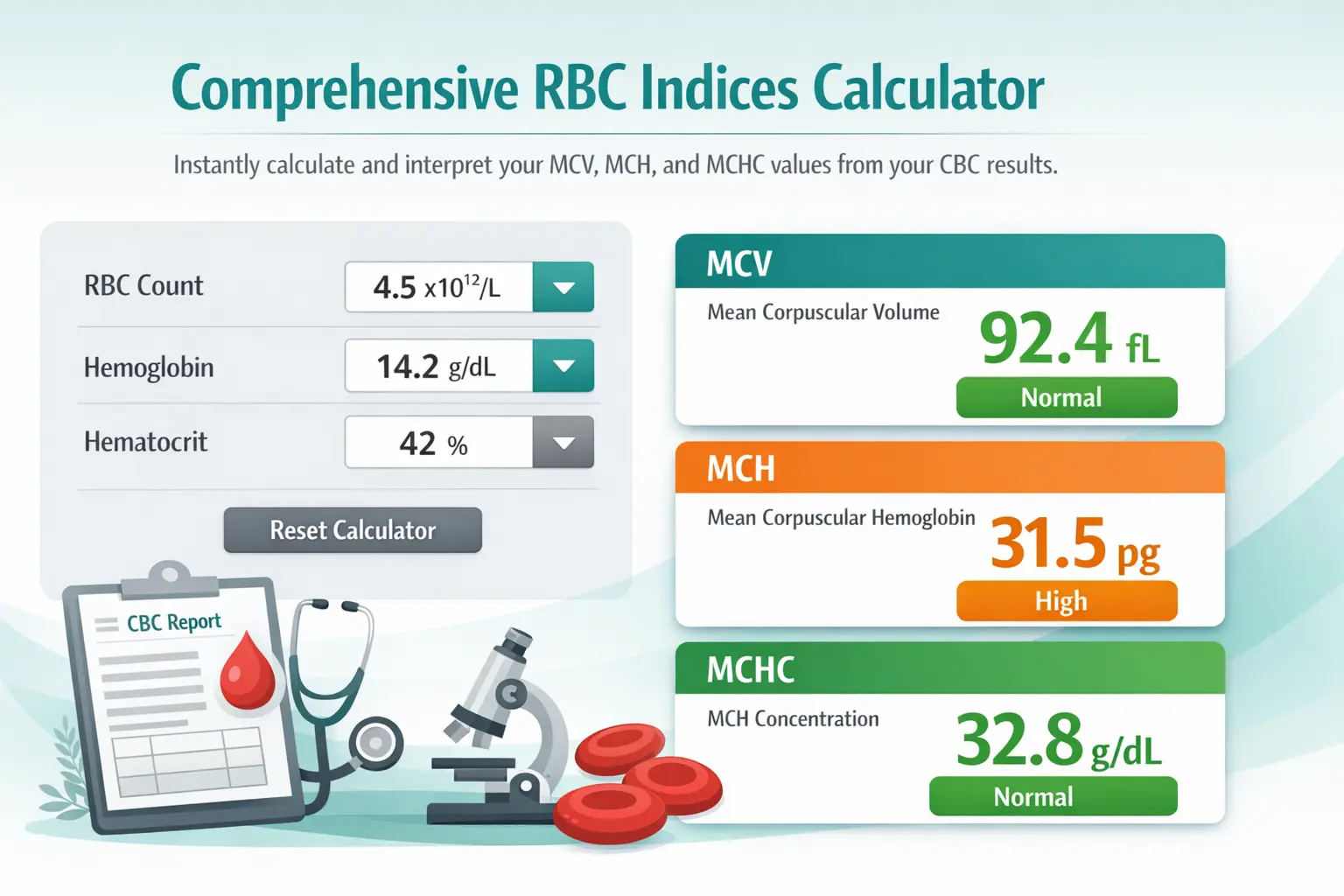
Comprehensive Guide to RBC Indices
Red Blood Cell (RBC) indices are fundamental parameters of a Complete Blood Count (CBC). These indices measure the physical characteristics of red blood cells, including their average size, weight, and hemoglobin concentration. Doctors rely on these values to diagnose, classify, and determine the root cause of various types of anemia and hematological disorders.
1. Mean Corpuscular Volume (MCV)
What it measures: The average volume and physical size of a single red blood cell.
Clinical Significance: MCV is the most critical index for classifying anemia into three morphological categories: Microcytic (small cells), Normocytic (normal cells), and Macrocytic (large cells).
| Classification | Value Range | Common Causes |
|---|---|---|
| Microcytic (Low) | < 80 fL | Iron deficiency anemia, Thalassemia, Lead poisoning, Chronic inflammation. |
| Normocytic (Normal) | 80 – 100 fL | Acute blood loss, Hemolysis, Chronic kidney disease, Bone marrow failure. |
| Macrocytic (High) | > 100 fL | Vitamin B12 deficiency, Folate deficiency, Liver disease, Alcoholism, Hypothyroidism. |
2. Mean Corpuscular Hemoglobin (MCH)
What it measures: The average mass (weight) of hemoglobin inside a single red blood cell.
Clinical Significance: MCH generally mirrors MCV. Smaller cells (microcytic) naturally hold less hemoglobin, resulting in a low MCH. Larger cells (macrocytic) hold more, resulting in a high MCH.
| Status | Value Range | Interpretation |
|---|---|---|
| Low MCH | < 27 pg | Cells are under-filled with hemoglobin (Hypochromia). Often linked to iron deficiency. |
| Normal MCH | 27 – 33 pg | Normal hemoglobin content per cell (Normochromia). |
| High MCH | > 33 pg | Cells are enlarged and holding more hemoglobin mass, typical in Macrocytosis. |
3. Mean Corpuscular Hemoglobin Concentration (MCHC)
What it measures: The concentration of hemoglobin in a given volume of packed red blood cells (the density of the color).
Clinical Significance: Unlike MCH which measures absolute weight, MCHC measures density. It indicates whether the cells are pale (hypochromic) or normally colored (normochromic) regardless of their physical size.
| Color Status | Value Range | Interpretation |
|---|---|---|
| Hypochromic (Low) | < 32 g/dL | Pale cells. Strong diagnostic marker for severe Iron Deficiency Anemia. |
| Normochromic (Normal) | 32 – 36 g/dL | Normal hemoglobin density. Seen in healthy individuals and normocytic anemias. |
| Hyperchromic (High) | > 36 g/dL | Cells are overly dense. Rare, but primarily indicates Hereditary Spherocytosis or severe burns. |
Bonus Index: RDW (Red Cell Distribution Width)
While not mathematically calculated from the basic Hb/Hct/RBC trio (it requires a hematology analyzer), RDW is the fourth critical index. It measures the variation in size among your red blood cells (Anisocytosis).
- Normal RDW (11.5% – 14.5%): Cells are generally uniform in size.
- High RDW (> 14.5%): High variation in cell sizes. For example, in early iron deficiency, the body starts producing smaller cells alongside normal older ones, spiking the RDW before the MCV drops completely.
Understanding Hematology Unit Conversions
Laboratory reports across the globe report in varying units. Our unit converter tool simplifies this, using these standard clinical conversion factors:
- Hemoglobin (Hb):
g/dLtog/L: Multiply by 10g/dLtommol/L: Multiply by 0.6206 (Based on Hb monomer molar mass ~16,114 g/mol)
- Hematocrit (Hct / PCV):
- Percentage (
%) to Ratio (L/L) : Divide by 100. (e.g., 45% = 0.45 L/L)
- Percentage (
- RBC Count:
x10¹²/L(Millions per microliter) tox10⁹/L: Multiply by 1,000.
Disclaimer: This advanced RBC Indices Calculator and Unit Converter is intended for educational and informational use only. It is not intended to be a substitute for professional medical advice, diagnosis, or treatment. Always seek the guidance of your physician or other qualified health professional with any questions regarding medical conditions or blood test results.
