

What a Kratom Certificate of Analysis Can—and Cannot—Tell You About Product Quality
Laboratory reports are becoming increasingly visible in the botanical-products market.
Consumers may encounter terms such as third-party tested, independently analyzed, HPLC tested, or Certificate of Analysis when researching products online. These phrases sound reassuring, but they do not all mean the same thing.
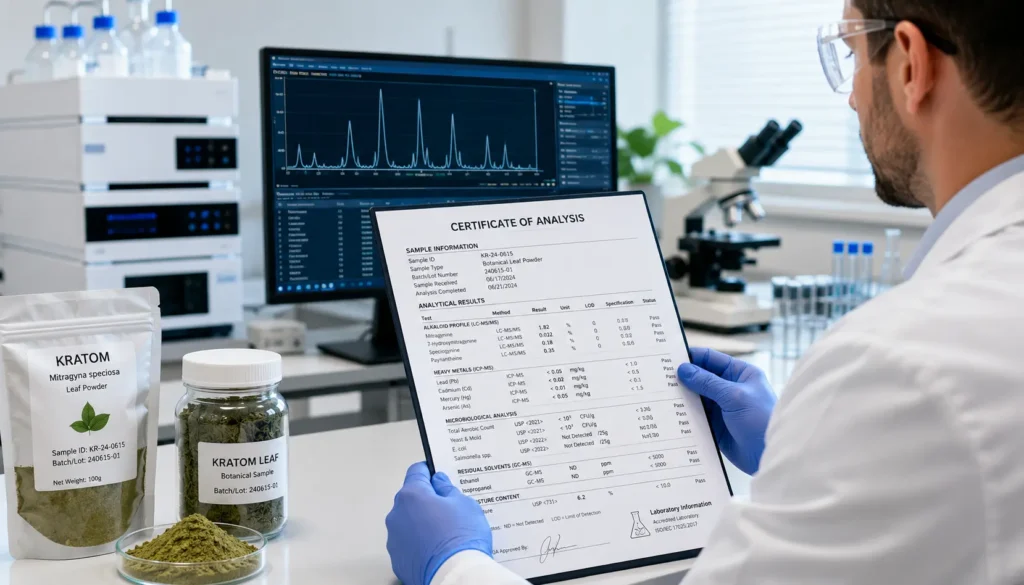
Kratom provides a particularly useful example.
Because kratom is a plant-derived material, its chemical composition and potential contaminants can vary. Growing conditions, harvesting, processing, storage, handling, and manufacturing can all influence the characteristics of a finished batch.
A Certificate of Analysis, commonly abbreviated as COA, can provide useful information about that batch.
But a COA is only valuable when you understand what was tested, how it was tested, what the results mean, and—equally important—what the document cannot establish.
What Is a Certificate of Analysis?
A Certificate of Analysis is a laboratory document reporting the results of tests performed on a particular sample.
For botanical products, a COA may include several different categories of testing, such as:
- chemical constituent or alkaloid analysis
- heavy metals
- microbiological contaminants
- moisture or water activity
- residual solvents
- pesticides, depending on the product and testing program
Not every laboratory report includes all of these.
That distinction matters.
A report showing alkaloid concentrations does not automatically demonstrate that the sample was tested for lead or Salmonella. Likewise, a microbiological panel tells you very little about the botanical’s alkaloid composition.
The first question when reading a COA should therefore be:
What exactly did the laboratory test?
The Batch or Lot Number Is One of the Most Important Details
A beautifully formatted laboratory report has limited value if you can’t connect it to the product being evaluated.
Look for a batch, lot, or sample identifier on the COA.
Then compare that identifier with the information on the actual product package or the vendor’s batch records.
Ideally, the connection should be clear:
Product → batch number → laboratory sample → test report
This concept is known broadly as traceability.
Without it, a consumer may be looking at authentic laboratory results that simply do not correspond to the product in front of them.
Botanical materials are not necessarily identical from batch to batch. A test performed on one production lot should not automatically be assumed to characterize every future lot sold under the same product name.
For that reason, batch-specific testing is substantially more informative than a single generic laboratory report used indefinitely.
Understanding Alkaloid Testing
Kratom, Mitragyna speciosa, contains naturally occurring alkaloids.
The alkaloid most commonly associated with kratom testing is mitragynine. Laboratories may also report other constituents, including 7-hydroxymitragynine, commonly abbreviated as 7-OH.
Liquid chromatography methods are commonly used to separate and quantify compounds in complex botanical samples.
Depending on the laboratory and analytical objective, methods may include:
- HPLC — high-performance liquid chromatography
- UHPLC — ultra-high-performance liquid chromatography
- LC-MS — liquid chromatography coupled with mass spectrometry
- LC-MS/MS — tandem mass-spectrometry methods
The analytical method matters because botanical samples are chemically complex.
A laboratory must separate the compound being measured from other substances in the sample and determine its concentration with acceptable precision.
The COA may report an alkaloid concentration as a percentage, milligrams per gram, or another unit.
When comparing results between laboratories or products, always compare the units as well as the number itself.
Why 7-Hydroxymitragynine Deserves Additional Attention
7-hydroxymitragynine has received significantly greater regulatory attention in recent years.
The FDA distinguishes naturally occurring kratom leaf—which contains 7-OH in trace amounts—from products in which 7-OH has been added or substantially enhanced. The agency has specifically warned consumers about concentrated or enhanced 7-OH products.
That distinction illustrates another important use of analytical testing.
Labels describe what a product is supposed to contain.
Laboratory analysis investigates what the tested sample actually contains.
For consumers evaluating traditional kratom leaf products, an alkaloid panel can therefore provide useful information beyond simply confirming the presence of mitragynine.
However, a numerical result still requires context.
A COA does not independently determine whether a concentration is medically safe, appropriate for a particular person, or suitable for treating any health condition.
Heavy Metals: Why Elemental Testing Matters
Plants interact directly with soil, water, fertilizers, processing equipment, and the environment.
As a result, botanical materials can potentially contain elemental contaminants.
For kratom, this is not merely a theoretical concern.
The FDA previously tested 30 kratom products for heavy metals and reported significant concentrations of lead and nickel in some samples. The agency also conducted additional elemental research using inductively coupled plasma mass spectrometry, or ICP-MS.
A comprehensive elemental analysis might examine substances such as:
- lead
- arsenic
- cadmium
- mercury
- nickel
The exact panel can vary.
What Is ICP-MS?
ICP-MS, or inductively coupled plasma mass spectrometry, is an analytical technique capable of detecting very small quantities of elements.
In simplified terms, the sample is prepared and introduced into extremely hot plasma, where atoms become ionized. The instrument then separates and measures ions by their mass-to-charge ratio.
Its sensitivity makes ICP-MS useful for detecting trace amounts of metals in foods, botanicals, supplements, environmental samples, and numerous other materials.
When reading a COA, however, finding the words ICP-MS is only the beginning.
You still need to understand the result.
Detection Limits and Quantitation Limits
Laboratory reports frequently contain abbreviations that confuse non-specialists.
Two of the most useful are:
- LOD — Limit of Detection
This generally represents the lowest amount of an analyte that the method can reliably distinguish from background noise. - LOQ — Limit of Quantitation
This generally represents the lowest amount that can be quantitatively reported with acceptable reliability under the method’s conditions.
A result such as:
does not necessarily mean that absolutely none of the substance exists in the sample.
It means the amount was below the laboratory’s established quantitation threshold.
Likewise:
ND
usually means not detected under the analytical method and detection limit used.
It should not automatically be interpreted as proof that the analyte exists at an absolute concentration of zero.
These distinctions are important whenever trace-level testing is involved.
Microbiological Testing Is a Different Type of Analysis
Chemical testing isn’t the only consideration with botanical materials.
Microbiological contamination may also be important.
A microbiological panel might test for organisms such as:
- Salmonella
- Escherichia coli (E. coli)
- coliforms
- yeast
- mold
- total aerobic microbial counts
The appropriate panel depends on the product and testing program.
Kratom has a documented history of microbiological concerns. In 2018, FDA actions included recalls of powdered kratom products associated with potential or confirmed Salmonella contamination.
This demonstrates why an alkaloid report alone should not be mistaken for a complete quality assessment.
A product can have a perfectly measurable alkaloid profile and still require separate testing for microbiological contamination.
Look at the Laboratory, Not Just the Results
Another useful question is:
Who performed the testing?
A third-party laboratory should ideally be independent of the company selling the product.
You may also see references to ISO/IEC 17025 accreditation.
ISO/IEC 17025 is an internationally recognized standard addressing the competence of testing and calibration laboratories. Accreditation doesn’t guarantee that every test result is flawless, but it provides additional evidence that a laboratory operates within an established quality and competency framework for its accredited activities.
Consumers should understand an important nuance:
A laboratory may be accredited, while a particular method or analyte may or may not fall within the laboratory’s accredited scope.
The most careful review therefore looks beyond an accreditation logo and considers the actual scope and testing methodology.
Check the Date
Laboratory results should also be reasonably connected in time to the batch being sold.
A COA from several years ago may demonstrate that a company once tested a product.
It doesn’t necessarily tell you anything about today’s inventory.
Look for:
- sample-received date
- testing date
- report date
- batch or production date where available
Together with the lot identifier, these help establish whether the document plausibly corresponds to the product.
What Does “Pass” Actually Mean?
Some laboratory reports simplify results into:
PASS
or
FAIL
That can be useful, but it is worth asking what standard determines the result.
A laboratory needs a specification, action limit, regulatory criterion, customer-defined specification, or other benchmark against which it evaluates the numerical result.
For example, a heavy-metal report may provide:
Analyte → measured amount → specification → result
The underlying numerical data are often more informative than the word pass by itself.
A scientifically literate reader wants to know both:
- What did the laboratory find?
- What criterion was used to interpret it?
Common COA Red Flags
A consumer doesn’t need to be an analytical chemist to identify questionable documentation.
Several warning signs deserve additional scrutiny.
- No identifiable laboratory
The report should identify the organization responsible for testing. - No sample or lot number
Without traceability, connecting the results to a particular product becomes difficult. - No testing date
A report with no meaningful date provides little information about when the analysis occurred. - Only one type of test
An alkaloid panel should not be presented as though it simultaneously proves microbiological and heavy-metal quality. - Cropped or incomplete reports
A partial screenshot may omit methods, specifications, sample identifiers, dates, or laboratory information. - Reports reused indefinitely
Botanical products change from lot to lot. Current testing is considerably more informative than a permanent generic COA. - Results without units
A number has little analytical meaning if the reader cannot determine whether it represents percent, ppm, ppb, mg/g, µg/g, or another measurement.
A COA Should Be Part of a Larger Quality System
Laboratory testing matters, but it happens near the end of a much larger chain.
Product quality also depends on:
- sourcing
- supplier qualification
- harvesting
- processing
- storage
- transportation
- sanitation
- packaging
- batch identification
- documentation
- handling practices
A laboratory cannot retroactively create a good manufacturing process.
It can test characteristics of the sample it receives.
This is why consumers researching botanical products should examine testing together with the seller’s broader quality practices. Educational resources explaining approaches to kratom quality and laboratory testing can provide additional context for the kinds of questions consumers may want to ask when comparing products and vendors.
The goal should be transparency, not simply displaying a laboratory logo.
What a COA Cannot Tell You
Perhaps the most important lesson is understanding the limits of laboratory testing.
A COA does not automatically prove that:
- every unit sold is identical to the tested sample
- a product is risk-free
- a botanical is appropriate for every individual
- the product will produce a particular effect
- the product can diagnose, treat, cure, or prevent disease
- there can be no medication interactions
- future batches will have identical results
It is a laboratory snapshot of a sample under defined testing conditions.
That can be extremely useful.
But it should not be turned into a claim the data cannot support.
Laboratory Literacy Is More Valuable Than a “Lab Tested” Label
The phrase lab tested is easy to print on a website.
Meaningful transparency requires more.
A useful COA should help answer questions such as:
- What was tested?
- Which batch was tested?
- Who performed the analysis?
- Which analytical method was used?
- What were the actual results?
- What units were reported?
- What were the detection or quantitation limits?
- Which specifications determined a pass or fail?
- When was the analysis performed?
These questions apply not only to kratom but to botanical materials more broadly.
The goal isn’t for every consumer to become a laboratory scientist.
It’s to understand enough about analytical testing to distinguish a meaningful test report from a marketing statement.
A Certificate of Analysis can be an important tool for evaluating product quality.
It becomes much more valuable when the reader knows what the numbers actually mean—and recognizes what they don’t.
