

Purity figures appear on every certificate of analysis, usually as a single percentage. That number is a summary of a chromatogram, and the chromatogram contains information the summary discards. Knowing how to read it changes what a certificate tells you.
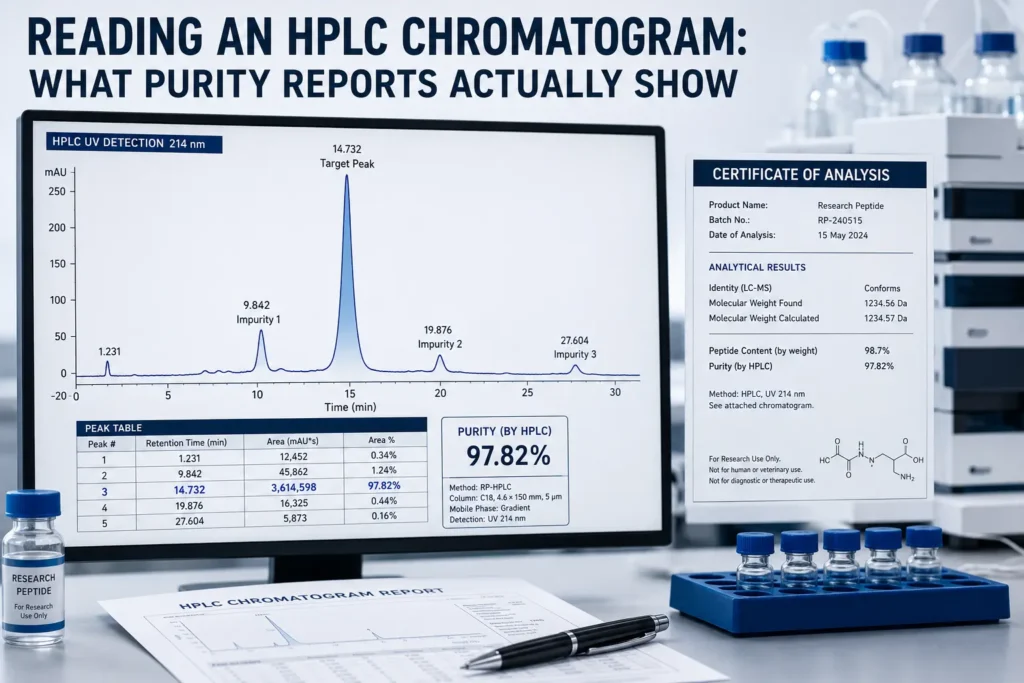
What HPLC Does
High-performance liquid chromatography separates a mixture by pushing it through a column packed with material that different compounds traverse at different speeds. Compounds exit at different times, and a detector records what emerges when.
The output is a trace: time on the horizontal axis, detector response on the vertical. Each compound appears as a peak. A pure sample produces one dominant peak. An impure one produces several.
Where the Percentage Comes From
Purity is calculated as the area of the target peak divided by the total area of all peaks, expressed as a percentage. Ninety-eight percent purity means the target peak accounts for ninety-eight percent of total detected area.
The phrase “of all peaks” carries weight. Purity is relative to what the detector saw — not to everything in the vial. Compounds the detection method does not register are absent from the calculation entirely. This is why purity and content are separate measurements: a sample can be highly pure by HPLC and still contain substantial non-peptide mass in the form of water and counter-ions.
What the Trace Shows That the Number Does Not
Peak shape carries information. A sharp symmetrical peak indicates clean separation. Broad or asymmetric peaks can indicate column interaction, sample degradation, or co-eluting compounds hiding under one apparent peak.
The number and position of impurity peaks matters too. Several small impurities scattered across the trace is a different situation from one substantial impurity close to the target peak, which may indicate a closely-related synthesis byproduct — often more consequential than the percentage suggests.
A certificate reporting purity without the chromatogram gives you the summary and withholds the evidence. That is a meaningful omission, and worth asking about.
Mass Spectrometry Is the Companion Test
HPLC establishes how much of the sample is one compound. It does not establish which compound. Mass spectrometry answers that by measuring molecular weight against the expected value for the target sequence.
Both are needed. A sample can be ninety-nine percent one substance that is not the substance ordered. Identity confirmation is what rules that out, and its absence from a certificate is a larger gap than a slightly lower purity figure.
The Third Number
Peptide content by weight completes the picture. Purity describes composition, identity confirms what the compound is, and content states how much of it is present. A certificate reporting all three characterises the material. One reporting purity alone characterises a third of it.
Practical Reading Order
Check identity confirmation first — is this the right compound? Then content — how much is actually there? Then purity, with the chromatogram if provided. That order reflects how consequential each answer is, which is roughly the inverse of how prominently they are usually displayed.
Applying It
For any specific compound, supplier documentation standards vary widely, and comparing what different vendors publish is more informative than comparing their purity claims. Reference resources covering compound classes such as the GHRH analog family collect that documentation detail alongside the underlying research context.
These are laboratory materials designated for research use only — not approved for human or veterinary use, not intended for diagnostic or therapeutic application.
